
Complaints and ADR: what a licensed gambling customer can do
 Available in GB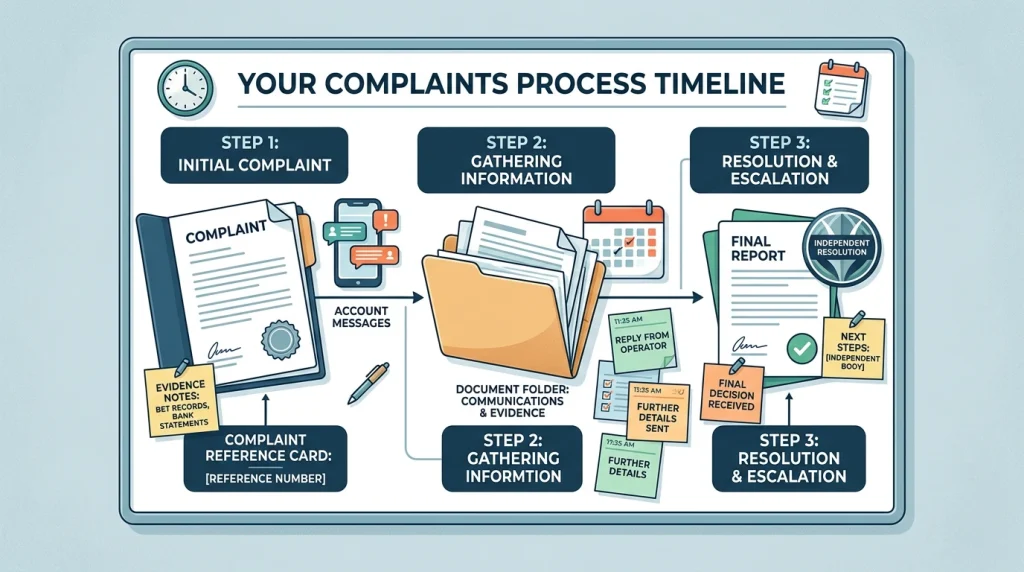
A gambling complaint can be about money, identity checks, account closure, bonus terms, customer service or a withdrawal delay. The difficult part is knowing which route is realistic. A complaint is not a shortcut to a guaranteed refund, and the regulator does not decide every individual transaction dispute. Still, a structured complaint can help you put the issue in front of the right people with the right evidence.
This guide is for disputes involving a gambling business that appears to be licensed for Great Britain. If the licence position is unclear, check that first. If the issue is connected to chasing gambling during self-exclusion or financial stress, pause before escalating the dispute and consider support as well as account evidence.
The basics are covered in our guide to casinos not on GAMSTOP.
A clear complaint route starts with evidence, the operator’s process and realistic expectations.
- Return to the main guide
- Check the licence first
- Read about ID checks and withdrawals
- Read about bonus and withdrawal terms
- Move data concerns to the privacy guide
What gambling complaints commonly involve
Official complaint guidance gives practical examples of the kinds of issues customers may raise: payments, terms and conditions, bonuses, identity verification, account closure and customer service. Those categories are useful because they keep the complaint specific. A message saying “this site is unfair” is hard to handle. A message saying “my withdrawal was paused after this document request, and I need the exact reason and complaint reference” is easier to track.
The first boundary is the operator’s identity and licence. For a licensed operator, account information should help you find complaint procedures, ADR information, safer-gambling information and details about customer-funds protection. If those basics are missing or unclear, use the licence-check guide before assuming the usual route will work.
The second boundary is the type of issue. A delayed withdrawal may depend on identity checks or unusual activity. A bonus dispute may depend on promotion terms. A privacy problem may belong with a data-protection complaint route. Sorting the issue does not weaken the complaint; it makes the next step clearer.
Complaint timeline and evidence path
| Stage | What to do | What not to assume |
|---|---|---|
| 1. Identify the business | Check the licence claim, trading name, domain and account details before relying on a route. | Do not assume a logo, badge or marketing phrase proves licensing. |
| 2. Use the operator’s complaint process | Submit the complaint through the stated channel and ask for a reference or written acknowledgement. | Do not start with threats or unsupported legal conclusions. |
| 3. Save evidence | Keep terms, promotion pages, account messages, document requests, payment records and withdrawal dates. | Do not rely on memory if pages can change or account access can be limited. |
| 4. Consider ADR when unresolved | For licensed operators, unresolved complaints can move to the alternative dispute route after the operator process and timing. | Do not treat ADR as a guaranteed payout or automatic finding against the operator. |
| 5. Report wider information where relevant | Information about serious conduct can be reported through official channels. | Do not expect the regulator to decide your individual transaction complaint. |
| 6. Separate data issues | If the problem is about personal data, cookies or document handling, follow the data route as well. | Do not bury a privacy complaint inside a payment complaint if the facts are different. |
How to write the first complaint
A good first complaint is calm, factual and narrow. Identify the account, the date of the event, the amount or account action involved, the term or message the operator is relying on, and the outcome you are asking the operator to consider. Ask for the complaint reference, the expected response route and any final response letter if the matter is not resolved.
For a withdrawal complaint, include the withdrawal request date, the status of the withdrawal, any document requests, and whether the requested information could reasonably have been asked for earlier. For a bonus complaint, include the promotion wording, the date accepted, the restriction applied and the part of the balance affected. For customer-service complaints, keep a record of conversations and do not mix several unrelated events into one long message unless they form a clear pattern.
Do not promise yourself that the complaint will restore an account, reopen a promotion or recover all money. The point of the first complaint is to create a fair record and give the operator a clear chance to answer. That record is also what you may need later if the route moves beyond the operator.
What ADR can and cannot do
Alternative dispute resolution is the next route for certain unresolved complaints involving licensed operators after the operator’s complaint process and timing have been followed. It is designed for disputes between the customer and the business. It is not the same as a public regulator investigation, and it should not be described as a guaranteed way to get money back.
The most useful question before ADR is whether your evidence is organised. Can you show what happened, when it happened and what rule is disputed? Can you show the operator’s response or lack of response? Can you separate the complaint from wider frustration about gambling losses? ADR is more likely to understand a clear dispute about a withdrawal, term, bonus, account closure or verification issue than a general statement that the result was unfair.
If your issue is that you were able to gamble when you believe safeguards should have stopped you, keep that evidence, but also think about support. Complaints and support can sit alongside each other. A complaint may deal with a business process; support deals with the immediate risk of harm and the pressure to keep gambling while the dispute is unresolved.
Where the regulator fits
The Gambling Commission regulates licensed gambling in Great Britain, but official guidance makes an important distinction: it does not decide individual transaction complaints for you. That means a customer should not write as if the regulator will automatically order a refund. The complaint route normally starts with the business, then moves to ADR where the rules allow.
Information can still matter to the regulator. If you have information about a gambling business that may point to wider compliance problems, there are official reporting routes. Treat that as reporting information, not as a personal claim service. Keep copies of what you send and avoid exaggeration. A precise description of dates, documents, account messages and terms is stronger than dramatic wording.
If the business is not clearly licensed for Great Britain, the regulator route may not give the protection you expected. That is one of the practical risks of dealing with unclear or offshore sites. The earlier you check the licence and the operator identity, the less likely you are to discover this problem only after a dispute.
When the issue is really about data
Some gambling disputes are not mainly about money or terms. If the problem is about personal data, identity documents, cookie consent, marketing messages or what the site says about data use, the privacy route matters. The Information Commissioner’s Office provides a data-protection complaint route, and the documents and data guide explains how to think about those concerns before sharing more information.
Do not send more documents just because a complaint is frustrating. Check whether the document request is tied to a clear account purpose, whether privacy information is available, and whether the operator identity is clear. For identity and withdrawal timing, use the ID and withdrawals guide. For promotion restrictions, use the bonus terms guide.
Support note before escalation
If the complaint is connected to gambling during a period of self-exclusion, chasing losses, pressure to recover money or a search for sites with fewer protections, take a pause before sending another message or opening another account. Keeping records is sensible, but it should not become a reason to keep gambling. Use support, keep protective tools in place and let the complaint route deal with the evidence rather than the urge to continue.
Data-related disputes are covered under documents and privacy.
A realistic complaint route is careful and patient. It checks the licence, uses the operator’s process, saves evidence, understands ADR limits, reports wider concerns where appropriate and separates data issues from gambling-account disputes. That approach does not promise a result, but it gives the customer the best chance of being understood without adding unnecessary risk.