
Documents, privacy and account safety before sharing details
 Available in GB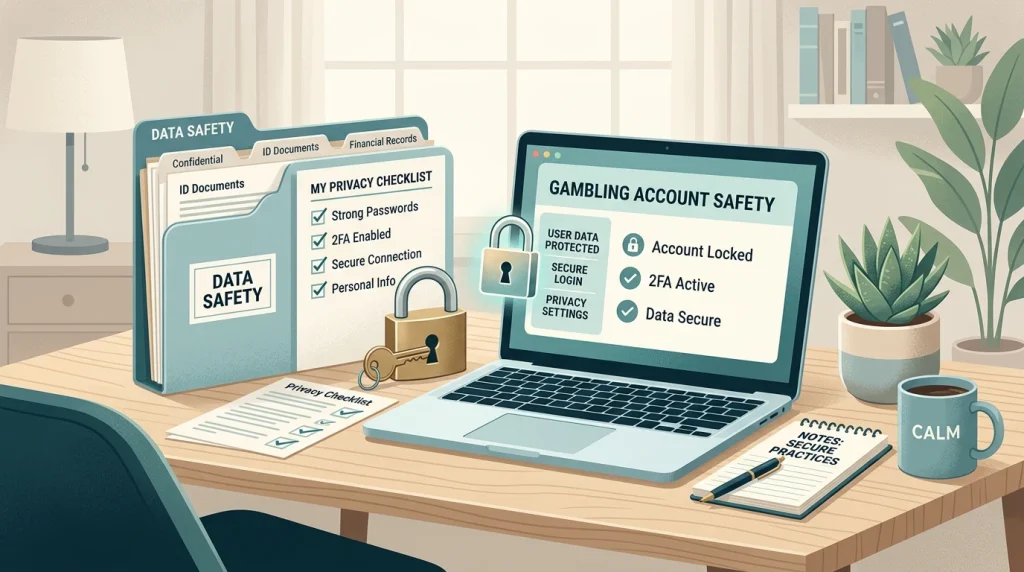
Online gambling accounts often involve personal information: name, date of birth, address, payment details, identity documents and account messages. Those details matter even when the gambling issue feels more urgent than the privacy issue. A site that is unclear about who operates it, why documents are needed or how data is used can create risk before any bet is placed.
This page explains how to think about documents, privacy information, cookies and account safety in a gambling context. It does not declare any operator secure or compliant. It also does not encourage gambling with fewer checks. Trying to reduce verification by using unclear sites can increase document, payment and account risk.
The basics are covered in our guide to casinos not on GAMSTOP.
Document requests should be judged together with operator identity, privacy information and account purpose.
- Return to the main guide
- Understand ID checks and withdrawals
- Check operator identity and licensing
- Review unlicensed-site risk signs
- Use the complaints guide
Why document and data checks matter
Age and identity verification can require personal details. For licensed online gambling in Great Britain, those checks are part of the account environment, not a suspicious event by themselves. The problem is not the existence of checks. The problem is when a customer is asked to share sensitive information without a clear operator identity, a clear account purpose or accessible privacy information.
Think of document sharing as a decision, not a reflex. A passport image, driving licence, address proof or payment evidence can reveal more than the gambling account needs for a single conversation. Before uploading anything, ask what the request is for, whether it matches the account issue, how the site explains data use and whether the business identity is clear enough to hold accountable.
That caution matters most when a site markets itself around looser checks, quick access or easy account opening. Fewer checks at sign-up do not remove risk. They may simply move the hardest questions to the withdrawal stage, when the customer has less leverage and more pressure.
What clear privacy information should help you understand
ICO public guidance explains that people have the right to be informed when their personal data is being used. In plain terms, a gambling customer should not have to guess the basics: who is using the data, why it is being collected, what categories of data are involved and what rights or complaint routes exist. This is not a promise that every privacy notice is perfect. It is a practical standard for what you should look for before sending documents.
Check whether the privacy information is easy to find from account pages, registration pages and document-upload areas. Check whether it names the business clearly. Check whether it explains identity checks, payment information, marketing, cookies and sharing with third parties in terms you can follow. If the privacy information is missing, vague or unrelated to the business name on the gambling account, stop and investigate before sharing more.
Also look for the difference between a site’s technical privacy notice and your own account question. A privacy notice may explain broad data use, but it may not answer why a specific document is needed today. When the request is specific, ask for the account reason in writing and keep the reply.
Data and document safety checklist
| Question | Why it matters | Practical action |
|---|---|---|
| Is the operator identity clear? | You need to know which business is asking for documents and whether a licence claim matches the account. | Check the business name, domain and licence information before uploading sensitive documents. |
| Does the site explain what data is collected and why? | The right to be informed means privacy information should not be hidden or confusing. | Read the privacy notice and save the relevant account or upload wording. |
| Is the document request tied to a clear account purpose? | Identity, payment-route, withdrawal and unusual-activity checks are different issues. | Ask what the request is for and what happens if the document is accepted or rejected. |
| Are cookies and marketing choices explained? | Cookies and similar technologies can affect tracking, advertising and account experience. | Review cookie information instead of clicking through without reading. |
| Is there a complaint route for data concerns? | A data issue may need a different route from a gambling payment complaint. | Keep evidence and use the data-protection complaint route where appropriate. |
Cookies, marketing and account tracking
Cookies and similar technologies are not only a website detail. In gambling, they can relate to account use, advertising, analytics and marketing choices. ICO guidance covers cookies and similar technologies, and enforcement action in the gambling sector has shown that cookie consent can be a real data-protection issue.
Before treating a site as trustworthy, look at how it handles cookie choices. Are the choices explained? Can you tell the difference between essential cookies and marketing or analytics choices? Does the cookie information match the business name and privacy notice? A polished banner is not enough if the underlying information is hard to understand.
Do not confuse cookie consent with gambling safety. A site can have a visible cookie banner and still have unclear licence information, weak complaint information or risky account terms. Privacy transparency is one part of the picture; it does not replace the licence, terms, payments and withdrawal checks covered elsewhere on this site.
When a document request should make you pause
Pause if the site asks for documents through an unclear upload page, does not explain the purpose, changes the reason for the request, or refuses to identify the business behind the account. Pause if the request appears only after a withdrawal but the site will not explain why the information could not have been requested earlier. Pause if the site asks for information that seems unrelated to the account issue, especially when the privacy notice is missing or hard to match to the operator.
None of these signs proves wrongdoing on its own. Gambling businesses may have real legal and account reasons to ask for information. The point is proportional caution. Sensitive documents should be shared only when the request is understandable, the business identity is clear and the account purpose is documented.
If the request is linked to age or identity checks, read the ID and withdrawals guide. If the concern is that the site itself is unclear, read the licence-check guide and the risk-signs guide before sending more information.
Data complaints and gambling complaints are not always the same
A complaint about a withheld withdrawal, a disputed bonus or an account closure usually starts with the gambling business complaint route. A complaint about personal data may also need a data-protection route. ICO provides a public route for data-protection complaints. Use that route for concerns such as unclear use of personal data, privacy information, cookie consent or document handling. Keep the gambling complaint focused on the account issue and the data complaint focused on the data issue.
That separation matters because the evidence is different. For a gambling complaint, you may need terms, deposit records, withdrawal dates and account messages. For a data complaint, you may need the privacy notice, cookie information, document request wording, your message asking for clarification and the response you received. Keeping the evidence separate helps avoid confusion.
Do not use a data complaint as a way to avoid necessary identity checks. If a check is part of a clear account obligation, the safer question is whether the request is explained and handled properly, not whether verification can be skipped. If the pressure to avoid checks is connected to self-exclusion, bank blocks or gambling limits, support is more important than another account.
If a request feels wrong, review the complaint and ADR route.
Safer handling of account documents
- Check the operator identity and licence claim before sending documents.
- Read the privacy and cookie information before accepting broad data use.
- Ask why a document is needed if the request is unclear or late in the account process.
- Keep copies of upload requests, messages and terms, but do not publish sensitive documents publicly.
- Use complaint routes calmly if the business will not explain the request or account decision.
- Do not choose an unclear site because it appears to ask fewer questions at sign-up.
Good account safety is not about trusting a slogan. It is about matching the document request to a clear business identity, clear account purpose, clear privacy information and realistic complaint route. If those pieces do not fit, wait before sharing more.