
Bonus terms, withdrawal rules and unfair restrictions
 Available in GB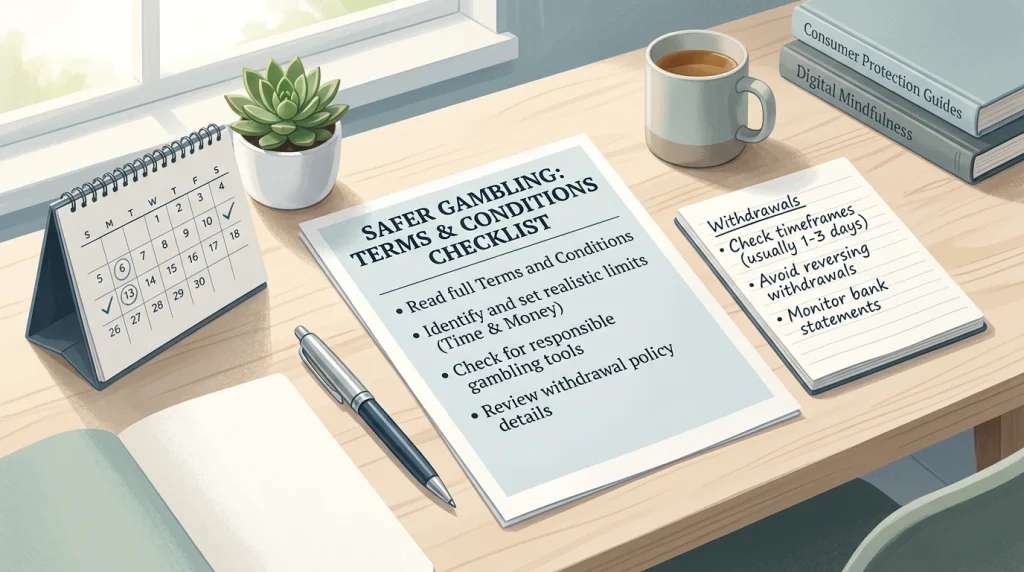
A gambling bonus can look simple on the surface, but the important part is usually in the conditions. The headline may mention free spins, matched money or a promotion window, yet the practical question is different: what must you do before you can withdraw, what could stop a withdrawal, and what happens if the operator later says a rule was broken?
This page does not compare offers or recommend any gambling site. It explains how to read bonus and withdrawal conditions before you act. That is especially important around sites described as outside GAMSTOP, where the appeal is often framed around access, speed or larger offers. A bonus should never be treated as a reason to gamble during self-exclusion, financial pressure or a period when you are trying to reduce harm.
The basics are covered in our guide to casinos not on GAMSTOP.
A bonus is not useful if the conditions make deposits, winnings or withdrawal unclear.
- Return to the main guide
- Check ID and withdrawal issues
- Understand complaints and ADR
- Review unlicensed-site risk signs
- Read safer next steps around self-exclusion
What to check before accepting any offer
Start with the full terms, not the advert. Official consumer guidance tells gambling customers to read terms and conditions and understand restrictions on offers and promotions. That advice is practical, not technical. If the rules are difficult to find, split across several pages or written in a way that hides the main restrictions, that is a reason to pause before depositing.
Look for who is eligible, whether identity checks must be complete, whether a promotion is available only to new customers, and whether the account must use a particular payment route. Then check the rules around play. Some promotions restrict games, contribution rates, maximum stakes, time limits or the way winnings are treated. If you cannot explain the rule back to yourself in plain English, you probably do not have enough certainty to rely on it.
Also separate deposit money, bonus money and winnings. A rule about bonus winnings may not work the same way as a rule about the cash you deposited. Official guidance also covers restrictions on withdrawing deposits and deposit winnings, so do not assume that all money in an account is treated the same simply because it appears in one balance.
Terms-reading checklist before accepting an offer
| Check | Why it matters | What to save |
|---|---|---|
| Eligibility and identity requirements | A promotion may depend on account status, country, age and completed identity checks. | The eligibility wording and the date you saw it. |
| Deposit and withdrawal restrictions | Some conditions affect deposits, bonus funds, deposit winnings or withdrawal requests. | The section that explains how balances and withdrawals are treated. |
| Wagering, game and stake rules | Promotional play may be limited by games, time windows, stake sizes or contribution rules. | The exact play restrictions, including any excluded games. |
| Payment-route rules | Some offers depend on how the account is funded or exclude certain payment methods. | The payment wording and any linked terms. |
| Document and account-closure wording | Terms may describe later document requests, account checks or closure rules. | Any account, verification and closure clauses that might affect a withdrawal. |
| Complaint evidence | If a dispute later happens, clear records are more useful than memory. | Screenshots, account messages, promotion pages and complaint references. |
Rules that deserve extra attention
Fair, open and transparent terms are a central expectation in official gambling guidance. That does not mean every term you dislike is automatically unfair. It does mean that important restrictions should not be hidden, unclear or sprung on a customer in a way that changes the practical bargain after the customer has acted.
Be cautious with wording that gives an operator unlimited discretion to cancel winnings, close an account or decide that a vague rule has been broken. Official material on promotional play restrictions points toward clear restrictions rather than unrestricted sole-discretion wording. In everyday terms, you should be able to know what behaviour is restricted before you play, not only after a withdrawal is requested.
Withdrawal wording needs the same care. A condition that affects deposits, deposit winnings or bonus winnings should be clear before the offer is accepted. If an operator says a withdrawal is blocked because of a promotion, ask which term applies, when it was shown, and how the term affects the specific part of the balance. Keep the question narrow. A focused written record is easier to use than a long argument about whether the whole site is fair.
Government and competition authority action in the online gambling sector has also treated unfair withdrawal obstacles and promotion practices as serious consumer concerns. Use that as a reason to take unclear terms seriously, not as proof that a particular unnamed operator has broken the law. A final conclusion needs the actual terms, timing, account history and evidence.
A simple decision path
- Find the full terms before depositing. Do not rely on the promotion banner or a short summary. Read the linked conditions and any general account terms that apply.
- Identify what money is affected. Check whether the rule applies to the deposit, bonus funds, deposit winnings, bonus winnings or all account funds.
- Check whether identity or payment rules are tied to the offer. If documents are required, understand why and how the site explains data handling before uploading anything.
- Look for time limits and excluded play. A missed deadline, excluded game or restricted stake can change the result of a promotion.
- Save evidence before and after accepting the offer. If the terms change or disappear, your own record may be the only clear copy of what you saw.
- Stop if the offer is pulling you toward risky gambling. No promotion is worth weakening a self-exclusion plan, bank block or personal limit.
When a bonus dispute becomes a complaint
A bonus issue can become a complaint when the operator refuses a withdrawal, cancels winnings, applies a restriction that was not clear, or handles the account in a way that conflicts with the terms you saw. Before complaining, collect the promotion page, the general terms, account messages, deposit and withdrawal records, and any document requests. If the complaint involves identity checks or delayed withdrawals, read the ID and withdrawals guide as well, because the timing of document requests matters.
Keep the first complaint specific. State the offer name if it was shown, the date accepted, the amount affected, the rule the operator is relying on and why you think the rule was not clear or was applied wrongly. Do not demand a guaranteed outcome. For licensed operators, there is a structured complaint and alternative dispute route, but neither the regulator nor an ADR provider should be presented as a promise of payment.
If the site is not clearly licensed for Great Britain, the complaint route may be weaker and harder to assess. That is why checking the licence and business identity belongs before accepting an offer. The risk-signs guide explains how unclear licence claims, missing account information and vague terms can combine into a larger problem.
Safety note: a bonus should not override protection
Offers can create urgency. Time limits, matched money and “last chance” wording can make a person feel that waiting is a loss. If you are searching because GAMSTOP, another self-exclusion, a bank gambling block or a personal limit is stopping you from gambling, treat that pressure as a warning sign. The safer next step is to keep the protection in place and speak to support before taking any gambling-related action.
Slow payouts usually trace back to ID checks and withdrawals.
The most useful way to read bonus terms is not to find the biggest promise. It is to find the restriction that could matter most if something goes wrong: unclear eligibility, a late document request, a withdrawal condition, a promotion rule or a complaint route that is difficult to follow. If the answer is unclear before you deposit, it is unlikely to become clearer when money is already at stake.