
Best Online Casino Game Shows in the UK: What to Know
 Available in GB
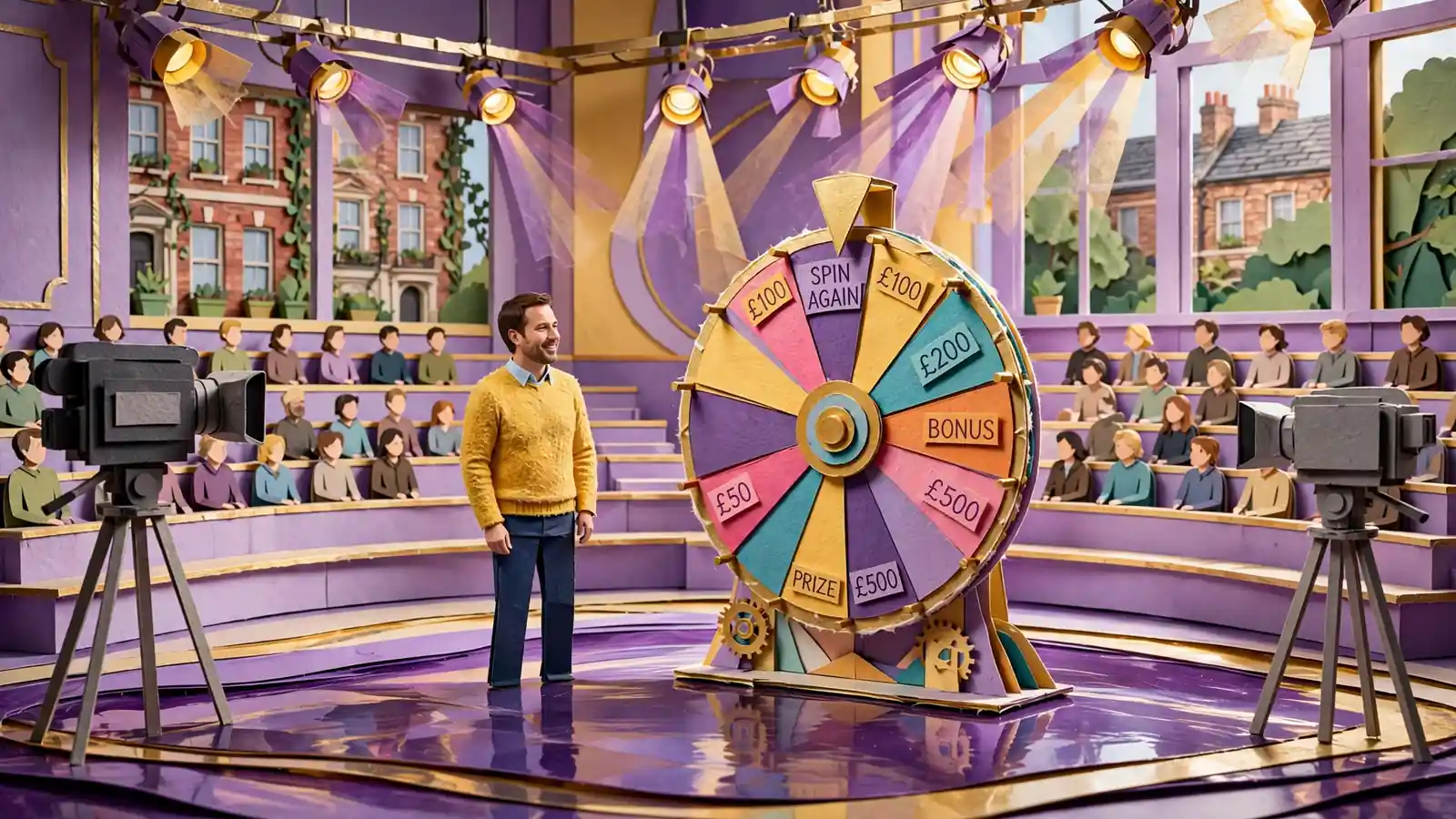
Live casino game shows combine a presenter-led studio broadcast with gambling, so their entertainment format does not change the nature of the outcome.
What Makes a Live Casino Game Show Different
A live casino game show borrows its surface from television and its underlying transaction from gambling. There is a presenter, a studio, a visible game area and an event unfolding in real time. The result is neither quite a conventional casino table nor ordinary entertainment programming. It is a remote gambling product arranged as a broadcast.
That distinction matters. A standard online casino game is generally experienced through software: symbols fall into place, cards are dealt by a random number generator, or a digital wheel produces an outcome. A live game show places a human-led presentation around the game. The screen becomes a small studio rather than merely a control panel. Sound, lighting, speech and pacing are part of the experience, even though the result remains a casino outcome rather than a television competition.
The phrase “game show” can make the format sound harmlessly theatrical. It is theatrical, but it is still gambling. A presenter may invite attention to a wheel, a bonus feature or a choice between outcomes; the participant is still staking money on a casino game. The set may resemble a television studio, while the legal character remains that of remote gambling.
A broadcast with a casino underneath
The live element is the first clear difference from conventional online play. A software-only game can be opened and played without a visible host or a shared studio atmosphere. Its rhythm is created by the program. A live casino game show, by contrast, is presented as an ongoing event. The presenter explains or announces what is happening, and the visual language suggests that the action is taking place now rather than being generated privately on a screen.
This does not turn the participant into a contestant in the television sense. There is no claim here that a player becomes part of a studio audience or influences a presenter’s decisions. The host is part of the presentation. The outcome remains governed by the game’s rules and random processes. A polished stage cannot change that rather plain fact.
The format therefore sits between two familiar models:
- a conventional online casino game, where the software interface is the main event;
- a broadcast game show, where entertainment and presentation normally take priority over wagering.
Live casino game shows combine the visual grammar of the second with the gambling function of the first. That combination explains their particular appeal, and also why descriptions need to keep the entertainment layer separate from the betting mechanism.
How the experience differs from ordinary online casino play
In a conventional online casino, the game often feels private and mechanical. A player selects a title, chooses a stake and starts the next round. The interface provides the necessary information, but the experience may be stripped down to buttons, animations, sound effects and results. Even when the design is elaborate, the game is usually built for individual interaction with software.
A live game show casino experience is more social in appearance. The camera may remain focused on a presenter or studio set. Speech gives the round a beginning and an end. The participant sees a sequence rather than only a result: an announcement, a visual action, a reveal and the settlement of the round. The sense of occasion is manufactured, but it is not imaginary as a design feature. The format is meant to feel like an event being watched and joined at the same time.
That change in pacing can alter the character of play. Software-led games can feel continuous, with little interruption between rounds. A presenter-led show introduces pauses, explanations and moments of anticipation. The waiting is not an accidental delay; it is part of the product. Television learned long ago that suspense needs room to breathe. Casino design has borrowed the lesson.
The presence of a host also makes the rules appear more legible. A presenter can frame an action in ordinary language instead of leaving every instruction to icons and menus. That may make the format easier to follow for someone who dislikes the coldness of a purely digital interface. It does not remove the need to understand the rules or the financial consequences of a stake. Clarity of presentation is not the same as safety of outcome.
Best Online Casinos with No Limits: UK Betting Guide
The “live” label has a precise limit
Live describes the presentation and timing of the game. It should not be read as a promise that every element is controlled by a human being. The outcome is still determined within the rules of the casino product. A host can spin a wheel, announce a result or guide the sequence, but the host is not there to negotiate the result with the audience.
This is where live casino game shows differ from a casual television programme. In entertainment television, the audience may watch without any financial exposure. In remote gambling, the participant’s stake connects the broadcast to a casino account. The studio is visible; the financial relationship is still with the operator providing the gambling service.
The word “live” also does not turn an online product into a physical casino. The participant remains remote, using a digital service. The camera supplies the sense of place, while the account, stake and settlement remain online. It is a simulation of presence rather than physical attendance. A studio can be real without the participant being there.
Presentation is not the same as control
The human host is the most obvious feature separating these shows from software-only games, but it is easy to give that feature too much significance. A presenter can make a round seem warmer, clearer or more dramatic. The presenter does not become a source of influence over the player’s result merely by appearing on screen.
This distinction is important because the format deliberately borrows social signals. A host speaks directly to the camera, reacts to events and gives the round a recognisable rhythm. Such devices make a gambling product feel less like a solitary transaction. They can also make the boundary between watching and wagering less visible.
The casino remains a casino even when it has a stage. The Gambling Act 2005 describes a casino as an arrangement giving people the opportunity to take part in one or more casino games. A live game show fits the spirit of that description through its gambling function, however television-like its design may be.
Why the format attracts attention
The appeal of the format lies partly in its refusal to look like a machine. Conventional casino software can be efficient, but efficiency is not always memorable. A live studio supplies personality, ceremony and a sense of shared timing. The player is not necessarily sharing a room with anyone, yet the programme creates the impression of a common event: the round begins, the host speaks, the action occurs and the result is shown.
Best Amatic Casinos in the UK: How to Find the Games
That atmosphere is a form of product design. It may suit people who find rows of software titles monotonous or who prefer games with an observable sequence. It may also attract those who enjoy the language of television: presenters, stages, reveals and recurring features.
None of this establishes that a particular show is better than another. “Best” is a judgement about taste, presentation, rules and value, not a fact that can be attached to the format as a whole. A lively studio does not prove a favourable game; a restrained interface does not prove an unfavourable one. The entertainment layer and the gambling proposition have to be considered separately.
The old trick is still effective: make the transaction feel like an occasion.
What remains the same
Despite the different presentation, the fundamental responsibilities of the gambling service remain. A live casino game show is not outside the rules governing remote gambling simply because a camera is involved. Operators offering real-money gambling to customers in England, Scotland and Wales must hold a UKGC licence. The Gambling Commission regulates remote gambling offered to consumers in Great Britain even when the key equipment is located elsewhere.
That framework gives the format its legal setting. It does not turn every live-looking product into an approved or suitable choice, but it does clarify the operator’s role. The casino account belongs to the operator, which handles the gambling relationship, including deposits, payouts, bonus conditions and customer support. A presenter or game studio is not a substitute for that responsibility.
The wider controls applying to UK remote gambling also remain relevant. GamStop has been a required part of the GB-licensed operator landscape since 31 March 2020. Licensed operators must ask customers to set a financial limit before the first deposit, and a reduction to that limit has to take effect immediately. Age verification is required before funds can be deposited, and operators must verify a customer’s name, address and date of birth before the first deposit.
Amatic Casinos UK: Games, Access and Licensing
These measures do not arise from the game-show format itself. They describe the environment in which licensed remote gambling operates. A studio set does not create an exemption. Nor does a charismatic host make a financial limit unnecessary.
Game-show design versus slot design
The distinction becomes sharper when live game shows are compared with online slots. Slot design is software-led and often built around reels, symbols, paylines, animation and automated rounds. UK online slot rules prohibit autoplay and require at least a 2.5-second gap between spins. Those requirements address the tempo and operation of slots, not the entire category of live casino presentation.
A game show may have a different rhythm because its rounds are staged and announced. That does not mean it is a slot, and it should not be described as one merely because both are available through an online casino. The rules, interface and outcome mechanism may differ. The shared point is that both are remote casino products when played for money.
The age-based online slot stake limits also belong specifically to slots: £5 per game cycle for players aged 25 and over, and £2 for those aged 18 to 24. Those limits should not be casually transferred to every live game-show format. A presenter, wheel or studio does not by itself determine the product’s legal classification. Precision is less exciting than a broad claim, but considerably more useful.
Bonus conditions are another separate matter. The UK Gambling Commission’s cap on wagering requirements for bonus funds is 10×, in force from 19 December 2025. A live presentation cannot make a bonus condition disappear, and “live” is not a synonym for “cash”. The offer attached to a product must be read as an offer, not inferred from its appearance.
The role of chance and visible action
One reason game-show formats feel different is that the action is visible. A wheel may turn on screen; a host may announce the outcome; the studio may react. Visibility gives the result a physical-looking form. It can feel more tangible than symbols stopping on a digital reel.
Amatic Online Casinos in the UK: Games and Software
Yet visible action should not be confused with personal control. Turning a wheel on camera does not mean the participant has chosen the result. The theatre of the action provides a narrative for chance. It makes randomness easier to watch, not easier to command.
This is a recurring feature of gambling culture. Physical objects, rituals and ceremonies have long been used to give uncertain outcomes a shape that people can observe. Online game shows continue that tradition with cameras, graphics and presenters. The technology is modern; the human desire to see chance perform is not.
The show therefore offers two experiences at once. There is the formal experience of placing a stake under defined rules, and there is the emotional experience of watching an event unfold. Confusing the two can lead to exaggerated expectations. The second may be dramatic; the first still decides whether money is won or lost.
A format, not a guarantee of quality
The label live casino game show identifies a presentation style. It does not guarantee a particular game, operator, payout structure, mobile experience or bonus policy. These details belong to the individual product and the operator offering it. The broad category can explain what makes the experience distinctive, but it cannot settle whether a title deserves to be called the best online casino game show in the UK in 2026.
That judgement requires more than a studio image. It would involve the actual rules, the way the result is generated, the available stake options, the treatment of bonuses and the operator’s current terms. It would also require the product to be available through a properly licensed remote gambling service for the relevant market.
The format itself can be described more simply. A live casino game show is a casino game presented as a real-time broadcast, with a host and studio atmosphere standing between the participant and the underlying software or game mechanism. It differs from conventional online casino play because the screen is designed to feel like a programme rather than a tool. The gambling function remains.
That is the useful boundary. Everything else belongs to the specific game and the operator behind it.
Best Betsoft Casinos UK: How Amatic Games Reach Lobbies
Finding Live Game Shows at UK Online Casinos
Finding a live game show at a UK online casino is, first of all, a question of the operator’s offer. A game may be familiar in the wider gambling market yet absent from a particular casino’s lobby. Conversely, a casino may display a live section without carrying every title associated with that category. Availability belongs to the operator’s current catalogue, not to the name of the format alone.
That distinction matters because a provider, a casino and a regulator perform different jobs. The operator is the business through which a customer opens an account, deposits funds and receives winnings. The provider supplies the gambling software or content. The regulator oversees the licensed gambling activity. Treating those roles as interchangeable makes a casino directory look more certain than it is.
Start with the operator, not a supposed universal catalogue
The United Kingdom does not have one central list of every live game show available at every online casino. Each operator decides which games to carry within the terms of its commercial arrangements and licence. Its lobby may therefore change when a title is added, removed, replaced or temporarily unavailable.
This makes the phrase “best live game show casino” less precise than it sounds. It might refer to the size of a live catalogue, the presence of a particular title, the quality of the mobile interface, the operator’s account conditions or simply a reviewer’s preference. Those are different tests. A ranking that does not state its test is decoration.
For the UK market, the essential distinction is between a casino that serves British customers under the required local framework and an overseas site that happens to display similar content. Remote gambling supplied to consumers in Great Britain falls under the Gambling Commission’s authority even when the equipment supporting the service is located elsewhere. Location of servers does not turn regulatory responsibility into a matter of geography.
The Gambling Commission is the single regulator for commercial gambling in Great Britain. It supervises gambling activity, including remote casino services, and grants operating permissions to gambling businesses. Individuals involved in operating those businesses may also require personal licences. The two forms of authorisation are not the same: one concerns the business offering the service, while the other concerns people whose roles bring them within the licensing system.
A casino’s presence in a polished app or a familiar brand name does not replace the legal requirement for an appropriate UKGC licence.
A casino’s presence in a polished app or a familiar brand name does not replace that structure. The relevant question is whether the business offering the remote gambling service holds the appropriate UKGC licence for the British market.
Why availability changes from one casino to another
A live game show is not an independent product that appears everywhere by default. It reaches a casino through the operator’s selected supply arrangements. The operator may work with one provider, several providers or an aggregator that brings together content from different sources. The resulting lobby is a commercial selection, not a public inventory.
Several practical consequences follow:
- one operator may list a title while another does not;
- a game may move between categories within a lobby;
- a title may be unavailable while the operator changes its content arrangement;
- the mobile and desktop versions may present the same catalogue differently;
- a casino’s promotional page may describe a broader category than the games currently visible after account access.
The last point deserves some suspicion. Marketing language is designed to gather several kinds of interest under one roof. A page about live casino products may include tables, streamed games and game-show-style titles without establishing that every named category is currently available to every customer. The lobby is closer to an operational statement than a banner.
An operator’s public pages are useful for identifying the services it says it offers, but the live casino area remains the decisive place to check current availability. Terms, geographical restrictions and account status can also affect what is displayed. That does not make the offer mysterious; it makes it changeable.
The regulatory question comes before the catalogue question
In a regulated market, the first filter is not whether a casino has an attractive game page. It is whether the business is authorised to provide remote gambling to people in Great Britain. The Gambling Commission regulates the activity offered to consumers, rather than merely inspecting the physical location of the company’s equipment.
That arrangement reflects a deliberate principle: a business cannot avoid British regulatory obligations simply by placing technical infrastructure outside the country. A customer-facing casino serving Great Britain remains within the relevant regulatory frame when its operation meets the conditions for remote gambling directed at British consumers.
Amatic Games at UK Online Casinos: What to Know
The licence therefore belongs to the operator’s legal capacity to provide the service. It is not a quality badge for every game in the lobby, and it is not evidence that a particular live title is currently offered. The regulator’s role and the casino’s catalogue must be kept separate.
A licensed operator may offer casino games, but the presence of a UKGC licence does not mean that every possible casino product is automatically available there. Nor does a casino’s display of a provider logo prove that all of that provider’s games are included. A licence answers one question — whether the business is authorised within the British system — while the lobby answers another — what content the operator currently makes available.
Two questions, two answers.
Reading a casino’s live section carefully
A reliable assessment of an online casino with live game shows should begin with plain operational details rather than a dramatic claim about being the best. The useful signs are modest:
-
The operator’s identity The casino should clearly identify the business providing the remote gambling service. A brand name alone may not explain which company stands behind the account.
-
The UKGC position The operator serving Great Britain needs the appropriate Gambling Commission authorisation. This is a question about the business, not about a game supplier or a review page.
-
The current lobby The live area should show which titles are actually available rather than relying only on a general casino landing page.
-
The boundaries of the offer The operator’s terms may explain whether certain games, promotions or account features depend on location or other conditions.
-
The distinction between editorial description and present availability A guide can mention a casino category without proving that a particular game remains in the catalogue. Current availability needs current confirmation.
This method sounds less thrilling than a top-ten chart. It is also harder to misread.
The same care applies to claims about “all live game shows” or “the biggest selection”. Such wording requires a defined comparison and a date. Without both, it says more about the tone of the page than about the casino. A careful description can state that an operator has a live casino area or lists particular content, but it should not turn a temporary catalogue into a permanent promise.
Why a ranked list would be misleading here
A list of the best live game show casinos would need more than a collection of recognisable operator names. It would need confirmed, current evidence about each operator’s catalogue and a consistent basis for comparing them. The relevant details could include which live titles are available, whether they are accessible to British customers, how the operator describes its licence and whether the offer is still current when the page is read.
Without that comparison, a ranking would create false precision. An operator mentioned in one editorial list might no longer carry the same games. Another might have added a title after the list was published. A third might advertise live casino content while presenting different products to different customers or devices.
The problem is not that rankings are always useless. It is that a ranking of this particular category cannot be responsibly assembled from operator names alone. The category changes at the point where a business updates its lobby, and the title “best” requires a judgement that has been explained rather than smuggled in through order.
The sensible unit of comparison is therefore the current operator offer. A casino can be assessed for its licence status and then checked for the live titles it actually displays. That is less neat than a permanent table, but gambling catalogues have never been known for respecting neatness.
The role of the Gambling Commission
The Gambling Commission’s position in this system is broader than a logo at the bottom of an operator’s website. It regulates commercial gambling in Great Britain, including online casino activity, and it deals with remote gambling offered to British consumers. Its remit follows the service offered to the market, not the address of the key technical equipment.
Best Netgame Online Casinos UK: Amatic Games Explained
The Commission also distinguishes between business authorisation and personal responsibility. Companies operating gambling services require the relevant operating permission, while individuals performing certain regulated functions may need personal licensing. This division recognises that a gambling service is both a corporate undertaking and a human one. Software may run the display; people remain responsible for the business around it.
For someone comparing casinos, that distinction helps prevent a common error: treating a provider’s authorisation as if it were the casino’s operating licence. A business supplying software is not automatically the business accepting deposits from British customers. Likewise, a casino’s licence does not certify every third-party statement made about its games.
The regulator establishes the legal frame. The operator establishes the available catalogue. A review establishes only what its evidence supports.
A current offer is more useful than a permanent promise
The phrase “online casinos with live game shows in the UK” suggests a stable group of businesses, but the market is not a museum display. Operators change their game menus, commercial relationships and presentation. A page that names a casino without tying the claim to a current offer risks remaining technically readable while becoming practically wrong.
A responsible description should therefore use time-sensitive language where the subject can change. It should distinguish between an operator being licensed to offer remote gambling and a particular live game being visible in that operator’s current lobby. It should avoid implying that a category page guarantees access to every title associated with it.
This also explains why a casino’s promotional material should not be treated as a complete catalogue. Promotional pages are invitations; the live lobby is an inventory. The first may celebrate breadth, while the second reveals what is actually available through the service at that point.
The difference is small in wording and large in consequence. “Offers live casino content” is a general statement about the operator’s service. “Carries every prominent live game show” is a much stronger claim. The latter requires individual confirmation and a date.
What can be established about a UK casino offer
The firmest conclusion is a limited one. A British-facing online casino can be considered within the legal market when the business providing remote gambling holds the required UKGC licence. The Gambling Commission’s remit covers commercial gambling in Great Britain, including online casinos, and it remains relevant even when the technical equipment supporting the service sits elsewhere.
Best New Online Casino Sites in the UK: What to Know
After that legal threshold, availability becomes an operator-level question. The casino’s own current lobby and terms are the appropriate places to establish what live content it offers. A general category label, an old editorial page or a provider reference cannot substitute for that check.
That approach does not produce a permanent list of “best” casinos. It produces something more durable: a way to tell a regulated operator from a content claim, and a content claim from a currently visible game. The catalogue may change. The distinction does not.
Recommended online casinos
- BeOnBetBonus: 100% up to €500 + 100 FS · Payout speed: 1-3 business days
- NightWinBonus: £900 + 400 free spins · Payout speed: 1-3 business days
- ZombillionBonus: Welcome Pack 250% up to £4000 + 200 FS · Payout speed: 1-3 business days
- BritsinoBonus: Welcome Package – Get your £2,200 + 2,000 FS · Payout speed: 1-3 business days
- DieselwinBonus: Welcome Pack 250% up to £4000 + 200 FS · Payout speed: 1-3 business days
- Revery PlayBonus: 100% up to€1,000+ 100 FS · Payout speed: 1-3 business days
- x3betBonus: Welcome Pack 100% Up to £1.000 + 200 Free Spins · Payout speed: 1-3 business days
Crazy Time and Funky Time: What the Search Terms Can—and Cannot—Establish
The names Crazy Time and Funky Time sit close to the language of live casino game shows, but a name alone does very little work. It identifies a subject of interest; it does not establish how a title is played, who supplies it, where it is available, what stakes apply, or which operator presents it to British customers.
That distinction matters because casino language often turns recognition into apparent knowledge. A familiar title can acquire a whole biography through repetition: a format, a wheel, a presenter, a bonus feature, a payout pattern. None of those details follows merely from the words Crazy Time or Funky Time. Naming is not evidence. It is only naming.
Crazy Time
Crazy Time may be described in broad terms as a live casino game-show title, because that is the category in which the name is being sought. Beyond that classification, care is required.
It would therefore be misleading to attach a list of features to the title as though they were settled particulars. A title can be distributed through different commercial arrangements, appear in one operator’s lobby and not another’s, or be presented under conditions that change with the operator and its current catalogue. The presence of a name in a promotional page, an editorial article or a search result would not by itself prove that a British customer can open and play it at a UKGC-licensed casino.
Barcrest Online Casinos UK: Availability and Play
The legal setting remains clearer than the product description. Remote gambling offered to consumers in Great Britain requires the relevant UKGC licence, and the operator is responsible for the customer-facing gambling relationship. That includes deposits, payouts, bonus terms and support. A provider’s connection with a title would not turn the provider into the casino handling those functions.
For a British casino search, the useful question is consequently not whether the name sounds established. It is whether a currently licensed operator lists the title and sets out the applicable terms. A title name cannot replace that check.
Funky Time
Funky Time belongs to the same narrow area of interest: a named live casino game-show title. Nor does it establish that any particular casino currently offers it.
That restraint is less dramatic than a catalogue of features, but it is more accurate. Casino products are commercial objects, not folklore. Their availability depends on agreements between suppliers and operators, while the conditions attached to play belong to the operator serving the account. A title may be known internationally without being listed by a particular UKGC-licensed casino at a particular time.
The same principle applies to claims about payment methods or promotional treatment. Nothing about the name establishes whether a casino permits a particular payment route, whether a bonus accompanies the game, or how any bonus is treated. UKGC-licensed operators operate within British requirements, including the ten-times wagering cap on bonus funds, but that rule does not supply missing product details. Regulation sets boundaries; it does not write a game’s rulebook.
What the two names establish
Taken together, Crazy Time and Funky Time establish a pair of specific product interests within the live casino game-show category. They do not establish a ranking, a recommendation or a verified shortlist of British casinos. They do not establish that either title is currently available, that the two games share a supplier, or that they use comparable mechanics.
This is an important difference between a product name and a product record. A reliable record would connect the title with a current operator listing, the relevant game information and the conditions under which the operator offers it. Without those connections, confident detail would be decoration rather than guidance.
The British framework also places responsibility in identifiable hands. The UK Gambling Commission regulates commercial gambling in Great Britain and issues operating licences to businesses offering remote gambling. The casino, rather than a software supplier, is the party dealing with deposits, withdrawals, account checks, bonus terms and customer support. A title therefore needs to be considered within the operator’s current licensed offering, not as a free-floating object detached from the account through which it is played.
The names remain useful. They narrow the subject and explain what kind of live casino entertainment is being sought. They simply cannot carry more information than they contain. That is the whole distinction.
The Live Game Show Offer, Without an Unsupported Shortlist
A live casino game-show offer is not defined by a colourful label alone. In Britain, the meaningful question is how a particular product is supplied, who accepts the wager, and which operator’s rules govern the account. A title shown in a lobby belongs to the casino’s current catalogue; it is not evidence that the software company operates a casino or deals with players directly.
What can be established about the offer
Remote gambling supplied to customers in Great Britain falls under the UK Gambling Commission’s regime, regardless of where the operator’s essential equipment is located. A business offering real-money gambling in England, Scotland or Wales must hold the relevant UKGC licence. The Commission is the sole regulator for commercial gambling in Great Britain, issuing operating licences to businesses and personal licences to individuals working in the sector.
That framework says something about the operator, not about the entertainment value or mechanics of a particular game. A UKGC licence does not turn an unnamed product into a confirmed live game show. Nor does an appearance in a casino lobby amount to a separate regulatory register entry for the title. The product still sits within the operator’s licensed remote-gambling service.
The account-level safeguards are clearer than the catalogue-level details. Legal online gambling in the UK is available to people aged 18 and over through licensed operators. Age must be checked before funds can be deposited, and identity details including name, address and date of birth must be verified before the first deposit. Before that first deposit, the operator must invite the customer to set a financial limit; when a limit is reduced, the change has to take effect immediately.
GamStop also belongs to the operator relationship. Since 31 March 2020, every online operator licensed for Great Britain has had to participate in the scheme. These protections can describe the regulatory setting of a casino account, but they cannot confirm that the casino offers a particular live game-show product.
Product information needs separate confirmation
A provider’s licence and an operator’s licence serve different purposes. Amatic Industries, for instance, holds a UK Gambling Software (Remote) licence and supplies games to British operators through direct integration or aggregator feeds. It does not run consumer casinos, accept British players’ bets, handle deposits, pay winnings, set bonus terms or provide account support. Those functions remain with the licensed operator.
That is a useful distinction for assessing any game catalogue, even though Amatic’s verified online catalogue contains video slots and random-number-generator table games rather than live-dealer games. Software authorisation is not a promise that every product associated with a supplier will appear at every casino, and a provider’s presence says nothing by itself about a live game-show range.
The same caution applies to technical presentation. Amatic titles published under the AMANET brand are built in HTML5, and the provider’s games are designed for cross-device play. That can describe how a supplied game runs, but it cannot establish a live studio, a host-led format or a particular casino’s current availability. A smooth interface is not a catalogue entry.
Promotional language requires similar restraint. UKGC rules limit bonus wagering requirements to 10× the bonus funds, while promotional terms still belong to the operator and may change. Credit cards cannot fund remote gambling, including through a credit-card-funded e-wallet top-up. Mixed promotions joining casino incentives to sportsbook free bets are not permitted. None of these rules identifies a live game-show title, but they do define part of the commercial environment in which an offer may be presented.
The sensible shape of an assessment
A responsible assessment of a live game-show offer can therefore deal with verifiable categories rather than invented rankings:
- the operator’s current UKGC licence status;
- the exact title displayed in the current casino lobby;
- whether the product is live-dealer, automated, or another format;
- the provider named for that title;
- the rules governing stakes, prizes, bonuses and withdrawals;
- the account protections that apply before and after the first deposit;
- the operator’s current support and complaints arrangements.
Each category requires the operator’s present information, not a recycled description of the general genre. Availability is a moving commercial fact. A name may be added, withdrawn, replaced, or supplied through a different technical arrangement. The label “live game show” cannot settle those questions.
Nor should offshore availability be treated as a substitute for a British offer. Casinos operating under licences from Curaçao or Anjouan sit outside the UKGC system. They are not covered by the British regulatory framework, GamStop participation or UKGC dispute-resolution routes. Their accessibility does not make them UK-licensed services.
The result is less dramatic than a top-ten table, but more useful: the existence of a live casino game-show category can be discussed in regulatory and commercial terms without assigning unverified titles or operators to it. For the actual offer, the decisive evidence is the licensed casino’s current product page and account terms. Nothing more theatrical is needed.
Are Amatic casinos on GamStop?
Amatic does not operate consumer-facing casinos. GamStop is mandatory for all online operators licensed in Great Britain, so check that the casino offering Amatic games holds a UKGC licence.
What is the RTP range of Amatic slot games?
RTP varies by game and casino. For example, Book of Aztec has versions with RTPs of 90.57% and 97.63%.
What is the maximum I can stake on Amatic slots in the UK?
The maximum stake per game cycle is £5 for players aged 25 and over, and £2 for players aged 18 to 24.
Do Amatic casinos work on mobile phones and tablets?
Yes. Amatic games are generally played in a mobile browser as HTML5 games, without a download.