
Play’n GO Slots at UK Online Casinos: What to Know
 Available in GB
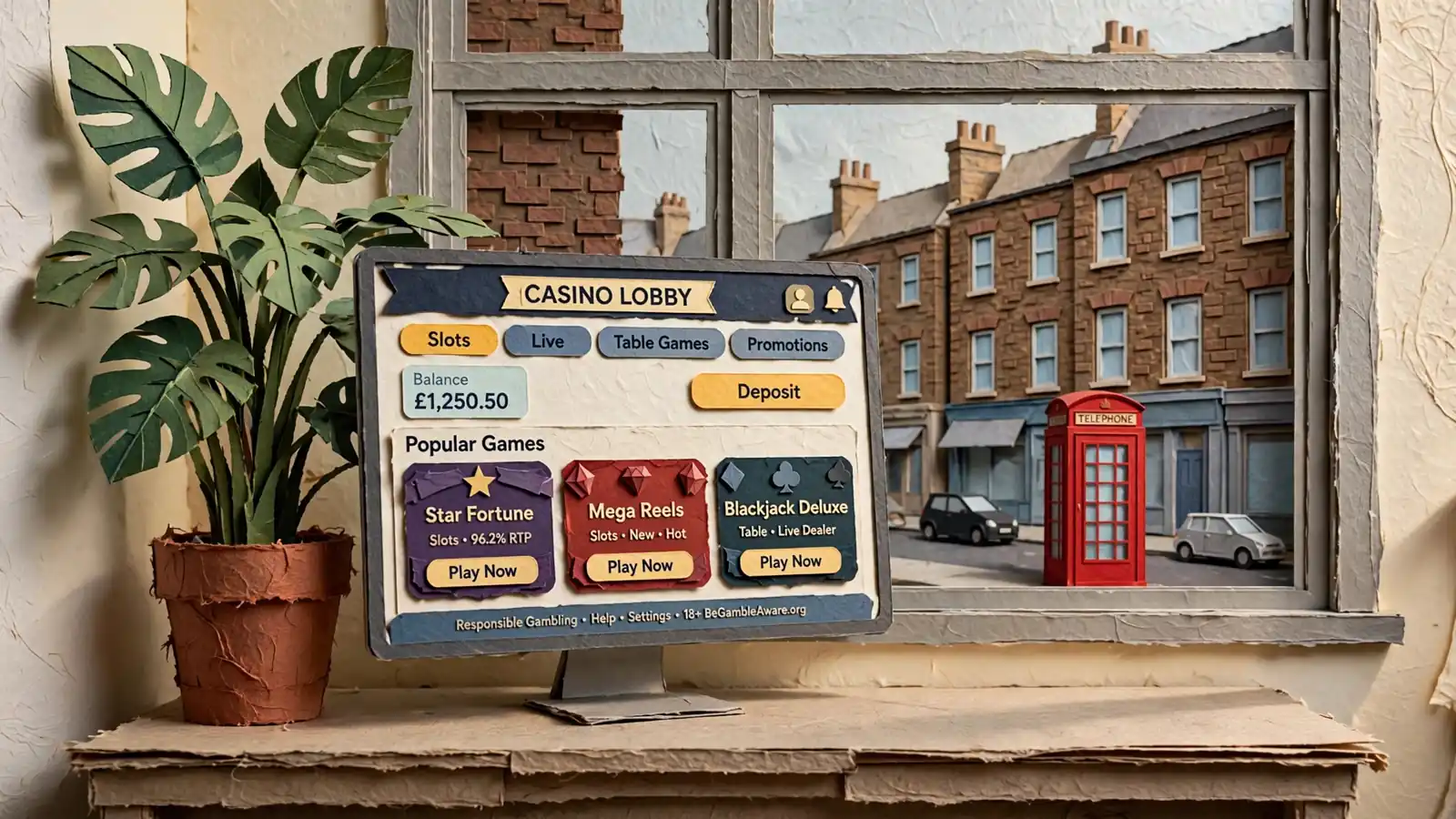
Play’n GO supplies games, while each casino controls its own account, payments, bonuses and player services.
How Play’n GO Games Reach UK Casino Lobbies
A slot provider and an online casino occupy different places in the gambling arrangement. The provider creates and supplies games; the casino presents those games within a consumer account, accepts deposits, settles winnings and deals with the player. That distinction matters when looking for Play’n GO slots in the UK, because the phrase “casino with Play’n GO games” describes an operator’s lobby rather than a Play’n GO betting service.
Play’n GO is therefore best understood as part of the supply chain behind a casino’s catalogue. A game can be recognisable as a provider title while the surrounding service belongs entirely to the operator. The account, cashier, bonus conditions, identity checks, customer support and withdrawal process are casino functions. The game itself arrives through a commercial relationship between businesses.
Provider supply is not casino operation
A business-to-business supplier does not need to resemble a familiar betting brand. Its role is to make games available to licensed operators, either through a direct technical connection or through a distribution platform that carries content from several suppliers. The operator then decides which titles appear in its lobby and how they are organised alongside games from other studios.
This arrangement is easy to overlook because the player sees one website, one balance and one play button. Behind that simple interface, several responsibilities remain separate. A provider supplies the gaming content and the technical means of delivering it. The casino runs the gambling service offered to customers in Great Britain.
That separation also explains why a provider’s own corporate identity should not be mistaken for a consumer casino. A software company may hold a UKGC software licence that permits it to supply games to British operators without holding the player-facing responsibilities attached to a casino operating licence. The licence covers the authorised business activity, not every activity associated with remote gambling.
The distinction is more than corporate housekeeping. It determines who controls the account and who must answer when something goes wrong.
NetEnt Casinos UK: Games, Operators and Oversight
How a title enters a casino lobby
There are two broad routes by which provider content can reach an operator. A casino may connect directly to the supplier’s gaming platform, or it may receive the games through an aggregator. An aggregator acts as a distribution layer, allowing an operator to connect to a range of game studios without building a separate integration for each one.
Once the technical connection exists, the casino still has a publishing decision to make. A title may be included in the lobby, placed in a particular category, shown in a promotional carousel or left unpublished. The presence of a provider’s games across the industry does not mean that every operator displays the same selection.
This is why a search for online casinos with Play’n GO slots can produce changing results. Game catalogues are commercial and editorial objects, not permanent registers. Operators add, remove, reorder or restrict titles as their agreements and product choices change. A casino’s front page may also show only a selection of its full catalogue, leaving provider names to be found through a search or filtering tool.
The visible lobby is the final layer of a longer process: studio supply, technical distribution, operator approval and publication. Four steps, one screen.
Who holds the player-facing licence
For British customers, the operator offering real-money remote gambling must hold the relevant UKGC licence. That operator is responsible for the consumer relationship, including deposits, payouts, bonus terms and customer support. The software supplier does not take bets directly from British players merely because its games appear on a licensed casino site.
This division gives the phrase “Play’n GO slots online casino UK” a precise practical meaning. It refers to Play’n GO content made available inside a casino service that carries the operator’s regulatory and financial responsibilities. It does not mean that Play’n GO itself provides a casino account, holds the player’s balance or processes a withdrawal.
The same principle applies to searches for casinos with Play’n GO games in the UK. The important question is not only whether the provider appears in a casino’s catalogue, but also which business is offering the account and under which UKGC licence. A provider name identifies the source of the game; it does not, by itself, identify the legal operator.
A provider’s name identifies the source of the game, but it does not, by itself, identify the legal operator responsible for the player’s account and regulatory duties.
Why lobby labels can mislead
Casino menus are designed for browsing, so their labels are not regulatory classifications. A heading such as “featured games” or “new releases” is an editorial choice. A provider filter is a useful catalogue tool, but it is not evidence that the provider operates the casino or that every title associated with the brand is currently available.
The same caution applies to lists of “best online casinos with Play’n GO slots UK 2026”. A list can describe where a game was seen at a particular time, but it should not be treated as a permanent industry register. Availability belongs to the operator’s current lobby and commercial arrangements, while licensing belongs to the relevant regulatory record.
For that reason, the provider-and-operator relationship should be kept in view before comparing casinos. Play’n GO supplies the games; the casino supplies the gambling service. One creates the content, the other carries the player account and the obligations that come with it.
Amatic Slots at UK Casinos: Software and Access
Recommended online casinos
- BeOnBetBonus: 100% up to €500 + 100 FS · Payout speed: 1-3 business days
- NightWinBonus: £900 + 400 free spins · Payout speed: 1-3 business days
- ZombillionBonus: Welcome Pack 250% up to £4000 + 200 FS · Payout speed: 1-3 business days
- BritsinoBonus: Welcome Package – Get your £2,200 + 2,000 FS · Payout speed: 1-3 business days
- DieselwinBonus: Welcome Pack 250% up to £4000 + 200 FS · Payout speed: 1-3 business days
- Revery PlayBonus: 100% up to€1,000+ 100 FS · Payout speed: 1-3 business days
- x3betBonus: Welcome Pack 100% Up to £1.000 + 200 Free Spins · Payout speed: 1-3 business days
The Shape of a Play’n GO Slot
A Play’n GO slot belongs to a category that is easy to recognise and surprisingly difficult to describe precisely without turning a general impression into a catalogue claim. Reel layout, paylines, symbols, bonus rounds and volatility are properties of individual games, not of a provider’s name alone. A studio may publish several formats, and a familiar visual style does not make every title mechanically identical.
That distinction matters in the United Kingdom, where the word “slot” describes a regulated form of remote gambling rather than a single technical design. The UK Gambling Commission oversees commercial gambling in Great Britain, including online casino activity, and its remit follows the service offered to consumers even when the equipment running it is located elsewhere. The regulator is the sole commercial gambling authority in Great Britain; businesses receive operating licences, while relevant individuals may hold personal licences.
Reels are only the visible part
The traditional slot image remains powerful: vertical reels, rows of symbols and a winning combination formed across a set of lines or other defined patterns. Digital games can preserve that appearance while changing almost everything beneath it. A title may use fixed lines, ways to win, expanding symbols, cascading symbols or a feature triggered by a particular symbol combination. Those mechanics should be read from the individual game’s rules rather than inferred from the provider label.
Megaways Slots at UK Online Casinos: How to Choose
The same caution applies to the word “machine”. In a physical betting shop or casino, it suggests a cabinet with a fixed screen and controls. An online slot is software presented through a remote gambling service. Its appearance may imitate a machine, but the commercial relationship is different: the game is part of a licensed online offering, and the operating licence belongs to the business providing that service to British consumers.
A slot’s mathematics is less visible than its artwork. Return-to-player information, hit frequency, volatility and maximum win conditions can affect the character of play, but they are not interchangeable terms. A higher stated return does not describe how often wins arrive; volatility does not identify the game’s theme or bonus structure. Treating these labels as decoration is how a colourful lobby becomes a misleading catalogue.
Bonus rounds shape the experience
Many modern slots divide play into a base game and one or more feature stages. A scatter combination may open free spins; a symbol may expand across a reel; a pick-and-reveal screen may turn a win into a short ritual of choices. These are design conventions, not evidence that every game from one studio contains the same features.
Slot Mechanics
Modern digital slots use various mechanics that differ from traditional machines, such as fixed lines, ways to win, expanding symbols, or cascading symbols. These mechanics are defined by the individual game’s rules rather than the provider label.
The free-spin round has become especially influential because it gives a slot a second rhythm. The base game may be repetitive by design, while the feature interrupts that repetition with altered symbols, multipliers or additional winning opportunities. This is not merely a matter of entertainment packaging. The conditions for entering the feature, and the way its prizes are calculated, belong to the game’s rules and must be considered separately from any bonus offered by a casino.
That separation is important in discussions of free play and casino promotions. A game’s own feature round is part of its software. A deposit offer, free-spin promotion or other incentive is a term set by the operator. One is a game mechanic; the other is a commercial condition. Blurring them makes a slot appear more generous than the underlying description supports.
Mobile play changes the frame, not the identity
A mobile casino game is not necessarily a different game. In many cases, the same title is adapted to a smaller screen, with controls arranged for touch rather than a mouse. Portrait and landscape layouts, menus and information panels may differ, but those interface decisions do not establish a separate mathematical model.
The distinction between mobile access and mobile-only software is therefore useful. A game that opens in a browser can travel between devices without becoming a new title. Its availability, however, remains tied to the remote gambling service displaying it. The regulator’s concern is the gambling activity offered to people in Great Britain, not whether the game is opened on a desktop, tablet or phone.
A neat screen is not a licence.
Amatic Slots in UK Casinos: How They Reach Players
What a slot list can and cannot show
A list of Play’n GO games can identify themes and titles, but a title alone says little about the structure of play. A serious description would need to distinguish reel format, winning mechanism, bonus triggers and published mathematical information for each game. Without those distinctions, a “best” list becomes an arrangement of names with an air of precision.
The regulatory setting supplies another boundary. The Gambling Commission issues operating licences to companies and personal licences to individuals working within Great Britain’s gambling industry. It does not turn a provider’s brand into a casino, nor does a game’s presence in a lobby explain the terms under which the surrounding service operates.
The shape of a slot is found in its rules, not in its logo.
Casino Availability Is an Operator Question
A game provider and a casino operator occupy different places in the gambling chain. The provider creates and supplies games; the operator presents them in a gambling service, manages accounts and accepts bets. That distinction matters whenever a page promises the “best Play’n GO casino sites in the UK”. A provider’s name may describe the games in a lobby, but it does not, by itself, identify the business holding the relevant UKGC licence.
A provider’s catalogue reaches a casino in one of two broad ways: through a direct technical integration or through an aggregator feed. In the first arrangement, the operator connects to the provider’s games itself. In the second, a distribution platform supplies access to titles from several providers through one technical connection. Either route can place a game inside a casino lobby without turning the provider into a consumer-facing casino.
Do
- Check the current operator’s provider list before depositing.
- Verify the specific UKGC licence of the casino operator.
- Consult the live lobby for current game availability.
Don’t
- Assume a provider’s name implies a casino account.
- Rely on old comparison pages for current game availability.
- Treat a provider’s branding as a regulatory licence.
That is the practical answer to why Play’n GO slot sites are discussed as casinos rather than as separate Play’n GO betting destinations. The player’s account belongs to the operator. The operator controls the cashier, account procedures, withdrawals, promotional conditions and customer-support route. The game supplier remains behind the catalogue. It is a business relationship, not a second casino account hidden behind the first one.
A provider name is not a casino shortlist
A list headed “top Play’n GO casinos in the UK” suggests a simple ranking: find the casinos, compare them and choose the strongest entry. The underlying market is less tidy. A game can be supplied to an operator, placed in a particular lobby, removed from that lobby, or made visible only after a search or a regional configuration. The title’s presence is therefore an operator-level matter, not a permanent property of the provider’s name.
The same caution applies to phrases such as “Play’n GO online casino sites”. They can refer to several different things:
- UKGC-licensed operators that may carry games from the provider;
- a lobby search for the provider’s name;
- an aggregator’s catalogue presented inside an operator’s service;
- an offshore site using the provider’s branding or titles outside the British regulatory framework.
Those categories are not interchangeable. A casino may advertise a broad software catalogue while a particular game is unavailable to British accounts. Another operator may show a provider page but have changed its selection since that page was written. A polished logo is not a licence register entry. Dry, but important.
The legal responsibility also sits with the operator serving the British market. The operator, rather than the game supplier, handles player deposits, payouts, bonus conditions and customer support. A supplier’s technical relationship with a casino does not give it authority to accept bets directly from British players, nor does it create a separate complaints route for the player.
Why current availability changes
Casino lobbies are commercial spaces, not archives. They change when contracts, distribution arrangements, technical integrations or market permissions change. A title can be present in one country and absent in another; it can appear on desktop and be configured differently elsewhere; it can be listed by a review while no longer appearing in the live lobby. The useful question is consequently not whether a provider has ever supplied games to an operator, but whether the relevant title is available to the relevant account at the time of play.
Amatic Slots at UK Casinos: How They Reach the Lobby
For that reason, operator staff should consult the current provider list before a first deposit when checking for Amatic titles. This point comes from an affiliate review and is best treated as a time-sensitive checking practice, not as a permanent description of every casino lobby. The same discipline is sensible when investigating another provider: the operator’s present catalogue is more meaningful than an old comparison page.
The check belongs on the operator’s own service. A current provider filter, an individual game page or a support response can establish what the account may actually access. Promotional wording, third-party listings and an old article cannot safely substitute for that live confirmation. Availability is a fact about a particular operator at a particular time.
What an operator comparison can and cannot establish
A comparison of UK casino sites can examine the operator’s licence status, account terms, payment rules, safer-gambling controls and support arrangements. It can also record whether the operator currently displays the relevant provider or title. It cannot infer that every game from the provider is available merely because one title appears, and it cannot turn an unverified listing into a recommendation.
Verification Unit
The sensible unit of verification is the combination of provider, operator, game, and jurisdiction.
This is especially relevant to pages using “best”, “top” or “new”. Those labels describe an editorial judgement about casinos, not a guarantee that a provider’s catalogue is present. A newly launched casino may have a modern interface and still lack a particular supplier. An established operator may carry the games but alter its lobby without notice. The word “new” says when the casino was discussed, not necessarily when the game became available.
The operator’s UKGC licence remains the central boundary for lawful remote gambling offered to British customers. Offshore casinos may display games associated with the same suppliers, but they operate outside the UKGC system and do not provide the same British regulatory framework. Their visibility does not make them UK casino sites in the legal sense.
So the sensible unit of verification is not the provider alone. It is the combination of provider, operator, game and jurisdiction. Once those four pieces are separated, the language becomes less glamorous but more accurate: a provider supplies software, an operator offers the gambling service, and the live operator lobby determines what is actually available.
Playing Slots on Mobile, for Cash or in Demo Mode
A slot can appear on a phone in two quite different senses. The first is technical: the game opens in a mobile browser and adapts to the smaller screen. The second is contractual: the account belongs to a casino operator, funds move through that operator, and any resulting winnings are paid under its terms. Confusing the two makes a piece of software sound like a gambling service. It is not one.
Amatic Slots at UK Online Casinos: How They Work
For Amatic titles, the mobile format is HTML5. That means the game is designed to run in a browser rather than requiring a separate download. The same general delivery model supports play across devices, although the presence of a mobile-friendly format does not by itself establish that a particular title is available at every casino or on every phone. A lobby still has to carry the game, and the operator remains the party responsible for the account.
Mobile access is not a casino account
A search for Play’n GO slots on mobile often blends together three questions: whether the game opens on a handset, whether a casino lists it, and whether the account permits real-money play. These are separate questions, even when the screen makes them look like one seamless product.
Mobile software answers only the first. The casino answers the other two. It controls registration, identity and age checks, deposits, withdrawals, customer support and the terms attached to any promotion. A provider’s software licence does not turn the provider into a consumer casino, nor does a mobile interface create an independent route to a game.
That distinction matters particularly in Britain, where remote gambling operators serving Great Britain must hold the relevant UKGC licence. The licence belongs to the business offering the gambling service, not to the phone, browser or slot screen. GamStop applies to UKGC-licensed online operators, while offshore casinos sit outside that system and outside UKGC protection. A glossy mobile page changes none of this. Pixels are not jurisdiction.
Attention Mobile access is not a casino account; the regulatory responsibility and licensing belong to the operator offering the service, not the device or browser used.
Real-money play
Real-money access begins with the operator’s account, not with the game’s title. Before a first deposit, a UKGC-licensed operator must verify the customer’s name, address and date of birth, and must check age before allowing deposits. The operator must also prompt the customer to set a financial limit before that first deposit; a reduction to an existing limit has to take effect immediately.
Payment rules follow the same institutional line. The operator handles deposits and payouts, and remote gambling cannot be funded with a credit card, including a credit-card-funded e-wallet top-up. The slot provider does not hold the player’s balance or decide whether a withdrawal is released.
The stakes are regulated as well. For online slots, the maximum per game cycle is £5 for customers aged 25 and over, and £2 for those aged 18 to 24. These limits apply to online slots as a category, rather than being a special setting attached to one supplier’s games. British slot design also prohibits autoplay and requires at least 2.5 seconds between spins.
Demo mode and free play
Demo mode is a different arrangement again. It allows a game to be opened without a cash balance being placed at risk. It can show the interface and let the mechanics run, but it does not establish that the same title is available for real-money play at that operator. Nor does a free demonstration create a claim to cash winnings.
The phrase “free spins” can be misleading in this setting. Spins in a demo session are not a cash promotion. Promotional free spins, where offered by a casino, belong to the operator’s bonus terms and may carry conditions distinct from ordinary play. The provider supplies the game; the casino decides whether a promotion accompanies it.
Jackpot King Slots UK: Providers and Casino Lobbies
Thus mobile play, real-money play and demo play are three layers of access. The first concerns the browser, the second the licensed gambling account, and the third a no-cash simulation. Keeping them apart is less exciting than a flashing reel. It is also more accurate.
The Provider Behind the Games
A slot provider is not a casino, even when its name appears prominently beside a game. The provider creates the software and supplies it to operators; the operator runs the gambling account, accepts deposits, records play and pays winnings. These are different commercial roles, and the distinction matters more than the branding on a lobby tile.
Amatic Industries illustrates the arrangement clearly. The Austrian business began in 1993 as a business-to-business software supplier and later developed its online division, AMANET, around 2010. Its UK Gambling Commission remote gambling software licence permits it to supply games to British operators. It does not turn Amatic into a consumer casino, nor does it give the company responsibility for individual player accounts.
That division of labour is easy to overlook. A provider may hold permission to supply gambling software, while the operator holds the permission needed to offer remote gambling to customers in Great Britain. The operator remains responsible for deposits, withdrawals, bonuses, customer support and the handling of complaints. The software company supplies the machinery; it does not become the cashier.
AMANET titles use HTML5 technology, allowing games to run across devices without treating a particular handset or computer as the centre of the universe. The wider catalogue includes video slots and random-number-generator table games, but not live-dealer games. That difference is important when a casino lobby places slots, roulette-style products and live tables beside one another: the shared menu does not prove a shared supplier.
Software Supplier
Creates and supplies the gaming content and technical means of delivery to licensed operators.
Casino Operator
Runs the gambling service, manages player accounts, processes deposits, and holds the UKGC licence.
Aggregator
Acts as a distribution layer, allowing operators to connect to multiple game studios through one integration.
The same principle applies to platform language. A casino platform is the operator’s customer-facing system: registration, identity checks, payments, account controls and game access sit there. Provider software is one component inside it. A request for a provider’s “casino bonus” therefore describes a casino promotion, not a software-company offer. Free play, deposit conditions and wagering terms belong to the operator that publishes them.
The provider’s own authorisation also does not make every casino carrying its software equivalent. A British operator offering remote gambling must hold the relevant UKGC licence, while an offshore business remains outside the UK regulatory system. The provider’s presence in a lobby is not a licence register entry.
That is the quiet architecture behind the colourful interface: one company builds, another operates, and regulation follows the activity each company actually performs. Not the same business.
Deposits, Free Spins and the Meaning of “No Deposit”
A slot provider does not hold the player’s balance. Deposits, withdrawals, identity checks, bonus terms and support belong to the casino operator offering the game. That distinction matters when a promotion is described as a Play’n GO offer: the wording may identify the games included, but the money arrangement remains between the player and the casino.
“No deposit” is particularly slippery language. It does not mean that a casino account exists without registration, that identity checks disappear, or that every withdrawal is immediately available. It refers to a promotional credit or free spins granted without a cash deposit under the operator’s stated conditions. Those conditions can include eligibility rules, a limited game selection, an expiry period and restrictions on converting winnings into withdrawable funds.
Amatic Casinos UK: Games, Access and Bonuses
A “free spin” is not automatically cash. Some offers attach wagering requirements to winnings, while others may credit the result as cash without a playthrough requirement. A specialist review has reported such zero-wagering free-spin treatment for promotions associated with 32Red, Betfred and Bet365, but promotional wording changes and the operator’s current terms govern the transaction. The distinction is more important than the cheerful adjective “free”.
One reported Bet365 promotion required a £10 lifetime deposit and distributed as many as 500 spins across 10 days. That is a deposit condition, not a contradiction in terms: an offer may be advertised as free spins while still requiring a qualifying payment at some point. A casino’s sign-up language is therefore not a complete description of the cost of access.
The same caution applies to searches for a £5 minimum deposit or a low-deposit casino featuring Play’n GO slots. A deposit threshold is an operator policy, not a property of the provider or its games. It may also sit alongside separate rules for payment methods, account verification and withdrawals. A low first deposit does not turn a casino into a Play’n GO service.
Promotions also have a regulatory boundary in Great Britain. The UK Gambling Commission’s 10× cap on wagering requirements attached to bonus funds took effect on 19 December 2025. That cap concerns the operator’s bonus terms; it does not promise that a particular casino offers Play’n GO free spins, a no-deposit reward or demo access.
In practical terms, the cleanest reading is simple: the game provider supplies content, while the casino supplies the promotion. “No deposit” describes a condition of that promotion, not a special way of playing a provider’s slots. The small print remains the real product.
What does “no deposit” mean?
It refers to a promotion where credit or free spins are granted without a cash deposit, subject to the operator’s specific terms and conditions.
Is a free spin always cash?
No, some offers have wagering requirements, while others may credit results as cash without a playthrough requirement.
Game Details and RTP: What Can Be Verified
RTP belongs to a particular game configuration, not to a software label as a whole. The figure can change with the version supplied by an operator, so a catalogue entry is not enough on its own. The relevant information is the RTP attached to the title and configuration shown in the casino lobby or game information panel.
Volatility is a separate description. It concerns the pattern of wins rather than the proportion theoretically returned over extended play. A high RTP does not automatically mean low volatility, and a low-volatility label does not turn a game into a reliable source of profit. Those are different measurements, and treating them as interchangeable makes casino copy sound more certain than mathematics permits.
The available game-specific figures concern Amatic’s Book of Aztec. A specialist review gives two RTP versions for that title: 90.57% and 97.63%. That difference is not a footnote. It shows why the operator’s displayed version matters when comparing slots. An RTP number should therefore be read alongside the exact title, the casino presenting it and any game-information screen attached to the play window.
Amatic’s wider online catalogue contains more than 250 titles, including video slots and RNG table games. Its typical slot format uses five reels and three rows, with nine or ten fixed paylines; scatter wins and a “Book of” free-spin round are recurring features. These details describe Amatic’s catalogue, not Play’n GO’s.
That distinction matters when a page promises a Play’n GO slots list, a highest-RTP ranking or categories such as low-, medium- and high-volatility games. A provider name cannot safely be used as a substitute for title-level data, and an Amatic figure cannot be transferred to a Play’n GO game merely because both appear in a UK casino lobby.
Amatic Casinos: How to Find Its Slots in the UK
RTP is also not a bonus term. It says nothing about wagering conditions, free spins or the cash value of a promotion. Those belong to the operator’s offer and its rules. The number on the game screen and the wording of the bonus page are different pieces of information. Conflating them is convenient, but inaccurate.
Bonus Terms Under UK Rules
A Play’n GO title does not carry a bonus of its own. Any welcome offer, deposit promotion or free-spin arrangement belongs to the casino operator that places the game in its lobby. The provider supplies the game; the operator sets the promotional terms and handles the account.
That distinction matters when phrases such as “Play’n GO casino bonus” or “Play’n GO slot bonus code” appear in an offer. They may describe a casino promotion that can be used on selected slots, not a bonus issued by Play’n GO. The same applies to a supposed no-deposit offer: its eligibility, conversion rules and withdrawal conditions come from the operator’s terms.
One UK rule now places a firm boundary on wagering requirements. The UK Gambling Commission’s 10× cap on bonus funds took effect on 19 December 2025. A UKGC-licensed operator cannot impose a wagering requirement above that limit on bonus funds. The rule concerns the amount of play required before bonus-related funds or winnings become withdrawable; it does not promise that a particular casino will offer a bonus.
The cap also does not turn every promotion into a useful one. An operator may choose not to offer Play’n GO free spins, may restrict a promotion to named games, or may attach conditions concerning eligibility and expiry. A bonus advertised beside a Play’n GO title therefore remains an operator-level offer, not a feature of the slot.
Understanding Bonuses
- A Play’n GO title does not carry its own bonus; all offers come from the casino operator.
- The UKGC imposes a 10x cap on wagering requirements for bonus funds.
- Promotional terms like eligibility and expiry are set by the operator, not the provider.
Bitcoin adds another layer of separation. A search for a Play’n GO bitcoin casino may lead towards offshore sites, but an offshore operator sits outside the UKGC system. It is not a UKGC-licensed casino simply because it displays a familiar game provider, and the presence of a Play’n GO title does not change that regulatory position.
The sensible reading of a “best” bonus is consequently narrow: it is an offer whose current operator terms are clear and whose wagering requirement stays within the UK limit. Brand association alone proves nothing. A polished banner is still only a banner.
Book of Dead and the Limits of the Available Evidence
Book of Dead is often associated online with Play’n GO, and that association explains why the title is frequently sought alongside the provider’s name. Yet a game title, a provider name and a casino listing are three different pieces of information. Treating them as interchangeable turns a recognisable label into an unsupported claim.
The same distinction matters for Legacy of Dead and Agent of Hearts. Their names may appear in discussions of Play’n GO, but a title alone does not establish who developed it, which operator carries it, or whether it is currently available to players in Great Britain. Availability is not a permanent property of a game; it belongs to the relationship between a supplier and a licensed operator at a particular time.
For UK remote gambling, the practical dividing line is the operator’s UKGC status. A legal online casino serving British customers must hold a current UKGC licence, while offshore casinos sit outside that system. A game page or promotional reference cannot replace confirmation that the relevant casino is authorised to offer remote gambling in Great Britain.
That also explains why a familiar title should not be used as shorthand for a particular casino recommendation. The presence of a game in one lobby would not prove that it appears in another, and an old listing may outlive the commercial arrangement that created it. Casino catalogues are less like libraries than railway timetables: useful when current, decorative when not.
UK Online Casinos with Big Jackpot Slots
For Book of Dead, the responsible description is therefore narrow. It is a named slot commonly linked with Play’n GO, but its provider attribution and current UK availability need to be established from up-to-date game and operator information before being presented as settled fact. The title is known. The chain behind it requires care.
Real-Money Play and UK Slot Limits
Real-money play on online slots in Great Britain is shaped by a rule that belongs to the market, not to an individual supplier. The stake cap applies to online slot games generally, so a Play’n GO title falls under the same limit as any other slot offered by a UKGC-licensed operator. The game’s provider does not create a separate allowance.
For players aged 25 and over, the maximum stake is £5 per game cycle. This limit took effect on 9 April 2025. A game cycle means the period covered by one completed slot play, rather than a player’s total spending during a session.
For players aged 18 to 24, the maximum is lower: £2 per game cycle. That age-specific limit began on 21 May 2025. The distinction is therefore based on the player’s age, not on whether the slot is a three-dimensional game, a familiar branded title or a newer release.
The rule also matters when a slot is discussed in terms of payout percentage or house edge. Those are characteristics associated with a particular game configuration; they do not change the permitted stake. Nor does choosing a demo version alter the regulatory meaning of real-money play, since no stake is placed in a free mode.
The same principle applies to payment methods. A player searching for Play’n GO slots with bitcoin may be thinking about how funds reach an account, but a payment option does not create an exception to the stake cap. The limit remains attached to the online slot game cycle.
A modest ceiling, imposed by law.
Can I get free spins on Amatic slots at UK casinos?
Yes. 32Red, Betfred and Bet365 offer free-spin wins with no wagering requirement; at bet365, the offer requires a £10 minimum lifetime deposit and provides up to 500 spins over 10 days.
Can I deposit with cryptocurrency at a site offering Amatic slots?
No UKGC-licensed operator was confirmed as accepting cryptocurrency for Amatic play. Offshore sites may offer it, but they operate outside the UK regulatory framework.
How does the UK’s 10× wagering cap affect Amatic casino bonuses?
Since 19 December 2025, wagering requirements on bonus funds at UK-licensed casinos cannot exceed 10 times the bonus amount.
Are Amatic casinos on GamStop?
Yes. Amatic games are offered through casino operators, and GamStop has been mandatory for all Great Britain-licensed online operators since 31 March 2020.