
Casinos That Accept Zimpler in the UK: Payment Guide
 Available in GB
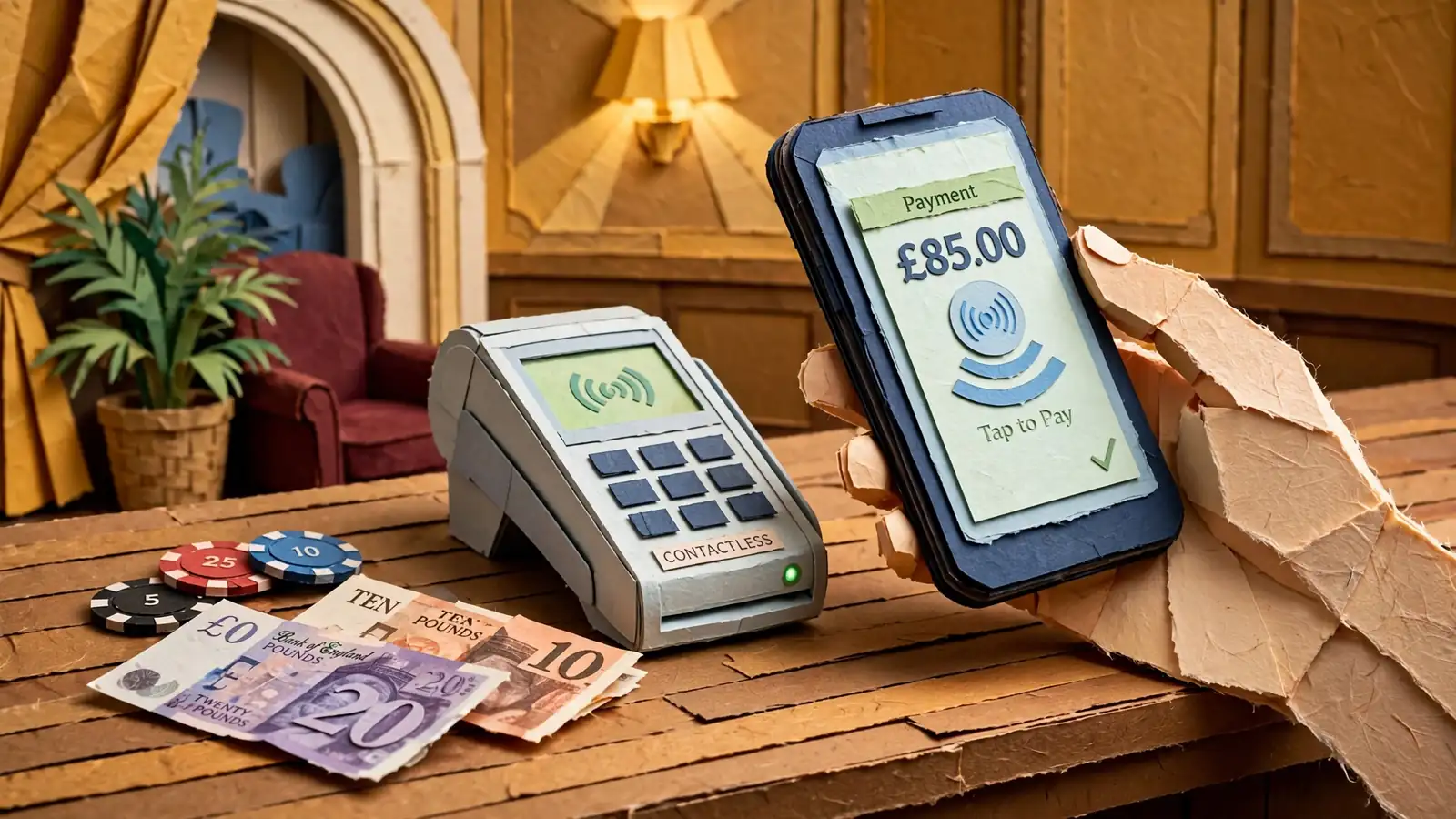
Payment availability is separate from games and bonuses, and the cashier is the practical place to check deposit and withdrawal options.
Zimpler’s Place in the UK Casino Cashier
Zimpler belongs to a particular part of the casino question: the cashier. A casino may offer a broad selection of games, operate an Android-compatible site and advertise real-money play, yet none of those features establishes that Zimpler can be used to fund an account. Payment support is a separate operational choice, displayed where deposits and withdrawals are set up.
That distinction matters because searches for UK casinos accepting Zimpler often turn into requests for “all” available sites, the best new options, or a Zimpler casino with a bonus or particular games. Those descriptions combine several unrelated matters. A payment method is not a mark of game quality, a guarantee of promotional eligibility or a property of a mobile device. It is a route through which money may be sent, and its presence has to be established in the relevant cashier.
The cashier is therefore the practical point of reference. It may show Zimpler by name, alongside cards, bank transfer, e-wallets or other routes. It may also distinguish between depositing and withdrawing, or display a method only after account registration, location checks or other account conditions. A logo elsewhere on a page is weaker evidence than the payment screen attached to the account. Money has a way of demanding administrative precision.
What can be separated from general payment support
A review of casino payment pages described a wider landscape containing Visa, Mastercard, bank transfer, e-wallets and several cryptocurrencies. That kind of overview is useful for showing the range of categories associated with UK-facing casino sites, but it does not prove that Zimpler is available at any particular operator. Nor does it establish that every method mentioned remains active for every customer.
Visa and Mastercard were also listed in the same type of material, while the current availability of a card product and its eligibility still depend on the live cashier. The same principle applies even more strongly to a named digital payment service. A general payment page can describe an operator’s intended or advertised options; the cashier determines which route is presented for the account and transaction concerned.
Casino Payments in the UK: Methods Compared
This is why “Zimpler casinos” should not be treated as a fixed class in the same way as a game category. There is no useful inference from the fact that a casino accepts e-wallets to the conclusion that it accepts Zimpler. E-wallet is a broad label, not a synonym. A site can support one wallet and omit another, change its payment partners, or present different routes over time.
Availability is a live cashier question
The sensible wording is narrower than the promotional language often attached to payment searches. A site can be described as accepting Zimpler only when Zimpler appears as an available route for the relevant UK account and the intended transaction. That does not turn the site into a “best” Zimpler casino, and it says nothing by itself about bonuses, games, withdrawal arrangements or the quality of the operator.
The reverse is also worth keeping in view. If Zimpler is not displayed, the fact that the cashier contains cards, bank transfer or other e-wallets does not make Zimpler available by implication. Payment menus are not philosophical statements about what a casino ought to support. They are lists of the routes connected to that account at that moment.
The phrase “still available” carries a time element. A payment provider can disappear from a cashier without changing the casino’s games or mobile interface. Conversely, a new route can appear while the rest of the site remains familiar. For that reason, older articles, static payment badges and broad operator descriptions cannot substitute for the current cashier. A 2026 reference to Zimpler needs a current check, not a memory of an earlier arrangement.
Zimpler and the meaning of “best”
Requests for the best Zimpler sites often bundle a payment preference with expectations about bonuses, games and mobile access. Those are different comparisons. A Zimpler deposit route, if displayed, answers only whether that route is offered. It does not promise a bonus, establish that a promotion includes the method, or identify any particular slot catalogue. Payment compatibility is an administrative fact, not a quality ranking.
Casinos That Accept Ripple XRP in the UK
The same applies to Android casinos. An Android phone can open a casino site, but the device does not create a Zimpler option in the cashier. The payment service belongs to the operator’s account infrastructure, while Android describes the means of reaching the site. One concerns money movement; the other concerns access. Confusing them produces a neat phrase and a poor explanation.
A careful account of Zimpler in the United Kingdom must therefore remain modest. The relevant question is whether the service is presented in the live cashier for the account and transaction being considered. Broader claims about UK payment categories can provide context, but they cannot be converted into a list of named Zimpler casinos. The cashier remains the dividing line between a payment possibility and a payment assumption.
Recommended online casinos
- BeOnBetBonus: 100% up to €500 + 100 FS · Payout speed: 1-3 business days
- NightWinBonus: £900 + 400 free spins · Payout speed: 1-3 business days
- ZombillionBonus: Welcome Pack 250% up to £4000 + 200 FS · Payout speed: 1-3 business days
- BritsinoBonus: Welcome Package – Get your £2,200 + 2,000 FS · Payout speed: 1-3 business days
- DieselwinBonus: Welcome Pack 250% up to £4000 + 200 FS · Payout speed: 1-3 business days
- Revery PlayBonus: 100% up to€1,000+ 100 FS · Payout speed: 1-3 business days
- x3betBonus: Welcome Pack 100% Up to £1.000 + 200 Free Spins · Payout speed: 1-3 business days
When Zimpler Is Missing: Other Ways to Pay
A missing Zimpler button does not leave the cashier empty. UK casino payment pages tend to group their alternatives into familiar families: debit cards, e-wallets, bank-based services and prepaid vouchers. Each handles the movement of money differently, and the important distinction is not whether a logo looks recognisable but whether the selected route supports the transaction needed. A method suitable for adding funds may not also be available for taking them out.
Debit cards: the conventional route
Debit cards remain one of the most widely encountered options at UK casinos. Visa and Mastercard are the principal names in this category, although the exact card products accepted by a particular cashier still need checking at the point of payment. A supplied list of logos is not a permanent guarantee: availability can depend on the operator, the card product and the account.
The British prohibition on credit-card payments for gambling also matters here. A debit-card deposit is not a disguised invitation to use borrowed funds, and a payment route that allows credit-card funding for gambling cannot be treated as an acceptable substitute. The same restriction applies where credit-card money reaches gambling through a money service business or a wallet. The cashier is therefore less a menu than a filter shaped by regulation.
Casinos That Accept Interac in the UK: Payment Options
Cards appeal through familiarity and directness. They do not require a separate wallet account, and the payment information is entered within the casino’s cashier. Yet a card being suitable for deposits does not, by itself, establish that it can receive a withdrawal. That distinction is easy to overlook when the deposit screen presents a neat row of logos.
E-wallets: separate balances, separate conditions
PayPal is often chosen for its speed and convenience, according to an affiliate review, but its treatment in promotions can differ from its treatment in the cashier. A payment method may work perfectly for a deposit while the associated transaction is excluded from bonus eligibility. Payment availability and promotional eligibility are different questions.
Skrill and Neteller occupy a similar part of the landscape. They are offered by some UK casino sites, and an affiliate review identifies both as methods that are often left outside promotional terms. Skrill remains one of the most frequently encountered deposit methods on UK-friendly casino sites in 2026, although that description belongs to a changing market rather than a permanent rule.
Jeton is a narrower alternative. An affiliate review places it at a handful of UK online casinos in 2026. That makes it a possible route at selected sites, not a general replacement for the more established card and wallet choices. The cashier decides the practical question.
E-wallets can be useful where a player prefers to keep casino payments apart from a main bank account. Their separation, however, creates another layer of ownership checks. The wallet must not be funded by credit-card money for gambling, and the wallet’s own terms may affect whether it can be used for both sides of the transaction.
Casinos That Accept Maestro in the UK: Payment Guide
Open banking and bank transfers
Open banking connects the casino payment to a bank account through an authorised banking flow. Bank transfer uses the account itself rather than a card network or stored wallet balance. An affiliate review describes open banking and bank transfer routes as capable of producing instant deposits and fast withdrawals at many sites. That is a statement about the possibilities of these systems, not a promise attached to every cashier.
The attraction is obvious: the funds originate from a bank account, and the payment route can be more direct than moving money through an intermediate wallet. Speed still depends on the operator and the banking process. Bank transfers may also be affected by cut-off times, weekends and currency conversion, details that disappear behind the deceptively calm word “instant”.
Trustly is one named open-banking payment method found in the UK market. Its presence in a cashier does not mean every casino using bank payments offers it, nor does it establish that deposits and withdrawals are both enabled. Those functions must be checked separately.
Prepaid vouchers
Paysafecard belongs to a different tradition. It is a prepaid voucher rather than a bank-linked account or an e-wallet balance, and its role is deposit-only. That makes it useful for controlling the amount introduced into a gambling account, but unsuitable as a route for receiving a casino payout.
The limitation is structural, not a minor cashier inconvenience. A voucher can carry value into the account, yet it does not provide the same kind of destination for returned funds as a bank account or an eligible wallet. Anyone comparing alternatives to Zimpler therefore needs to distinguish a payment method that handles the complete cycle from one designed only for the opening movement.
Comparing the categories
The broadest alternatives are debit cards, e-wallets and bank-connected methods. Prepaid vouchers are more restricted. Card and bank routes tie the transaction to financial institutions; e-wallets place an intermediary between the casino and the bank; Paysafecard stops at the deposit stage. None is automatically the “best” route in every cashier.
Casinos That Accept Wirecard in the UK: Payment Options
A sensible comparison begins with the icons shown after account registration and continues into the method’s individual terms. Visa or Mastercard may appear without every card product being eligible. PayPal, Skrill or Neteller may be usable while excluded from a promotion. Open banking or bank transfer may advertise rapid movement while remaining subject to banking schedules. Paysafecard may solve the deposit question while offering no withdrawal path.
The cashier is where the abstract alternative becomes a real one. Logos are only the beginning.
Deposits, Withdrawals and the Original-Source Rule
A deposit and a withdrawal are related transactions, but they do not travel through the cashier in the same way. Money can reach a gambling account almost immediately, while a payout waits for checks, approval and the payment system’s own processing. The distinction matters when considering whether a casino supports a particular route, including a Zimpler payment option: seeing a method listed for deposits does not, by itself, establish that it can be used to receive winnings.
A card deposit illustrates the difference neatly. The payment may appear in the casino balance at once, yet the corresponding withdrawal can take several business days. The first movement is an authorisation to fund play; the second is a controlled release of money from the operator. Speed at the cashier is therefore not a timetable for the return journey.
A specialist review identifies two parts of withdrawal processing that can extend that journey: the casino’s internal approval and the completion of verification, particularly on an initial withdrawal. This is not merely administrative decoration. Remote gambling licensees must establish who is using the account and whether the payment activity fits the account information before releasing funds. A withdrawal that pauses for KYC is moving through a control system, not necessarily failing.
The practical sequence may look like this:
- A payment method is selected in the cashier and the deposit is authorised.
- The funds are credited to the gambling account, subject to the operator’s checks.
- A withdrawal request is submitted through the methods made available for payouts.
- The casino reviews the request and may complete or renew KYC checks.
- The approved payment is sent through the relevant provider or banking channel.
Each stage belongs to a different party. The operator decides whether the request is approved; the payment provider or bank then handles delivery. A delay can therefore arise before the money leaves the casino or after it has entered the external payment network. Treating both stages as one instant transaction creates expectations that the cashier never promised.
Why the original payment source matters
UK anti-money laundering controls commonly require a payout to return to the source from which the deposit came. This is often called the original-source rule. It helps the operator trace the movement of funds and reduces the risk that an account is used to pass money between unrelated people or accounts.
That rule can make the available withdrawal route narrower than the deposit menu. A method may be displayed for funding but not offered as the destination for a payout; another route may be proposed only after additional ownership checks. Paysafecard, for instance, is a deposit-only voucher, so it cannot serve as the return path for winnings. The cashier’s withdrawal screen, rather than the general list of payment logos, shows what the account can actually use.
The cleanest transaction trail is often one named account used consistently for both directions. Matching the account holder’s details with the payment account reduces avoidable friction over ownership. A different name, a third-party wallet or a bank account that does not correspond with the gambling account can prompt questions even when the deposit itself went through without difficulty.
What happens when routes differ
Casinos accepting Zimpler for a deposit may still direct a withdrawal to another eligible method, subject to the operator’s policy and the applicable checks. That is a transaction-flow issue, not evidence that Zimpler is universally accepted or that a particular casino currently supports it. The same principle applies to cards, bank channels and e-wallets: deposit compatibility and payout compatibility must be confirmed separately.
Withdrawal speed is consequently shaped by the casino’s approval process and the account’s verification status, as a specialist review notes. A fully verified account may avoid one source of delay, but approval still precedes delivery. The reassuringly instant deposit is only the opening scene. The accounting department gets the final line.
Casinos That Accept Klarna in the UK: Payment Rules
Mobile Slots and Payment Compatibility
A mobile slot does not carry its own payment method. The game is software delivered through a casino’s mobile website or app; the cashier is the part of the account that determines how money enters and leaves. That distinction matters when Zimpler is attached to a search for UK mobile or online slots. The relevant question is not whether a particular machine is a “Zimpler slot”, but whether the casino cashier presents Zimpler for the account and transaction being considered.
The same applies to desktop play. A slot opened on a phone, tablet or computer remains the same game, while the available cashier options can depend on the operator, the customer’s location, account checks and the payment products supported at that moment. A mobile interface may display fewer buttons than a full website, or arrange them differently, but it does not turn a game into a payment product. The cashier has the duller job, and the more important one.
What mobile compatibility actually means
For a payment route to matter, it must be available at the operator’s cashier rather than merely mentioned in a general payment list, an old review or a page about online slots. The cashier is where availability becomes concrete: it shows the methods enabled for the account and the transaction type. A game page cannot establish that.
The same separation prevents a second common confusion. “Online slots” describes the format of the game; “real-money play” describes the account balance used for it; Zimpler, if displayed, would describe a funding route. These are three different layers. Combining them in one phrase may be convenient for a search box, but it does not make them one product.
A specialist review may list Visa and Mastercard among the payment methods associated with UK casino sites. That kind of listing is not a substitute for checking the cashier, because current UK availability and the eligibility of a particular card product still have to be confirmed there. UK-licensed casinos cannot accept credit-card payments for gambling, so the presence of a card brand does not mean every card carrying that brand is suitable.
Apps, browsers and slot libraries
An app can provide access to a casino’s games without changing the underlying payment arrangement. Deposits are still handled through the operator’s account and cashier, not by the slot itself. A browser-based mobile site follows the same logic. Whether a game loads in an app, a browser or a desktop window says nothing reliable about whether Zimpler appears as a funding option.
Casinos That Accept Tether in the UK: Payment Guide
Nor does the title of a game prove that it can be played with a particular payment route. Once funds are in the casino account, they are generally balance funds rather than money tagged to a specific slot. Payment compatibility belongs to the account infrastructure; game compatibility belongs to the software and device. Keeping those categories apart makes the transaction question less mysterious.
Claims about “free Zimpler slots” also blur two unrelated ideas. Free play concerns whether money is being risked; Zimpler concerns how an account might be funded. Neither phrase establishes that a payment method is available, and neither changes the need to inspect the cashier before treating a route as usable.
Real-Money Play, Limits and Slot Rules
Real-money slot play in Britain begins with a pause imposed by the rules. Before a new customer can make a first deposit, a remote gambling licensee must prompt them to set a financial limit. This is not a decorative message placed beside the cashier, nor a suggestion that disappears once the account has been opened. It is part of the route into gambling with money.
The purpose is plain enough: the account should have a boundary before funds enter it. A limit can make spending more visible and less dependent on the mood of the moment. The machinery is modest, but so are many useful safeguards. A locked door is not a philosophy of architecture.
The controls must remain available at account level, rather than being offered only during registration. That matters because circumstances change. An account may begin as an occasional diversion and become something more regular; a financial control that cannot be found later is little more than ceremony. UKGC-licensed remote gambling operators are required to provide accessible tools for managing these limits.
What the payment method does not change
A deposit route does not create a separate class of slot rules. Whether a cashier displays Zimpler, a card, an e-wallet or another payment option, the conditions attached to the game remain conditions of the licensed gambling service. A payment brand is not a slot machine, a game provider or a special form of real-money play.
The same distinction applies to phrases such as “Zimpler slots” or “slots that accept Zimpler”. They describe, at most, a hoped-for relationship between a cashier and an account. They do not identify a separate catalogue of games. A slot does not become a Zimpler slot because its deposit was made through a particular route.
Casinos That Accept Siru Mobile in the UK
Nor does a payment option turn real-money play into free play. A no-deposit offer, where one exists, is a promotional question and belongs to the terms attached to that promotion, not to the mechanics of the slot itself. Payment, eligibility and game rules are different compartments, even when a website places them on the same screen.
Autoplay and spin duration
Online slot autoplay is not permitted in Britain. Spins must be initiated individually rather than arranged as an unattended sequence. The rule removes the machine-like rhythm in which one decision silently hands control to the next.
British online slot spins must also last at least 2.5 seconds. This is a rule about the game cycle, not a promise of a particular outcome or pace of winnings. It applies whether the game is opened on a phone, tablet or computer and whether the account was funded through a payment service or another permitted route.
Real-money play therefore sits inside several layers of control: a financial limit before the first deposit, account-level tools that remain accessible, and game mechanics that prevent autoplay and impose a minimum spin duration. The cashier may change. The boundaries do not.
Deposit Costs, Currency and Payout Timing
A deposit and a withdrawal follow different operational paths. A payment can reach a casino account quickly, while the later payout still waits for internal approval, account checks or the receiving bank’s processing. “Instant” therefore describes one stage, not the entire journey. A quick deposit via a Zimpler-enabled cashier would not, by itself, establish an equally quick withdrawal.
The cost is also broader than any label shown beside a payment button. A transaction may involve a casino charge, a fee from the payment provider, an issuer or bank fee, and a network charge. Currency conversion adds another layer. The exchange rate may contain a spread rather than appearing as a separate item, and that spread can cost more than a visible flat fee. A payment that looks free at the cashier can therefore be less economical once the amount received is compared with the amount sent.
Currency matters twice
The casino account’s currency determines how the transaction is recorded, while the bank or payment account may operate in another currency. GBP is supported on the supplied casino pages, but the account currency still needs checking before the first transaction. Otherwise, a deposit or withdrawal can trigger conversion even when the displayed amount looks familiar.
This matters particularly when a payout travels back through a bank or payment service. The amount credited may reflect the provider’s exchange rate, the bank’s charge and any additional network cost. The nominal withdrawal figure is only part of the calculation.
Why bank transfers take their time
Bank-transfer delivery is shaped by the payment instruction’s cut-off time, weekends and currency conversion. An instruction entered after a bank’s processing window may wait for the next working cycle; a weekend can add another pause. Conversion may require an additional stage before the funds reach the account.
A specialist review identifies these timing and cost factors, but they are not permanent properties of every transaction. The bank, payment provider, account currency and casino process all have a part to play. A direct withdrawal route may still be subject to these stages, even when the deposit appeared immediate.
The practical distinction is simple: deposit speed measures arrival at the gambling account; payout timing measures approval, release and delivery. Treating the two as twins is tempting. They are not.
Bonuses and Payment-Method Conditions
A payment method can affect promotional eligibility even when it remains available for making a deposit. The cashier and the bonus terms perform different jobs: one records how money enters the account, while the other determines whether that transaction qualifies for an offer. Treating them as interchangeable is an efficient way to misunderstand both.
PayPal illustrates the distinction. It is valued for speed and convenience, yet a specialist review reports that deposits made through PayPal may be excluded from bonus eligibility. That does not turn PayPal into an unusable deposit route; it means that the payment choice and the promotional conditions need to be read together. A welcome offer can therefore apply to one funding method and not another, even within the same account.
The same qualification matters for e-wallets. Skrill and Neteller are available at some UK casino sites, while a specialist review reports that they are often left outside promotional offers. The wording of the terms matters more than the payment button’s presence. A wallet may appear in the cashier, process a real-money deposit and still fail to activate the promotion attached to that deposit.
DO
- Check the cashier for available payment routes
- Inspect promotion terms for payment exclusions
- Verify both deposit and withdrawal compatibility
DON’T
- Assume a Zimpler slot is a specific category
- Assume bonus eligibility automatically includes all payment methods
- Assume deposit speed equals withdrawal speed
This is particularly relevant when a search concerns casinos accepting Zimpler, real-money slot play and a welcome bonus at the same time. The payment route belongs to the cashier; the bonus belongs to the offer’s rules. Neither label automatically settles the other. A Zimpler reference in a payment menu would not, by itself, establish eligibility for a welcome offer, free spins or a bonus code. Nor would the existence of a slot promotion prove that Zimpler deposits qualify for it.
The practical reading order is simple: identify the payment methods shown for the account, then inspect the promotion’s payment exclusions before depositing. Terms can distinguish cards, wallets and other routes, and the exclusion may concern the method rather than the game selected. The attraction of a bonus is often printed in large type; the payment condition tends to be smaller. That is where the expensive sentence hides.
Minimum Deposits and Payment Limits
Deposit size is governed by the payment route selected at the cashier, not by the name attached to a search for Zimpler. A specialist affiliate review places the usual starting point for a casino deposit at £10–£20, with the exact threshold depending on the method. That range is a reference point rather than a promise that every cashier will display the same figure.
This matters for searches involving a small Zimpler deposit. A requested £5 transaction cannot be treated as available merely because a payment service is associated with low-value transfers elsewhere. The casino’s cashier decides whether that method is offered, what its minimum is and whether the account is eligible to use it. A mobile payment label changes the route, not the operator’s transaction rules.
The minimum may differ between payment categories. A card, e-wallet, bank route or prepaid service can each be configured separately, while the same method may show different conditions at different operators. The amount displayed before confirmation is therefore more useful than a general payment guide. It is the figure attached to that particular account and transaction route.
Maximums are less portable still. A specialist affiliate review notes that a casino may set a ceiling per transaction, per day or per month, and that the applicable ceiling can depend on both the payment method and the account’s status. A cashier can therefore distinguish between the amount permitted in a single deposit and the total permitted across a stated period. One limit does not explain the other.
Account status can influence the available range because payment controls are part of the operator’s assessment of an account. The method itself may have technical or risk controls, while the casino may apply separate restrictions at account level. These settings can change without making the payment method universally unavailable.
The practical distinction is simple: the minimum answers whether a particular deposit can be started; the maximum answers how large or frequent deposits may be within the cashier’s rules. Neither point establishes that Zimpler is offered, that it supports instant deposits, or that a non-GamStop site accepts it. Those are separate questions of payment availability and operator status, not matters of transaction size.
Comparing Payment Routes Without a Universal Winner
A sensible alternative to Zimpler cannot be chosen by speed alone. A route that appears quick for a deposit may behave differently when winnings are withdrawn, while a method with no visible charge can still involve an exchange-rate spread or a payment-provider cost. The useful comparison is therefore made across the whole transaction, not at the cashier’s first screen.
A specialist review identifies PayPal, open banking services and debit cards connected to fast payout systems among the quicker withdrawal routes. That is a description of a changing payment landscape, not a permanent ranking. Approval by the casino, account verification and the payment method’s own processing arrangements remain part of the journey. A rapid deposit is not evidence of an equally rapid payout.
Cost needs the same restraint. A specialist review notes that no payment method is the lowest-cost choice in every situation. The calculation can include:
- a fee charged by the casino;
- a payment-provider fee;
- a bank or card-issuer charge;
- the exchange-rate spread where currencies differ;
- a network fee, where the route uses one.
The amount being moved matters. A flat charge and a percentage-based cost do not affect every transaction in the same way, and a conversion spread may be less visible than a stated fee while still changing the final value. “Free” is sometimes merely a fee wearing a quieter coat.
Withdrawal suitability is a separate test. Some routes are designed for deposits but do not support payouts, while others may require funds to return through an approved or matching channel. The casino’s cashier should therefore be checked for both directions before a method is treated as a complete alternative. This matters more than finding a payment logo among the available deposit icons.
A practical comparison asks four questions: what will the casino charge, what will the provider or bank charge, will currency conversion apply, and how does the route handle withdrawals after approval? The answers can differ between accounts and transactions. That is why a general claim about the best Zimpler alternative, or the fastest site for Zimpler-style slot payments, would turn a conditional choice into a false certainty.
GamStop Status Does Not Establish Payment Availability
GamStop status and payment availability answer different questions. GamStop is concerned with self-exclusion: whether a person has chosen to block access to participating gambling services. Zimpler, by contrast, is a cashier matter. Its presence would need to be confirmed in the payment options of the particular remote gambling licensee, together with the conditions attached to deposits and withdrawals.
That distinction matters because “not on GamStop” is not a payment description. It does not establish that a casino accepts Zimpler, that Zimpler can be used for deposits, or that it is available for withdrawals. Nor does the appearance of Zimpler in a payment discussion establish anything about a site’s GamStop status. The two labels belong to separate administrative systems, rather like a door pass and a bank card: both concern access, but neither proves what the other can open.
Searches for non-GamStop casinos offering Zimpler therefore need two independent checks. The first concerns self-exclusion arrangements and the operator’s status. The second concerns the live cashier, where the available payment methods and their permitted transaction functions should be displayed. A named site should not be treated as evidence merely because it appears in a list or is described as “Zimpler-friendly”.
For British customers, the regulatory safeguards attached to a UKGC-licensed remote gambling operator include a financial-limit prompt before the first deposit and accessible account-level controls afterwards. These requirements concern money management, not the branding of a payment service or a casino’s relationship with GamStop. Age verification is also required before funds can be deposited, while self-exclusion tools form part of the responsible-gambling framework.
The practical boundary is plain: a GamStop label cannot verify a cashier, and a cashier label cannot verify self-exclusion status. Claims about online casinos combining both characteristics require current, operator-specific evidence rather than a convenient category name. Categories are not proof.
What is the fastest withdrawal method for UK casinos?
PayPal, open banking services and debit cards linked to fast payout systems are generally among the quickest options. The casino’s approval process and your verification status also affect how soon funds arrive.
Can I deposit in GBP?
Yes, GBP is supported at the supplied sites. Check that your account is set to GBP before depositing to avoid currency-conversion costs.
Which method has the lowest fees?
There is no universally cheapest method. Compare casino and provider charges, any exchange-rate spread, and network costs for the amount you plan to send.
Are Visa and Mastercard deposits definitely debit cards?
No. Visa and Mastercard are listed, but whether a particular card is accepted depends on the card product and its eligibility in the live cashier.
Can I use a credit card at 333 Casino in Great Britain?
No. Credit-card gambling has been banned for UK customers since 14 April 2020.
Is Skrill available?
Yes, Skrill is offered at some UK-friendly casino sites. Availability and promotion eligibility can vary by casino.
Which payment methods are listed for 333 Casino?
The listed methods include Visa, Mastercard, bank transfer, e-wallets and several cryptocurrencies. Check the live cashier to confirm which options are currently available for your account.