
Online European Roulette in the UK: Single-Zero Guide
 Available in GB
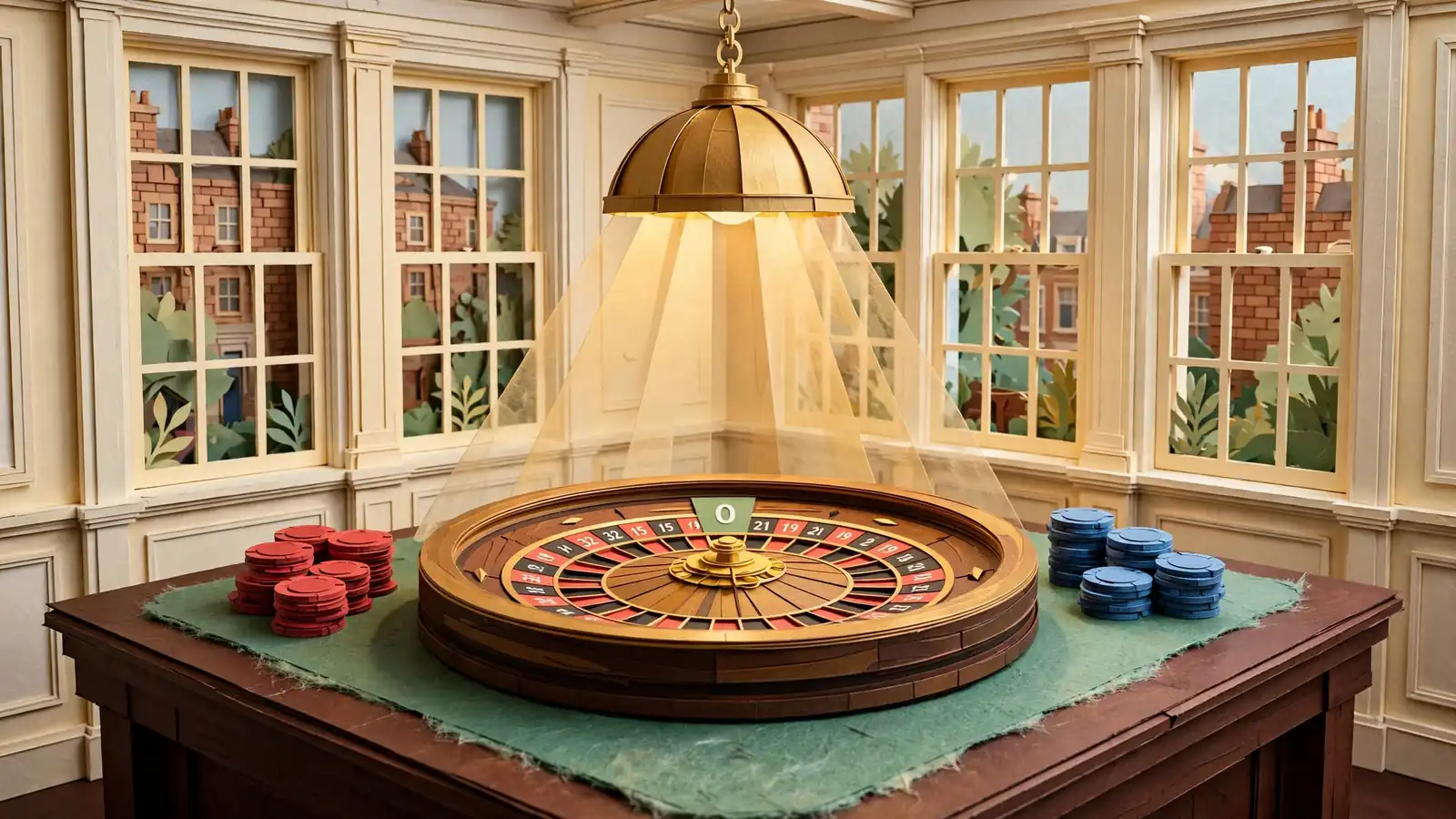
See how the single-zero wheel, betting areas and play formats affect the way European roulette works.
What Makes European Roulette a Single-Zero Game
European roulette is built around a wheel with 37 pockets. Thirty-six carry the numbers 1 to 36; the remaining pocket is green and marked zero. That solitary green interruption is the game’s defining detail. Everything else follows from it: the way the wheel is calculated, the price of the casino’s advantage and the distinction between European and American roulette.
The numbered pockets are not arranged in numerical order. The wheel uses a fixed sequence in which red and black pockets alternate as far as the layout permits, while the zero sits apart from both colours. A ball released around the rim eventually falls into one pocket, but no pocket becomes more likely because it has been quiet for several spins. The wheel has no memory, however much human spectators try to lend it one.
The phrase “single-zero game” is therefore literal, not decorative. There is one green zero and no second green pocket. On a standard European wheel, the possible results are:
- the numbers from 1 through 36;
- one zero.
That makes 37 possible pockets in total. The number of numbered pockets is 36, while the complete wheel contains one additional outcome that belongs to neither red nor black. This is the answer to the practical question of how many numbers and pockets a European wheel has: 36 numbered positions, 37 pockets altogether.
Why one zero matters
Roulette bets are commonly described by their potential return, but the wheel’s structure determines the less visible part of the bargain: the casino advantage. A winning wager is paid according to a set schedule, while the zero creates an outcome that defeats many bets covering the ordinary numbers or colours. Because the game has 37 possible results but payouts are based on a 36-number field, the operator retains a mathematical edge.
For European roulette, that house edge is 2.70%. It is not a prediction about the next spin and not a statement that a particular session must end in loss. It is the long-run cost built into the relationship between the wheel and its payouts. Short sequences can move in either direction; the underlying arithmetic does not change.
This is why the single zero matters more than its small visual presence suggests. It occupies only one pocket, yet it separates a fair division of the numbered field from the casino’s advantage. The green space is modest on the felt and consequential in the calculation.
European and American wheels
American roulette adds another green pocket: double zero. Its wheel has 38 pockets, consisting of numbers 1 to 36, zero and double zero. The extra space increases the number of possible outcomes without producing a corresponding improvement in the standard payouts. In the broadest mechanical sense, the difference between European and American roulette is one additional pocket. In financial terms, that pocket makes the American version more expensive for the player.
Casino Games: Slots, Live Tables and More
The European wheel’s single zero gives it a house edge of 2.70%, compared with 5.26% for American roulette. The figures describe the same basic tension in two forms: fewer green pockets leave less room for the casino’s mathematical advantage, while an added zero widens it.
The distinction can be easy to miss when both games display familiar red and black numbers. A digital lobby may place the variants close together, and a live studio may make both appear equally ceremonial: polished wheel, white ball, brief pause, result. Yet the extra green pocket changes the probability model before the first bet is placed.
That is the quiet history of roulette’s design. The game looks like a contest between colours and numbers, but the casino’s strongest architectural feature is the outcome that belongs to neither. European roulette keeps that feature to one zero. Its comparative appeal begins there, with a wheel whose entire argument is contained in 37 pockets.
Recommended online casinos
- BeOnBetBonus: 100% up to €500 + 100 FS · Payout speed: 1-3 business days
- NightWinBonus: £900 + 400 free spins · Payout speed: 1-3 business days
- ZombillionBonus: Welcome Pack 250% up to £4000 + 200 FS · Payout speed: 1-3 business days
- BritsinoBonus: Welcome Package – Get your £2,200 + 2,000 FS · Payout speed: 1-3 business days
- DieselwinBonus: Welcome Pack 250% up to £4000 + 200 FS · Payout speed: 1-3 business days
- Revery PlayBonus: 100% up to€1,000+ 100 FS · Payout speed: 1-3 business days
- x3betBonus: Welcome Pack 100% Up to £1.000 + 200 Free Spins · Payout speed: 1-3 business days
The Roulette Table: Numbers, Colours and Betting Areas
A European roulette table is a diagram of the wheel translated into felt, lines and small betting spaces. The wheel presents the numbered pockets in a circular sequence; the table lays those same numbers out in a rectangle that can be read at a glance. One is built for motion, the other for choice.
The defining feature is the green zero. A European wheel has 37 pockets in all: numbers 1 to 36 and one zero. On the table, that zero sits apart from the numbered field, normally in its own green box. The numbers themselves are arranged in three vertical columns, with the rows running across the layout. This arrangement is not a second version of the wheel’s order. It is a practical map, designed to gather several kinds of wager around the numbers.
Wheel pockets 37
House edge 2.70%
Winning payouts (Straight-up) 35:1
Reading the numbered field
The central section contains the numbers from 1 to 36. Each number occupies a separate square, and the squares are coloured red or black in the familiar alternating pattern. The colour is not decoration. It allows the numbered field to be read in two ways at once: as individual pockets and as groups sharing a visual characteristic.
The layout is usually wider than it is tall. Three columns run from the low end of the sequence towards the high end, while twelve rows cross them. The zero is outside this rectangular block, marked in green so that it cannot be mistaken for either colour. It is the table’s small interruption, and the feature that keeps the single-zero wheel visibly different from a table without a green pocket.
A number’s position on the cloth therefore has two meanings. Its square identifies the exact number, while its column and row connect it with neighbouring numbers. The wheel has no rows or columns; those categories belong to the table. They are ways of organising the circular set for human eyes.
This matters particularly in a digital casino. An online table may reproduce the traditional green cloth, or it may use a cleaner interface of buttons and panels. Either way, the useful question is whether the numbered field remains legible: single numbers should be distinguishable, the zero should remain green, and the grouped areas should be clearly separated from the number squares. A polished animation cannot repair a confusing layout.
Colours and the green exception
Red and black create the table’s most immediately recognisable division. The red numbers are scattered among the black ones rather than placed in separate blocks, echoing the distribution on the physical wheel. The pattern gives the eye a quick visual signal, but it does not turn colour into a forecast. The cloth records the wheel’s design; it does not make the next pocket more visible to chance.
Online Casino Games for Real Cash in the UK
Green is reserved for zero. On a European roulette table, this single green space is not part of the red or black field. Its position outside the main block makes the structure plain: thirty-six numbered pockets share the two colours, while one pocket stands apart.
The wheel beside a live European roulette casino table makes the same distinction in a different form. Its pockets circle around the rim, with the zero visibly green and the numbered pockets alternating between red and black. The cloth is therefore a flattened, rearranged representation of the physical wheel. Looking from one to the other reveals why the table contains both isolated numbers and broad groupings.
The surrounding betting areas
Around the numbered field are larger marked sections. These are the outside areas, covering groups defined by colour, parity or numerical range. Their labels vary slightly in typography and language between operators, but their purpose is stable: they provide a quick way to select a category rather than a single numbered square.
The table may also show areas linked to the three columns and to horizontal rows of three numbers. These markings sit at the edges of, or alongside, the numbered grid. They are not extra pockets. They are visual boundaries drawn over the same thirty-six-number field, allowing the arrangement to be read in larger units.
Inside the grid, the lines between squares have their own importance. A chip placed within one square belongs to that number. A chip placed across a dividing line relates to the adjacent numbers on either side. At a corner where several squares meet, the marking refers to the group gathered around that point. The cloth’s geometry does much of the explaining before any text appears.
That geometry is why a European roulette casino table can look complicated without being disorderly. The central grid answers “which number?” The surrounding bands answer “which group?” The green zero answers “what sits outside both?” Once those layers are separated, the layout becomes a compact vocabulary rather than a wall of markings.
Live Casino Lightning Roulette in the UK: How It Works
The table as a map, not a prediction
A European roulette wheel with 37 pockets is circular, symmetrical in appearance and indifferent to the arrangement printed on the cloth. The table is linear because people need to place chips, compare spaces and see the boundaries of their selections. It is a map made for hands and eyes, not a diagram of probability.
That distinction also places so-called European roulette strategy in its proper setting. A strategy may organise selections or money, but the table layout itself contains no hidden route through the wheel. Red does not become more persuasive because it is surrounded by black; a column does not acquire momentum because the previous result appeared elsewhere. The marks describe categories. They do not command outcomes.
For online play, the best layout is consequently the one that preserves these relationships without visual clutter: a distinct green zero, readable numbers, visible red and black squares, and clearly bounded outside areas. The physical table has felt and polished wood; the digital version has pixels and animation. The map remains the important part.
Single-Zero Bets, Payouts and the Cost of a Losing Streak
The European roulette table offers two broad families of decisions: inside bets, placed on particular numbers or compact groups of numbers, and outside bets, spread across larger sections of the layout. The distinction is practical rather than ceremonial. Inside bets pursue a smaller target and offer a larger payout when successful; outside bets cover more possible results but return less.
That balance is the grammar of roulette. A bet cannot become safer and more lucrative at the same time merely because it has acquired a confident name.
European roulette inside bets
Inside bets sit on, or immediately around, the numbered area of a European single-zero table. They are the choices associated with individual numbers and neighbouring clusters. The most concentrated is the straight-up bet: one selected number, with the single zero remaining part of the wheel’s possible outcomes.
Straight-up
One selected number.
Split
Two adjacent numbers.
Street
Three numbers in a horizontal row.
A winning straight-up bet pays 35:1. The same payout applies to a single-number bet on American roulette; the difference between the variants lies in the wheel and its probabilities, not in this stated return. A successful wager therefore produces the original stake back along with the 35:1 winnings, subject to the table’s rules for presenting returns.
A split bet joins two adjacent numbers. Its payout is 17:1, lower than the straight-up return because the wager covers a larger target. On the table, its position reflects that relationship: the chip is placed across the boundary shared by the two numbers. It is a small piece of geography carrying a particular mathematical bargain.
A street bet covers a horizontal row of three numbers and pays 11:1. It sits at the edge of the relevant row, linking the three-number line to the wider betting area. The pattern is easy to read:
| Bet | Numbers covered | Payout |
|---|---|---|
| Straight-up | One | 35:1 |
| Split | Two adjacent numbers | 17:1 |
| Street | Three numbers in a horizontal row | 11:1 |
These are not different ways of predicting the same event. They are different ways of distributing a stake across the numbered field. A straight-up wager leaves almost everything outside its target; a street bet accepts a wider possibility in exchange for a smaller return. The single-zero wheel supplies the same random result whichever arrangement is chosen.
This is why a European roulette single-zero table layout matters beyond its appearance. The lines and spaces turn abstract probability into a physical set of choices. A chip on one number is a narrow claim. A chip straddling two numbers is a broader claim. A chip on a row broadens it again. The table makes the categories visible before the ball settles anywhere.
European roulette outside bets
Outside bets move away from individual numbers and cover broad characteristics of the numbered results. Red or black, even or odd, and high or low are the familiar examples. Each pays 1:1 when successful.
Red and black divide the numbered pockets by colour. Even and odd divide eligible numbered results by parity. High and low divide the numbered field into two ranges. The zero is the awkward guest in every one of these arrangements: it is neither red nor black, neither even nor odd, and neither high nor low. A wager based on one of those pairs does not win when the ball lands on zero.
The lower payout can make outside bets look like a calmer form of play. They produce more frequent-looking successes than a straight-up bet because the chosen category contains many numbers. Yet frequency is not the same as certainty. The zero remains outside the paired categories, and each spin begins without memory of the previous one.
Online Casino Tournaments in the UK: Rules and Prizes
That last point matters when people speak of a “safe” colour or a “due” parity. The table does not remember that black has appeared repeatedly. The European roulette single-zero wheel has no mechanism for correcting an untidy sequence. A long run of one result does not make its opposite more likely on the next spin.
Outside bets also illustrate how the house advantage survives the attractive simplicity of a 1:1 return. A winning bet doubles the stake in total, but a zero result removes the wager under the ordinary arrangement. The return is therefore not a promise that the chosen half of the table will prevail over time. It is simply the specified payment for a winning outcome.
Choosing among the betting options
The question of how to play European roulette is often reduced to a choice between excitement and restraint. In reality, the choice is between different distributions of risk. Inside bets concentrate the stake and make a successful result more rewarding. Outside bets spread the target and make the payout correspondingly smaller. Neither arrangement changes the underlying fact that the wheel decides the result.
A player may combine several bets, perhaps placing a straight-up chip beside an outside wager. That creates a more complicated position, not a more predictive one. The combined wagers can win or lose in different patterns, and the total result depends on the single number selected by the ball. More chips can make the table look strategic. Chance remains unimpressed.
Martingale Risk
A losing streak can damage a bankroll before a win appears, as each doubling makes the next loss more expensive.
This is also where the phrase “European roulette payouts” needs careful handling. A payout table describes what happens after a winning bet; it does not describe how often that bet will win, nor does it erase the house edge. The 35:1 straight-up payment, the 17:1 split return, the 11:1 street return and the 1:1 outside return are fixed features of the wagers listed here. They are not forecasts.
The same distinction applies when roulette is played online, whether in a free demonstration mode or for money. The interface may make betting areas easier to select, and a digital display may show the chosen wagers with unusual neatness. Those conveniences do not turn a past sequence into evidence about the next spin. A free game removes the financial stake, not the randomness.
The attraction of doubling after losses
The Martingale system offers one of gambling’s most persistent stories. After every loss, the next bet is doubled, with the hope that one eventual win will recover the earlier losses and leave a profit equal to the initial stake. On an outside bet, where the stated return is 1:1, the arithmetic has an immediate surface appeal: a winning double-sized wager appears capable of covering the accumulated losses.
The system’s weakness is not hidden in the arithmetic. It is hidden in the assumption that the next result will arrive in time, at a workable stake, and under conditions that permit the progression to continue. A losing streak can damage a bankroll before the hoped-for win appears. Each doubling makes the next loss more expensive than the last, while the wheel continues to produce outcomes by chance rather than by obligation.
French Roulette Online Casinos in the UK
The method also confuses recovery with prediction. It does not make red more likely after black, or even more likely after odd. It changes the amount exposed to the next spin, not the odds governing that spin. A sequence of losses is unpleasant, but it is not evidence that a win has become mathematically due.
There is a dry little paradox at the centre of Martingale thinking: the strategy treats randomness as though it were keeping accounts. The wheel keeps none.
No roulette strategy can predict the final outcome. The European roulette house edge remains part of the game’s structure, and bet selection cannot make chance disclose its next decision. Inside and outside wagers are legitimate ways to arrange a stake; doubling is a way to alter its size after an adverse result. Neither transforms uncertainty into knowledge.
RNG, Live Dealer and Speed Roulette: Three Ways to Play
European roulette online can feel like three different games, although the wheel’s mathematics remains unchanged. The difference lies in how each spin reaches the screen: software can generate it, a camera can show it, or a faster studio format can compress the pauses between decisions.
RNG roulette
RNG roulette uses a random number generator to produce simulated spins. There is no physical wheel and no dealer’s hand; the result is created by software and displayed immediately. That makes the format well suited to players who value pace over ceremony. A new round can begin quickly, and minimum stakes may be lower than at a streamed table, sometimes starting at 10p.
RNG Roulette
In this format, a random number generator produces simulated spins, offering a faster pace without a physical wheel or dealer.
The experience is spare. There is no studio, no ball circling the track and no small theatre of the dealer announcing the result. In return, the interface tends to be direct: wager, spin, result. It is roulette reduced to its mechanism.
Live dealer roulette
A live dealer table restores the physical scene. A real wheel is filmed in a studio, a human dealer places the ball, and the drop is streamed to the online casino. The attraction is not a change in probability but the visible sequence of actions. The wheel exists somewhere beyond the screen, which gives the game a social and ceremonial quality that software cannot quite imitate.
This is the format behind searches for a live European roulette casino or an online casino with a European live dealer. The important distinction is delivery: the table is physical, while participation remains remote. The pace is consequently shaped by dealing, ball placement and the studio’s rhythm rather than by an instant software command.
Speed roulette
Speed roulette pushes the same studio idea towards efficiency. A specialist review records that this format can exceed 150 spins an hour, while a standard table is put at 80–100 spins an hour. The figures describe tempo, not an improved chance of winning. More rounds simply expose a bankroll to more outcomes in less time.
Live Dream Catcher Casino UK: Game Guide
That acceleration changes the mood. A conventional live table leaves room for conversation and observation; speed roulette treats the interval between results as an inconvenience to be removed. RNG play is faster still, while live dealer roulette offers the most visible connection to a real table.
Three delivery methods, then, and no fourth kind of luck.
Demo Roulette and Branded Variants
A roulette search can lead to several different kinds of product, and the word roulette does not settle the matter. A conventional online table represents a wheel, a ball and a sequence of wagers. A demo version reproduces the play without real-money stakes. A roulette-themed slot belongs to a different family altogether, even when its title borrows the name of the European game.
What demo roulette actually changes
European roulette demo play is a practice mode for an RNG game or another digital roulette presentation. The software simulates spins rather than operating a physical wheel, so the display may resemble a casino table while the underlying product remains electronic. No real-money result is created in the demo, and any balance shown on screen is part of the demonstration rather than withdrawable funds.
Online Casino Without ID UK: Checks and Licensing
That distinction matters because a demo can show the order of play, the betting interface and the movement of a simulated ball without reproducing the financial conditions of paid gambling. RNG roulette is designed for quick digital play and can have low entry stakes, sometimes as low as 10p when offered for real money. Demo mode, however, is not a cheaper deposit option. It is a different state of the game.
The phrase “European roulette slot demo” can therefore describe a slot-style product presented for free play, not necessarily a virtual table with the standard roulette experience. The label is descriptive only; the rules, symbols, winning combinations and presentation must be checked in the game information.
When roulette becomes a slot
Titles built around ideas such as three-dimensional European roulette, European Roulette Gold or European Roulette Platinum may sound like versions of the table game. A title alone cannot establish that they use a wheel, standard roulette bets or the familiar sequence of number outcomes. If the product is classified as a slot, its play is governed by slot mechanics, with reels or other game-specific features taking the place of a roulette table.
That is not a minor editorial distinction. A branded name can preserve the atmosphere of roulette while changing the mathematical structure completely. The word European may be part of the theme rather than a guarantee of a single-zero wheel.
The clean division is simple: demo roulette is a non-cash mode; RNG roulette is a simulated table; a roulette-themed slot is a slot, whatever its title suggests. Marketing enjoys blurred borders. The rules do not.
European or American Roulette: One Extra Zero, a Different Edge
The choice between European and American roulette is not decorative. It changes the wheel’s arithmetic before any chip reaches the layout.
European roulette has 37 pockets: numbers 1 to 36 and one zero. American roulette adds a second green pocket, marked 00, bringing the total to 38. That extra space does not create another ordinary number to back. It is an additional losing position for most standard wagers, and the effect belongs to every spin, whether the game is found at a physical table or in an online European roulette casino game.
Online Bingo UK: Rooms, Slots and Cash Play
The difference appears most clearly in the house edge. European roulette carries an edge of 2.70%, while American roulette stands at 5.26%. The figures are not predictions about the next result; they describe the mathematical advantage built into the wheel over a large number of wagers. A red result can still follow a long run of black, and a chosen number can still arrive immediately. Chance has no memory, but the extra green pocket never takes a day off.
American roulette also includes the basket bet, covering 0, 00, 1, 2 and 3. Its house edge is 7.89%, higher than the general American roulette figure. The wager’s name sounds almost domestic; its mathematics is less welcoming.
Some UK online casinos offer an American-style wheel with a third green pocket labelled 000. This is not a standard feature to assume across the market: it has been reported in a specialist affiliate review. Where that version appears, the stated house edge is 7.69%. The table therefore deserves closer attention than its thumbnail image suggests.
For a European roulette casino game, the single-zero design is the less costly of these two standard choices. The distinction remains the same in an online European roulette casino game: software can change the presentation and pace, but it does not erase the consequence of adding another green pocket.
Online Slot Payout Percentages: What They Mean
Casino Choice Begins with the Licence, Not the Lobby
A polished lobby is not evidence of legitimacy. For real-money European roulette casinos serving Great Britain, the decisive question is whether the operator holds the right licence from the UK Gambling Commission (UKGC). The Commission is the sole regulator of online casino activity in Great Britain, and its authority follows the market being served rather than the country in which a company happens to be based.
That distinction matters. An offshore business may display a foreign licence, use familiar payment branding or stream roulette from an impressive studio, yet remain outside the UKGC system. Such a platform cannot legally offer real-money live roulette to British residents. A foreign address is not a substitute for British authorisation.
What a UKGC licence changes
A UKGC licence is more than a badge placed in a website footer. It places the operator inside a framework covering customer protection, financial controls, complaints and responsible gambling. The licence number should be checked on the Commission’s public register before any deposit is made; a logo alone proves very little.
Verification Steps
- Confirm the operator on the UKGC public register
- Check that the licence covers remote gambling
- Verify the age-check process
- Locate deposit and loss controls
- Find self-exclusion information
For online casinos with European roulette, that check establishes whether the business is authorised to provide gambling services to the British market. It also separates a regulated operator from a site that merely accepts British traffic. The latter may be easy to reach, but accessibility does not create legal permission.
The Gambling Act 2005 provides the wider legal framework for gambling in England, Wales and Scotland. Northern Ireland is outside that Act’s scope, while the UKGC’s regulatory role concerns Great Britain. Within that regulated market, operators offering real-money casino games must hold the relevant remote gambling permission.
The principle is plain, if not especially glamorous: licence first, interface later.
Age verification comes before the first deposit
A legitimate operator must establish a customer’s age before allowing money to be deposited into a gambling account. This is not an optional tick box hidden among marketing preferences. It is a condition of access.
Online gambling in the UK is legal for people aged 18 and over when the operator holds a UKGC licence. Age checks therefore serve two purposes: they keep gambling away from children and confirm that the account belongs within the lawful customer base. A site that appears to let an unverified account fund play has raised a regulatory question before the first roulette spin takes place.
Limits are part of the account, not an afterthought
UKGC-licensed live casino operators must provide practical controls over gambling activity. New customers must be prompted to set a financial limit before making a first deposit, and account-level controls must remain accessible afterwards.
The required protection is broader than a single deposit cap. Licensed operators must offer:
- deposit limits;
- loss limits;
- session-time reminders;
- reality checks;
- cool-off periods; and
- GamStop self-exclusion.
These tools address different moments in a gambling session. A deposit limit concerns money entering the account; a loss limit concerns the result of play. Session reminders and reality checks interrupt the strange compression of time that digital gambling can produce, while a cool-off period creates distance without necessarily closing the account permanently. GamStop self-exclusion is the more decisive barrier, allowing a person to exclude themselves across participating gambling services rather than relying on one casino’s settings.
Responsible gambling tools are therefore not decorative features attached to the bottom of a roulette page. They are part of what regulated operation means.
The complaint route matters too
A UKGC licensee must maintain an internal complaints process and provide access to an approved Alternative Dispute Resolution service. That gives customers a defined route when an account, payment or game-related dispute cannot be settled directly with the operator.
The arrangement does not promise that every complaint will end in the customer’s favour. It does mean that a regulated casino cannot simply replace accountability with silence or a disappearing support window. The operator also has obligations connected with the Research, Education and Treatment levy, which supports work addressing gambling-related harm.
For anyone comparing European roulette casinos in 2026, this is the useful order of inspection:
- Confirm the operator on the UKGC public register.
- Check that the licence covers the relevant remote gambling activity.
- Verify the age-check process before depositing.
- Locate deposit, loss, session, reality-check and cool-off controls.
- Find the self-exclusion information, including GamStop.
- Read the complaints and ADR procedure.
Only after those checks do table design, VIP labels or a larger roulette lobby become relevant. A European roulette table can be perfectly recognisable and still sit inside an unlawful offering. Regulation is less theatrical than the game, which is precisely why it deserves attention first.
Reading Casino Roulette Offers Without Mistaking Them for Free Money
A roulette promotion is not simply a balance waiting to be withdrawn. It is an arrangement between bonus funds, eligible games, game weighting and wagering conditions. The attractive number sits at the entrance; the conditions decide how much of it can actually travel.
For European roulette, the important detail is usually its contribution to the wagering requirement. Across many UK operators, roulette stakes are counted at between 10% and 20% of the required wagering. A £1 qualifying stake therefore does not necessarily reduce the requirement by £1. It may count as only the relevant fraction, depending on the operator’s terms. The distinction is easy to miss and expensive to misunderstand.
Wagering Requirements
Attention Roulette stakes may only count towards wagering requirements at a fraction of the total, typically between 10% and 20%.
Live tables and RNG games may be treated differently
The same wheel design can receive different treatment according to how the game is delivered. Live roulette may attract game weighting of 10% or 20%, while RNG roulette can be assigned 100% weighting. This is why a casino that appears generous about roulette may still make a difference between a streamed table and a computer-generated game.
The wording matters. “Roulette included” does not establish that every roulette title qualifies, nor does it say that every stake carries the same contribution. A live European table, an auto-roulette product and a roulette-themed slot can sit under separate rules. The label is not the contract.
No-deposit promotions can be narrower still. Some UK operators leave live roulette outside the wagering calculation altogether. Where it is included, an operator may apply a contribution rate from 0% to 10%. This range is reported in a specialist review, and it should not be mistaken for a universal rule. Promotional pages change; the terms attached to a particular offer govern that offer.
That also explains the awkwardness around phrases such as “free European roulette”. A demo game can provide spins without real-money stakes, but it does not create bonus funds or satisfy a wagering requirement. A promotional balance may be called a bonus, yet still be restricted by eligible games, maximum stake conditions, expiry provisions or withdrawal requirements. Free, in casino language, is often a word with paperwork behind it.
What to check before choosing a roulette offer
A useful comparison of UK European roulette casinos begins with the promotion’s mechanics rather than its headline. The following points determine whether roulette is relevant to the offer:
- whether live roulette is eligible at all;
- whether RNG roulette is treated separately;
- the game weighting applied to each format;
- whether the offer is a deposit promotion or a no-deposit promotion;
- which bets or roulette titles are excluded;
- how bonus funds and cash funds are used;
- the wagering requirement and any maximum-bet condition;
- the time limit and withdrawal restrictions stated in the terms.
The 2026 position gives the headline requirement a firm boundary. From January 2026, licensed operators in the UK cannot set bonus wagering above 10 times the applicable bonus or deposit basis. That ceiling does not make every offer equally generous: game weighting, exclusions and other conditions still determine the practical burden. A lower multiplier with poor roulette weighting may be less useful than it first appears.
The search for the “best” European roulette casino therefore has no answer independent of the promotion being considered. One operator may give RNG roulette full weighting and live roulette a smaller share; another may exclude live play from a no-deposit offer. The sensible comparison is between complete terms, not between decorative banners.
RTP information should also be accessible when a UK-licensed operator presents roulette for real-money play. It belongs beside the game information, while bonus terms belong in the promotion’s conditions. Mixing the two only makes the offer harder to read.
A casino offer is not free money. It is a set of accounting rules with a green baize motif.
Should I play American or European roulette if I’m in the UK?
European roulette generally offers better odds: its house edge is 2.70%, compared with 5.26% for standard American roulette. Some American tables include a third green pocket marked 000, raising the house edge to 7.69%.
What are inside and outside roulette wagers?
Inside bets are placed on specific numbers or small groups of numbers, such as a straight-up bet or a split bet. Outside bets cover broader categories, such as red or black, even or odd, and high or low.
Is Lightning Roulette rigged?
No roulette strategy can predict the result: each spin is determined by chance. A straight-up bet without a lightning multiplier pays 29:1 in Lightning Roulette, while outside bets keep standard roulette payouts.