
Live Roulette UK with English-Speaking Dealers
 Available in GB
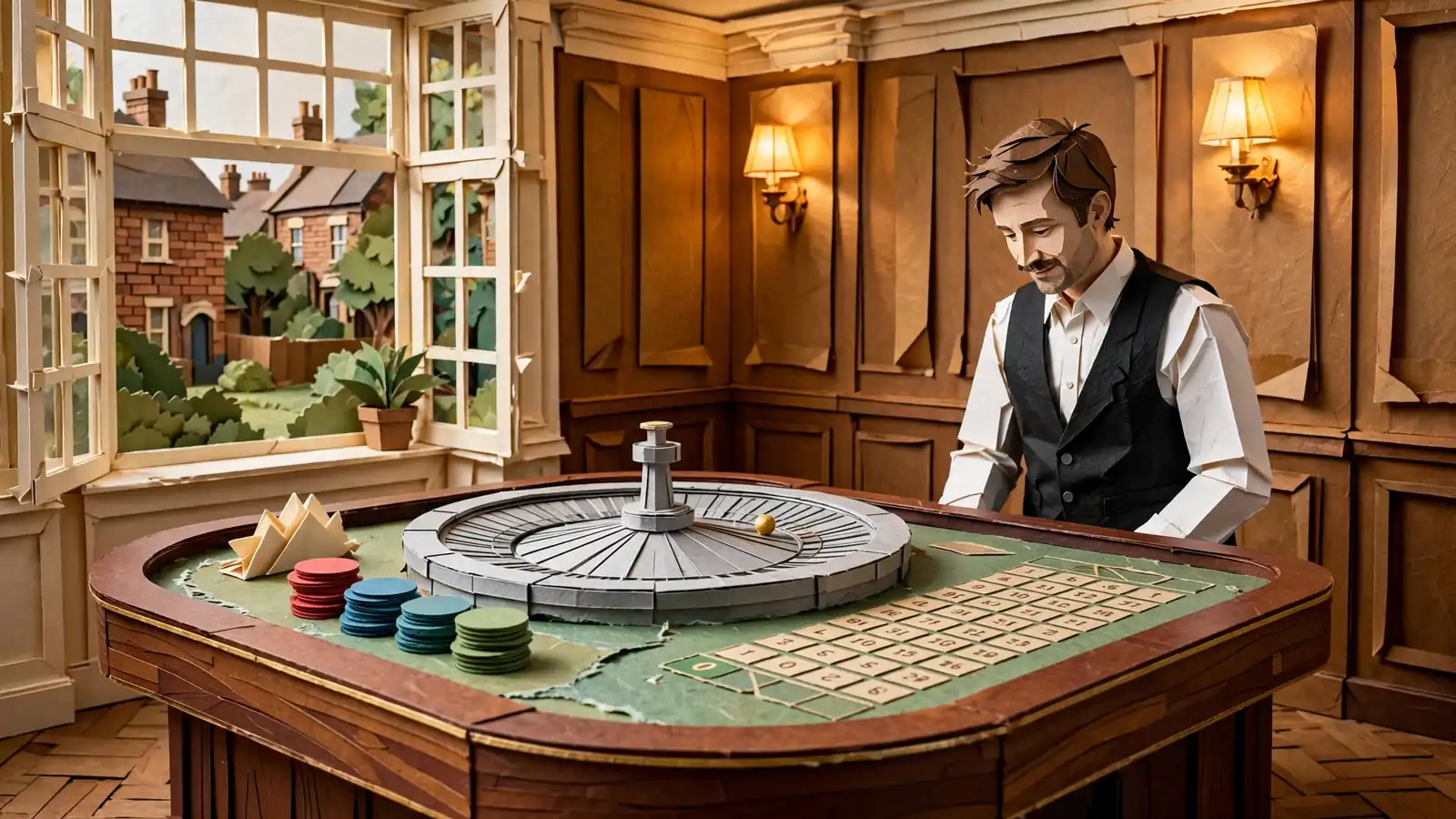
See how real dealers, streamed tables and betting controls shape the online roulette experience, from finding a game to understanding its pace.
What Makes a Roulette Table Live
A live roulette table is not merely a digital wheel dressed up with animation. It is a real table filmed in a studio or casino, with a human dealer operating the wheel and announcing each stage of the round. The video feed carries the scene to the online casino, while an interface places the betting layout, balance and table controls beside it. The result sits between television and participation: the physical action is elsewhere, but the wager is made through the screen.
That distinction matters. A computer-generated roulette game can reproduce the appearance of a wheel, yet a live table has a visible person, a tangible wheel and a sequence of spoken announcements. The dealer introduces the round, indicates when wagering opens, signals its closure and announces the result. The camera may show the wheel, the ball and the table from different angles, giving the game a social setting rather than the solitary feel of a conventional software game.
The dealer is therefore more than decoration. Their movements establish the rhythm of the table. Chips, wheel and ball are handled in view, and the spoken commentary helps mark transitions that might otherwise be reduced to buttons changing colour. A live roulette casino game depends on this combination of physical procedure and digital access. The stream provides the atmosphere; the interface provides the means to take part.
Spoken English has a practical importance in that arrangement. Clear announcements make it easier to follow when a round begins, when the wagering window closes and which result has been declared. It also helps with incidental interaction: a greeting, a clarification, or a short response from the dealer can make the table feel intelligible rather than like a silent broadcast with a betting panel attached.
Mines Casino Game UK: How the Grid and Randomness Work
For an English-speaking customer looking at roulette casino games in the UK, the language of the dealer is part of the table’s usability. A feed can be technically sharp and still feel oddly inaccessible if key information arrives in a language that is not understood. Captions or interface labels may repeat some details, but they do not necessarily convey the pace or emphasis of a spoken announcement. English is not a guarantee of a better outcome—chance remains stubbornly indifferent—but it can remove an unnecessary barrier between the table and the person watching it.
Live tables also create a small public scene. Several participants may appear to be sharing one wheel, even though each is connecting remotely. The dealer addresses the table as a group, while the platform displays individual wagers and results privately. This arrangement preserves a trace of the old casino ritual: people gathered around a common object, waiting for the same ball to settle.
The format has been part of the British online casino landscape for some time. Grosvenor first presented its live casino offering in 2013, alongside card and casino games such as Blackjack, Texas Hold’em and Roulette. That early mixture is revealing. Live roulette was not developed as an isolated digital curiosity; it emerged within a broader attempt to bring the atmosphere and personnel of table gaming onto the screen.
So “live” describes the source of the action, the presence of the dealer and the streamed table—not a special promise about results. The wheel is real. The uncertainty is too.
Recommended online casinos
- BeOnBetBonus: 100% up to €500 + 100 FS · Payout speed: 1-3 business days
- NightWinBonus: £900 + 400 free spins · Payout speed: 1-3 business days
- ZombillionBonus: Welcome Pack 250% up to £4000 + 200 FS · Payout speed: 1-3 business days
- BritsinoBonus: Welcome Package – Get your £2,200 + 2,000 FS · Payout speed: 1-3 business days
- DieselwinBonus: Welcome Pack 250% up to £4000 + 200 FS · Payout speed: 1-3 business days
- Revery PlayBonus: 100% up to€1,000+ 100 FS · Payout speed: 1-3 business days
- x3betBonus: Welcome Pack 100% Up to £1.000 + 200 Free Spins · Payout speed: 1-3 business days
UK Roulette Casinos and the Licence Behind the Screen
A roulette casino serving customers in Great Britain is not defined by its green baize, polished interface or choice of live tables. The decisive question sits behind the screen: does the operator hold the relevant licence from the UK Gambling Commission?
The Commission regulates commercial gambling in Great Britain and is the sole regulator for that activity. Its remit includes online casinos and remote gambling offered to consumers in Great Britain, even when the equipment running the service is located elsewhere. Geography, in other words, does not provide an escape hatch. An operator selling roulette to this market must meet the local licensing requirement.
Online Casino Without ID UK: Checks and Licensing
That makes the licence the first practical test of any online casino offering roulette. It is more useful than a glossy lobby, a parade of payment logos or a familiar name repeated across advertising.
How to check a roulette casino
The UK Gambling Commission maintains a public register of licensed businesses. Before making a deposit, the operator’s legal identity and licence number should be checked there. The details on the register should correspond with the casino presenting the account, rather than merely with a similarly named company.
This distinction matters because a casino brand may not be the same thing as the business legally responsible for the gambling service. The register is the place to establish who holds the operating licence and whether that licence covers the relevant remote activity. A badge on a website is only a claim until it matches the regulator’s record.
The address shown in the casino’s terms, the company name attached to the account and the licence information should form a coherent picture. A mismatch is not a minor design flaw. It is a reason to pause before funds are transferred.
The Commission also issues personal licences to individuals working in regulated gambling, alongside operating licences for businesses. For an ordinary player assessing roulette casinos UK services, the operating licence is the central check; the wider licensing structure explains why responsibility is attached both to the company and to people performing regulated roles.
What licensing means for deposits
A licence does not turn gambling into a harmless pastime, nor does it predict the result of a roulette wager. Its value is institutional: it places the operator within a regulatory system with rules about how a remote gambling service is run.
That system includes controls around money entering an account. UK-licensed casinos cannot accept credit cards for gambling. A wallet cannot be used where its balance is funded by a credit card for that purpose, and credit-card funding routed through a money service business is also excluded. These restrictions close several routes by which borrowed money might be presented as ordinary casino funds.
Online American Roulette in the UK: How It Works
Remote operators must also prompt new customers to set a financial limit before the first deposit and provide accessible account-level controls for changing limits. This is an important difference between a responsible gambling tool and a decorative statement in a footer. The control has to exist at account level, where it can affect future deposits and spending.
Age verification belongs to the same practical architecture. An operator must verify a customer’s age before allowing that person to deposit funds into a gambling account. The check is therefore a condition of access to real-money gambling, not a courtesy performed after play has begun.
Complaints are part of the licence
A casino’s complaints page deserves attention before money is deposited, although it is rarely the page placed most prominently in the lobby. UK Gambling Commission licensees must offer an internal complaints process and access to an approved Alternative Dispute Resolution service.
The first stage is the operator’s own process. If the matter is not resolved there, the availability of approved ADR provides an external route for eligible disputes. This does not promise that every complaint will end in the desired result. It does mean that the casino is not the only institution named in the dispute framework.
Terms should explain how a complaint is submitted and how the operator handles it. Vague assurances about customer care are weaker than a clearly identified procedure. The quiet pages matter.
Limits, self-exclusion and the human boundary
Licensed casinos must provide responsible gambling tools, including self-exclusion. They must also contribute to the Research, Education and Treatment levy, which supports work connected with gambling-related harm.
Self-exclusion is not the same as a temporary change of mood or a personal promise to stop after one more session. It is a formal restriction on access. GAMSTOP is the national self-exclusion programme for participating online gambling services in Great Britain, while an operator should also provide its own account-level self-exclusion arrangements.
DO
- Set a financial limit before your first deposit
- Use account-level self-exclusion tools
DON’T
- Use credit cards for gambling
- Rely on temporary mood changes for gambling control
Account limits and self-exclusion serve different purposes. A financial limit regulates the amount an account may be used for within the operator’s controls. Self-exclusion is a decision to prevent gambling access altogether for the selected period or arrangement. Neither tool changes the odds of roulette; both acknowledge that a casino is dealing with people, not just transactions.
The most reliable assessment of a Roulette casino UK operator is therefore unglamorous: locate the licence, match the legal details, inspect the deposit restrictions, find the limit controls and read the complaints route. Then check that self-exclusion is available before the account becomes emotionally or financially important.
Only gamble what can be afforded to lose. A licence supplies oversight, not a guarantee of profit or protection from every poor decision. That distinction is the whole point.
From Lobby to Live Table: Finding Roulette Online
An online casino normally treats roulette as a department rather than an isolated destination. The lobby may open on a general catalogue, with live casino, table games, jackpot games and slots arranged as separate rooms. The names vary between operators, but the underlying task is much the same: move from the broad casino menu to the area where streamed tables are collected.
Online European Roulette in the UK: Single-Zero Guide
A search field inside the casino can help when the lobby is crowded. Typing “roulette” may bring up both live tables and computer-operated versions, so the result still needs reading. A tile marked Live Roulette indicates a table hosted through a live-casino feed; a tile that mentions a studio, dealer or live table usually points in the same direction. A game labelled simply “roulette” may require closer inspection, because the word alone does not describe how the game is operated.
The distinction matters in a roulette online casino UK setting. A live table is commonly presented with a video window, a betting layout and information about the current table. The interface may show the dealer’s name, the table’s open or closed status, and the minimum and maximum stakes selected by the operator. A digital table, by contrast, may display an animated wheel or an automated draw without a person appearing on screen. Both belong to the wider roulette category, but they offer rather different kinds of company.
Moving through the lobby
The route to a live table is usually easier when the lobby is read as a set of filters. Common labels include:
- Live casino, for streamed games with dealers;
- Table games, where roulette may sit beside blackjack and other games;
- Roulette, which can combine live and automated formats;
- Favourites or recently played, where a previously opened table may reappear.
A casino online roulette section may also divide tables by language, studio, stake range or game format. These labels are practical rather than ceremonial. They allow a player to avoid opening every tile in search of an English-speaking dealer or a table suitable for the intended budget. The clearer the labels, the less the lobby resembles a brightly lit cupboard in which every drawer contains the same object with a different name.
On a mobile screen, some categories disappear behind a menu button or horizontal scrolling row. A desktop layout may show filters at the side, while a phone may place them above the game tiles. The table itself can then open in a separate window or within the casino page. Browser permissions for sound and video may affect the presentation, especially where spoken announcements are part of the live format.
The account status also changes what is visible. Some operators display the lobby before registration but restrict table access until an account has been opened. Others allow browsing while reserving play for logged-in customers. Registration does not remove the operator’s legal duties. Before deposits are permitted, the operator must verify that the customer is old enough to gamble. In Great Britain, online gambling is legal for adults aged 18 and over when the casino holds the required Gambling Commission licence.
Access is not the same as approval
Finding a table in a lobby says nothing, by itself, about whether the operator is authorised to serve British customers. Navigation is a product question; permission is a regulatory one. The two can sit beside each other on the same screen without being the same thing.
A polished roulette casino online can still demand a separate check of its operating details. The operator’s name, licence information and link to the Gambling Commission register should be identifiable before money is deposited. The public register is the relevant place for confirming the licence number, rather than a badge placed in a footer or an assurance written in promotional copy.
Online Casino Tournaments in the UK: Rules and Prizes
This distinction is especially useful when a brand appears in reviews or comparison pages. A specialist review reported that the public register dated 26 September 2026 did not show a LuckyPays entry under that brand or its stated domain, including luckypays.io. That is a time-specific register observation, not a permanent description of every site carrying a similar name. The register itself remains the proper reference point when an operator’s identity or authorisation is uncertain.
What the table page should reveal
Once a live roulette tile is opened, the table page should make the essential information legible before a wager is entered. The interface generally contains the wheel display, the betting area, the current round status and the available stake controls. Rules and table limits should be accessible from the same screen or from a clearly marked information panel.
The live feed may occupy most of the page, while the betting layout sits below it or beside it. On a smaller device, the layout can become a sequence of panels rather than a single view. That affects ease of following the round, but it does not change the operator’s obligations. Deposits, account controls and gambling tools remain account matters, not decorative features of the table.
A table can also show whether betting is open, closing or closed. This status is important because a live game moves according to the studio’s schedule, not according to the player’s preferred pause. The interface should make the transition visible and provide the relevant confirmation when a wager has been accepted.
If the chosen table is unavailable, the lobby may offer similar rooms from the same studio or another provider. That is a route back to browsing, not a reason to treat every substitute as equivalent. Dealer language, table limits, rules and the operator’s identity still belong to the particular table and casino being opened. Finding the room is only the beginning of knowing where one has arrived.
Roulette Tables, Dealers and the Games Around Them
A live roulette room is rarely devoted to roulette alone. Its atmosphere is borrowed from the wider casino: dealers speaking across felt, cameras following the action, cards being dealt at neighbouring tables, and a lobby arranged less like a single game than a hotel floor with the corridors removed. The wheel may be the centre of attention, but it belongs to a larger social theatre.
The dealer is the most visible person in that theatre. A good presentation depends on more than spinning the wheel or announcing a result. The dealer acknowledges the table, manages the rhythm of each round, answers routine questions and keeps the sequence intelligible for people watching through a screen. In a British-facing room, an English-speaking dealer makes those small exchanges less formal and less fragile. Announcements can be followed as they happen, rather than reconstructed from a display after the fact.
That human presence also separates a live table from a purely digital casino game. The dealer does not turn chance into skill, nor does conversation alter the mathematics. It does, however, give the game a public setting. There are other players, a shared pace and the faint feeling of occupying the same room, even when the room is a studio somewhere else.
More than one kind of table
A roulette casino site may place several table-game families beside its roulette rooms. Blackjack brings a different vocabulary and tempo, with the dealer working through cards rather than a wheel. Baccarat has its own ceremony and restrained pace. Poker tables, including versions of Texas Hold’em, shift attention towards the relationship between players as well as the dealer. The point is not that one game is superior. Each creates a different arrangement of people, pauses and visible decisions.
Live Blackjack Online Casino UK: How It Works
Providers shape this setting too. Names such as Evolution, NetEnt and Eyecon may appear in casino lobbies or game information, depending on the operator’s catalogue. They are not casinos and do not stand in for the operator; they are companies associated with producing or supplying games. That distinction matters because the polished studio, the dealer’s presentation and the account holding the customer’s funds may belong to different parts of the same commercial chain.
Grosvenor offers a useful British example of how this environment developed. In 2013, the operator first unveiled its live casino games, presenting a selection of card and casino games that included Blackjack, Texas Hold’em and Roulette. The launch placed live dealing within an established casino brand rather than treating it as a novelty detached from the traditional gambling floor. A familiar name, translated into cameras and streaming, was the commercial promise.
The result is a landscape in which a roulette table can feel both intimate and industrial. One dealer may be addressing a handful of players while the studio serves many tables at once. Lighting, camera angles, branded layouts and carefully timed announcements turn a working room into a performance space. The elegance is deliberate; so is the machinery behind it.
For anyone comparing live roulette casino sites in the UK, the surrounding games reveal something about the table’s character. A room with several live formats may feel busy and conversational, while a dedicated roulette area may appear quieter and more focused. Neither atmosphere proves quality. It simply shows that roulette online now belongs to a broader culture of mediated table games, where the dealer remains the human face of an otherwise highly engineered room.
Choosing a Table Without Pretending There Is a Top Ten
A “best” roulette casino is not a permanent title. A table that suits one person may be poor for another: the dealer’s language, the pace of the presentation, the clarity of the interface and the operator behind it all alter the experience. A sensible comparison therefore starts with the particular table, not with a theatrical ranking.
Dealer
Clear spoken English and understandable announcements
Table Information
Rules, limits and betting status plainly displayed
Operator
A named business and a licence number that can be checked
The dealer is part of the table
For a live roulette table aimed at people in Britain, spoken English is a practical feature rather than decorative hospitality. The dealer announces the progress of the round, responds to table activity and gives the game its human rhythm. Clear English makes those moments easier to follow, especially when several tables appear similar in the casino lobby.
The voice should be intelligible, but so should the surrounding presentation. A dealer who speaks English cannot compensate for an interface that hides the current wager, closes betting without a clear signal or makes the table’s limits difficult to find. Conversation is useful; readable information is essential.
What the table should make visible
Before choosing a table, several details deserve a quiet inspection:
- the minimum and maximum permitted wager;
- the available betting areas and the way selections are displayed;
- the rules applying to the table;
- the point at which betting closes;
- the treatment of a disconnected or interrupted round;
- the table’s currency and any relevant account conditions.
The point is not to hunt for a magical set of roulette numbers. Numbers on the wheel do not become more obedient because a casino gives the table a polished name. Nor does a “best odds” label establish an advantage that the published rules do not explain.
The maximum wager matters particularly to anyone searching for a casino with a high roulette ceiling. It should be treated as a table-specific condition, not as a badge of quality. A generous maximum may be irrelevant to a cautious player, while a clearly displayed lower limit can be more useful than an impressive headline. The same applies to a claimed roulette strategy: a casino can present betting options, but it cannot turn chance into a reliable method.
The operator must be identifiable
The table’s appearance is only half the comparison. Remote operators serving consumers in Great Britain are required to hold the relevant Gambling Commission licence. That makes the operator’s identity more important than a logo placed beside the game.
The name shown in the casino’s terms, account area or footer should correspond with the business listed on the UK Gambling Commission’s public register. The licence number should be checked there before depositing. A table may be streamed professionally and still be offered by an operator whose regulatory position has not been established. Glossy furniture on screen is not a licence.
A useful comparison record can be brief:
| Point to compare | What to look for |
|---|---|
| Dealer | Clear spoken English and understandable announcements |
| Table information | Rules, limits and betting status plainly displayed |
| Operator | A named business and a licence number that can be checked |
| Fit | Conditions suited to the intended style of play |
This framework avoids pretending that there is one best live roulette casino for everyone. It asks a less glamorous, more useful question: whether this table is understandable, suitable and attached to an operator whose permission to serve Great Britain can be verified.
Placing a Roulette Bet: Money, Pace and Limits
Entering a live roulette table is less mysterious than the surrounding casino language suggests. Once the table loads, the dealer, wheel and betting layout appear on screen, together with the controls for choosing a wager. The available playing funds are shown in the account balance, while the table displays its accepted stakes and the countdown to the next spin.
The basic sequence is straightforward:
- Select the chip value offered by the table.
- Place it on a number, colour, group or other marked area of the layout.
- Check the wager before betting closes.
- Wait while the dealer completes the spin.
- See the result and any return reflected in the table and account balance.
A spoken announcement may mark the end of betting, but the software also closes the betting phase. A late click is not a wager simply because the wheel has not yet stopped. Pace belongs to the table, not to impatience.
The amount chosen should remain money that can be lost without disturbing rent, bills or ordinary financial commitments. Gambling is entertainment with an uncertain cost, so only what can be afforded to lose belongs in a roulette balance. The warning is less glamorous than a bonus banner, and considerably more useful.
A live roulette table may also offer controls for setting or reviewing account limits. Great Britain’s remote-gambling rules require new customers to be prompted to establish a financial limit before making a first deposit, with account-level controls available afterwards. Those controls are not a prediction tool; they are a boundary around spending.
Roulette should not be confused with online slots when reading about stake regulation. A specialist review reports that the Great Britain slot cap is £5 per game cycle for adults aged 25 and over, while adults aged 18 to 24 face a £2 cap. The same review states that these slot limits do not extend to roulette or blackjack. In other words, a roulette table is not made safe by borrowing a rule designed for another product.
Placing a Bet
Step 1: Choose value
Select the chip value offered by the table.
Step 2: Place bet
Place it on a number, colour, group or other marked area of the layout.
Step 3: Confirm
Check the wager before betting closes.
Step 4: Result
Wait while the dealer completes the spin and see the result.
A wager can normally be removed or altered while the betting window remains open, subject to the table’s interface. After closure, the dealer’s spin determines the outcome; no later adjustment changes it. The result is recorded whether the chosen selection wins or loses, and the next round begins only when the table permits it. Live play has a rhythm: place, wait, resolve. Nothing in that rhythm turns chance into control.
Casino Bonuses and the Conditions That Matter
A roulette casino bonus can look generous while being largely irrelevant to roulette. The headline may describe a welcome offer, a deposit bonus or even a live-casino promotion, but the useful information sits in the conditions beneath it. A careful reading begins with eligibility: whether the offer is for new customers, existing account holders, selected games, a particular payment method or a limited campaign period. A promotion may also require an account to be verified before it can be claimed.
The phrase “no deposit” deserves the same scrutiny. A roulette casino no-deposit bonus may not require an initial cash deposit, yet it can still carry conditions about registration, identity checks, permitted games, withdrawal eligibility or the release of winnings. “No deposit” describes one part of the offer, not the whole arrangement. It is not a synonym for unrestricted play.
What the small print changes
Wagering conditions determine how promotional funds, and sometimes associated winnings, must be used before a withdrawal is permitted. The wording should make clear:
- which part of the offer is subject to wagering;
- whether roulette, live roulette or a named variant counts towards that requirement;
- whether different games contribute at different rates;
- whether a maximum promotional stake applies;
- when the offer expires;
- what happens if the customer withdraws before meeting the terms.
A casino Roulette bonus may therefore be unsuitable for someone interested only in a live table. Some promotions exclude table games altogether; others include them only under particular conditions. The same caution applies to a Lightning Roulette casino bonus: the name of the game does not establish that the promotion covers it.
Restrictions can also concern deposits. A deposit bonus might be attached only to the first qualifying payment, while a later payment does nothing. A customer may be limited to one offer, or prevented from combining promotions. Payment reversals, interrupted play and account closure can have their own clauses. Marketing copy is designed to be noticed. Conditions are designed to be read.
The operator should also explain how a promotion interacts with account controls. A bonus should never be treated as a reason to raise a financial limit or continue gambling beyond what can be afforded to lose. Remote operators must provide account-level limit controls and prompt new customers to set a financial limit before the first deposit. Those safeguards remain relevant whether the offer concerns roulette, slots or another casino game.
A sensible comparison of roulette casino bonus offers therefore starts with the full terms, not the advertised value. If the wording is unclear about eligibility, qualifying wagers, exclusions or withdrawal, the offer is unclear in the only place that matters.
Free Roulette: Practice Without a Cash Wager
Free-play roulette is the quietest way to inspect an online table before money enters the picture. A player can open a practice version, look over the felt, and become familiar with the controls without making a deposit or placing a cash wager. It is closer to a rehearsal room than to a casino account with the stakes temporarily removed.
The first useful lesson is visual. The table normally shows the wheel, the betting layout, chips or stake controls, the dealer’s video feed where a live format provides one, and a record of recent results. Free play allows these elements to be recognised at an unhurried pace. A player can see how an inside or outside selection is marked, where a wager is confirmed, and how the interface signals that betting has closed. None of this requires a financial decision.
A free roulette casino may also present different table designs. Conventional roulette, European-style tables and French roulette can have distinct layouts or rule displays. The important point is not to treat a familiar name as a complete explanation. The table’s own rules should be read before play, particularly where the interface describes payouts, available wagers or a house edge. “Free” removes the cash risk from the session; it does not turn every version into the same game.
The distinction matters in the United Kingdom. Practice mode is not a deposit, and it does not establish that an operator may accept real-money gambling from British customers. A free table can be useful for learning the software while leaving questions about the operator, account and cash play entirely separate. Age checks apply before an operator permits deposits, not as an invitation to regard a demo as a route around gambling safeguards.
Free play has firm limits. It cannot reproduce the feeling of risking personal money, and it cannot show whether a player would maintain sensible boundaries during a losing session. It also says nothing about future results: a run of simulated wins is merely a run of simulated wins. The roulette casino edge has not been defeated by practice, and no sequence on a free table predicts the next spin.
For that reason, free roulette is best treated as orientation, not training for guaranteed profit. If play moves from demonstration to gambling, only money affordable to lose should be used. The interface may be free. The consequences need not be.
Winning at Roulette: Chance, Not a Reliable Method
The phrase “winning at roulette” can mean two rather different things. It may describe a single successful wager, or it may suggest a repeatable method that turns play into dependable profit. The first is an ordinary possibility; the second is a claim that chance cannot support.
Roulette outcomes are uncertain. Previous spins do not instruct the wheel what to do next, and a run of one colour does not make the other colour due. Choosing red, black, an outside wager or a number changes the shape of the possible result, but it does not give the player control over it. A carefully selected wager remains a wager.
That distinction matters when systems are presented as the best way to win. Progression systems, in which the stake is altered after a loss or a win, can make a sequence look organised. They do not remove losing sequences, and they cannot guarantee that a session ends ahead. The same is true of claims about patterns, “due” numbers or special timing. A tidy explanation is not the same thing as a predictive advantage.
Online and electronic roulette do not turn uncertainty into a calculation that can be mastered. A screen may make the process feel more mechanical, while a live table adds a dealer and conversation, but neither format promises a winning method. The appearance changes; the essential risk does not.
A sensible approach is therefore narrower than the question of how to win every time. Gambling can be treated as paid entertainment, with a fixed amount set aside in advance and no attempt to recover losses by increasing the wager. Once that amount has gone, the session has reached its boundary. Only money that can be afforded to lose belongs in the calculation.
Licensed operators must provide account controls and responsible-gambling measures, including self-exclusion, but a tool cannot replace a personal limit. If roulette begins to feel like a way to repair finances rather than a discretionary pastime, support from GamCare, BeGambleAware or Gamblers Anonymous is more relevant than another betting system.
There is no reliable route to guaranteed profit at casino roulette. Chance remains in charge.
Lightning Roulette and Other Live Variants
Lightning Roulette belongs to the newer branch of live roulette: the familiar wheel and dealer remain, but the presentation adds a layer of game-show drama. It is still a live casino product rather than a slot, despite the occasional search for “Lightning Roulette slots”. That distinction matters. A slot is a separate digital game; a live roulette variant retains the table setting, the croupier and the visible wheel.
The word variant should not be mistaken for a promise of an improved outcome. It describes a version that differs from a conventional roulette table in its format, visual treatment or additional features. The name alone does not establish the rules, the available wagers or the way any special feature operates. Those details belong to the individual table’s information panel and should be read before money is placed.
A British casino may present Lightning Roulette among its live tables, sometimes alongside other recognisable products. The same lobby can contain conventional roulette, blackjack and game-show titles such as Crazy Time or Dream Catcher. They may share a dealer-led setting, but they are not interchangeable games. A branded variant is a particular product, not a general label for every lively-looking table.
There is also a quieter distinction between a live variant and a first-person roulette title. First-person games simulate the viewpoint and rhythm of a table without necessarily putting a real dealer at its centre. The screen may feel immediate; the underlying format is different. Naming does not settle that question either.
For any Lightning Roulette live casino table, the useful comparison is therefore modest: identify the product, open its rules, note what differs from the standard table and confirm that the operator is authorised for Great Britain. Novelty can decorate roulette. It cannot repeal chance.
Are online casino games licensed and regulated?
Yes. The UK Gambling Commission regulates online gambling in Great Britain, and remote operators serving its consumers must hold the relevant licence.
What are the online slot stake limits in Great Britain?
The limit is £5 per game cycle for adults aged 25 and over, and £2 for adults aged 18 to 24. These limits do not apply to roulette or blackjack.
Is LuckyPays licensed by the UK Gambling Commission?
The Gambling Commission register dated 26 September 2026 does not list LuckyPays or its stated domain, luckypays.io.
Can I play roulette at non-GamStop casinos from the UK?
A roulette operator serving customers in Great Britain must hold the relevant UK Gambling Commission licence.