
Monopoly Live Casino UK: How the Game Works
 Available in GB
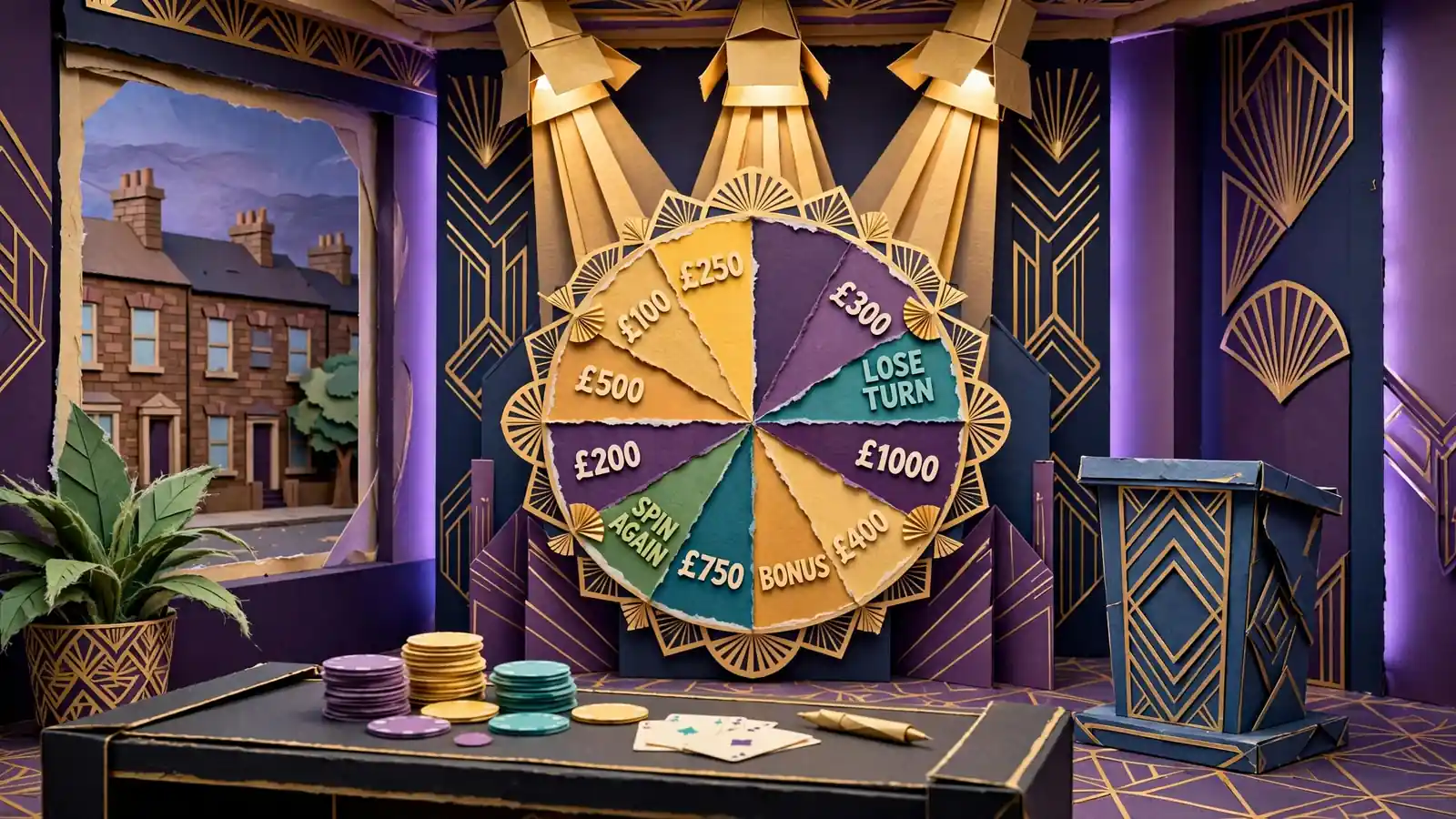
Monopoly Live turns a familiar board-game world into a studio-hosted casino broadcast, but the presentation does not make outcomes predictable.
Monopoly Live: A Board Game Turned into a Live Casino Show
Monopoly Live takes the visual language of a familiar board game and places it inside a studio-made casino production. The result is neither a digital board game in the domestic sense nor a conventional table. It is a live game-show format: a real presenter works in a broadcast studio, a physical wheel or other set equipment occupies the centre of the scene, and the online audience follows the action through a video stream.
That combination explains much of the title’s appeal. Monopoly is already a small theatre of property, chance and social ambition. Streets have names, fortunes rise and collapse, and the board turns wealth into something brightly coloured and legible. A live casino borrows that theatrical quality but removes the family gathering around the dining table. The room becomes a studio; the studio becomes a screen; the screen becomes a gambling venue.
The word “live” matters here. It describes the presentation and the presence of a human host, rather than suggesting that the game has become more predictable or more intimate. The presenter conducts the broadcast, keeps the pace moving and gives the round a sense of occasion. On-screen graphics carry the information that would otherwise be supplied by a physical table, while the camera turns an individual gambling action into part of a continuing programme.
This is the distinctive territory of a live casino. Instead of watching symbols resolve on an entirely automated interface, the customer sees a real environment being filmed. The format sits somewhere between television, a casino floor and an interactive software product. It is polished enough to resemble a game show, yet structured around casino play rather than entertainment alone. The familiar Monopoly imagery supplies the setting; the studio production supplies the atmosphere.
From board-game memory to casino format
The transformation is culturally revealing. Monopoly was designed around ownership, rent and the unequal distribution of opportunity. Its fiction is domestic and competitive at once: the board fits on a table, but its subject is the accumulation of property. In the casino version, that old fiction is not reproduced as a full property-management game. It becomes a visual vocabulary for chance, anticipation and prizes.
Casino Games: Slots, Live Tables and More
That distinction is important when considering Monopoly Live casino offerings in Britain. The title may evoke the boxed game, but the online product belongs to the live-gambling category. The name, graphics and presenter create recognition; the underlying experience is shaped by the conventions of a casino show. It should therefore be understood on its own terms, rather than judged as though it were simply a playable copy of the household board.
The format also explains why people who find ordinary casino interfaces cold may be drawn to live games. A static screen can make gambling feel like an administrative task: select an option, wait for a result, repeat. A live studio adds human movement, sound and pauses. None of that changes the essential nature of the activity, but it changes the way the activity is encountered. Casino design has always known that anticipation is part of the product. The camera merely makes the lesson visible.
The British setting
Monopoly Live appears within a British online gambling market that has made room for live casino broadcasting alongside other remote casino products. This market is not an unregulated digital frontier. Commercial gambling in Great Britain falls under the UK Gambling Commission, which is the country’s sole regulator for that sector. Its remit includes remote gambling offered to people in Great Britain even when the technical equipment running the service is located elsewhere.
Best Low Volatility Slots UK: How They Work
That arrangement reflects a distinctly modern problem of jurisdiction. A customer may see a presenter in a studio, access the game through a website and interact with software hosted across borders. The physical location of the machines does not decide whether British regulatory obligations apply. What matters is the service being offered to consumers in Great Britain.
The Gambling Commission grants operating licences to gambling businesses and personal licences to people whose roles require individual authorisation. In practical terms, the system distinguishes the company providing the gambling service from the people responsible for carrying out regulated functions. The distinction is easily missed when the customer sees only a brand, a login screen and a video feed. Behind that polished surface sits a licensing structure.
This is why “online casinos with Monopoly Live” should not be treated as a single undifferentiated category. The game is a product, while the casino site is the operator’s service around it. The studio production may look the same from one screen to another, but the legal and operational setting belongs to the business offering access. The title does not, by itself, establish anything about the organisation hosting it.
The Monopoly Live experience consists of a studio production provided by a game provider, hosted on a separate website operated by a gambling business.
A show, not a promise
The live presentation can make a casino game feel more substantial than a purely automated alternative. There is a host, a set, a visible rhythm and the suggestion of a shared room, even though the audience is dispersed across private screens. Yet production value is not a guarantee of fairness, profit or superior outcomes. A brightly lit studio remains a gambling environment.
That sober point belongs beside the entertainment value, not beneath it. Monopoly Live succeeds as a concept because it understands the pleasure of ceremony: the wheel turns, the presenter reacts, and a familiar fictional world gives the event a recognisable shape. For some players, this is the attraction of a live casino; for others, the performance is merely decoration around a wager.
The sensible starting point is therefore neither nostalgia nor suspicion, but separation. Monopoly supplies the theme. The live studio supplies the spectacle. The regulated online market supplies the setting. They meet on one screen, but they are not the same thing.
A colourful machine, still.
Recommended online casinos
- BeOnBetBonus: 100% up to €500 + 100 FS · Payout speed: 1-3 business days
- NightWinBonus: £900 + 400 free spins · Payout speed: 1-3 business days
- ZombillionBonus: Welcome Pack 250% up to £4000 + 200 FS · Payout speed: 1-3 business days
- BritsinoBonus: Welcome Package – Get your £2,200 + 2,000 FS · Payout speed: 1-3 business days
- DieselwinBonus: Welcome Pack 250% up to £4000 + 200 FS · Payout speed: 1-3 business days
- Revery PlayBonus: 100% up to€1,000+ 100 FS · Payout speed: 1-3 business days
- x3betBonus: Welcome Pack 100% Up to £1.000 + 200 Free Spins · Payout speed: 1-3 business days
What the Live Casino Room Adds—and What It Does Not
Monopoly Live online sits between a casino game and a television-style production. The board, presenter, studio and broadcast give the session a visible setting, while the operator’s website supplies the account, payment system and access point. Those are related parts of the experience, but they are not the same thing.
Online Bingo UK: Rooms, Slots and Cash Play
The game belongs to its provider and follows its own presentation and operating design. The casino hosting it is a separate business. That distinction matters because a polished live room can make the surrounding website feel more trustworthy than the available evidence warrants. A bright studio is not a licence, and a familiar board is not a promise about withdrawals, complaints or account controls.
The room is part of the appeal
A live casino adds human presence to an otherwise remote activity. There is a presenter, a shared broadcast and a sense that the round is taking place somewhere rather than being generated in an invisible mechanism. For some players, that theatrical quality is the principal attraction of Monopoly Live: it resembles a small game show as much as a conventional casino table.
The online setting also makes the format available without a physical casino floor. A player may watch the broadcast through a browser or another supported device, while the operator records the relevant account activity. The studio remains the same production environment for everyone connected to it; the account, balance and available controls belong to the casino site.
That separation is easy to overlook. Live does not mean personal. The presenter may create a social atmosphere, but the broadcast is not a conversation with the operator, nor does it alter the financial terms attached to the account.
The host is not the game
When Monopoly Live appears in an online casino, several layers sit on top of one another:
- the game’s provider and studio presentation;
- the casino operator that offers access through its website;
- the account system handling deposits, withdrawals and records;
- the regulatory and customer-support arrangements attached to that operator.
Only the last three belong to the hosting casino. A different operator may display the same game while providing a different interface, payment experience or complaints route. The visual identity of Monopoly Live therefore cannot be used as a shortcut for judging the site around it.
This is also why an appealing search for a casino offering Monopoly Live should not immediately become a hunt for the most elaborate lobby. The relevant question is whether the operator’s arrangements are clear and suitable for British customers. Game availability is one feature, not a complete description of the business.
A short history of the live room
The format is not a recent invention of one particular website. Grosvenor introduced its live casino offering in 2013, with card and casino games such as Blackjack, Texas Hold’em and Roulette. That early move placed live dealing within an established operator environment rather than leaving it solely to physical venues.
Live Casino History
Grosvenor introduced its live casino offering in 2013, featuring games such as Blackjack, Texas Hold’em and Roulette, helping to establish live dealing within the online operator environment.
Since then, the online live room has become a recognisable part of casino design: a bridge between streamed entertainment and gambling infrastructure. Monopoly Live belongs to that broader development, but its show-like appearance should not be confused with a special legal category or a separate kind of account.
The operator still determines how customers access the service and how the account is managed. The studio supplies atmosphere. The website supplies the transaction. Different jobs.
For anyone considering whether to play Monopoly Live online, this distinction offers a calmer way to read the experience. The broadcast can be judged as entertainment; the casino can be judged as a gambling operator. Neither judgment should be borrowed from the other. A lively room may be enjoyable to watch, yet the hosting site still deserves independent attention.
Finding Monopoly Live on a Casino Site Without Trusting the Label
A casino page can call itself a “Monopoly Live casino” without proving much at all. The phrase may describe a genuine live game, a promotional landing page, or simply a piece of search-facing decoration. The name on the banner is not the legal identity of the business behind it. That distinction matters in Britain, where remote gambling aimed at Great Britain consumers must be covered by the relevant Gambling Commission licence, wherever the operator’s equipment is located.
The sensible starting point is therefore not the game tile. It is the operator.
Find the legal operator behind the page
Casino sites often use a trading name that differs from the company named in their terms and conditions. A footer may contain the registered business name, company number, licence reference and registered address. The account, payments and complaints pages may reveal the same information in less glamorous surroundings. Those details are more useful than a badge placed beside a logo.
Before any deposit, the following points should be identifiable:
- the legal name of the operating business;
- the licence number issued for remote gambling;
- the domain or brands covered by that licence;
- the regulator named by the operator;
- a route to the operator’s complaints procedure.
A site that makes the game easy to find but the operator difficult to identify has arranged its priorities rather clearly. The title promises entertainment; the small print carries the legal burden.
Check the register, not just the badge
The UK Gambling Commission’s public register is the decisive reference point for a British-facing casino. The licence number shown on the site should be entered into the register, rather than accepted because it appears in a footer or a graphic. The registered business name should match the casino’s stated operator, and the listed domains and trading names should make sense alongside the page being inspected.
This check is not a ceremonial glance at a green tick. It involves comparing identities:
- Copy the licence details from the casino’s own legal or regulatory page.
- Search the Commission’s public register using the operator’s legal name or licence number.
- Check that the licence covers remote gambling offered to Great Britain consumers.
- Compare the register’s business and domain information with the casino site.
- Stop if the details conflict, cannot be found or belong to another business.
A valid licence attached to a different company does not transform an unrelated website into a licensed casino. Nor does a familiar brand name establish that every domain using it is included. Domains matter because online gambling is delivered through them, and a licence entry that does not connect to the site in question leaves a material gap.
Treat changing register information as changing information
Regulatory registers are public records, not permanent certificates carved into stone. A business can change its trading names, domains or licensing position. For that reason, a register check should be made close to the time of opening an account, not copied from an old article, forum post or review.
A specialist affiliate review, for instance, may report that a particular operator was absent from the public register on 26 September 2026, including under its stated domain and brand. That is a time-specific observation, not a timeless verdict about every future version of the business. It illustrates the right habit: verify the current entry directly, rather than treating a third party’s description as regulatory evidence.
Verify the Operator
- Find the legal name of the operating business
- Locate the licence number issued for remote gambling
- Confirm the domains covered by that licence
- Identify the named regulator
- Check the route to the complaints procedure
The same caution applies to “licensed casino” labels on comparison pages. Such pages may discuss offers, game availability or the atmosphere around casinos with Monopoly Live, but none of those descriptions substitutes for checking the Commission’s record. A list called the best Monopoly Live casinos UK can still be only a list of editorial opinions. Its heading is not a licence.
Separate the game from the casino
The presence of Monopoly Live says something about the catalogue, not necessarily about the quality or legal status of the host. A site may display a provider’s branding, show a live lobby or advertise a casino with Monopoly Live while leaving the operating company obscure. The game and the operator are separate questions:
- Is the named game actually available through the account area?
- Which business accepts the wager and holds the account?
- Does that business appear on the Commission register?
- Does the registered identity correspond with the domain?
- Are the terms written for customers in Great Britain?
This separation also prevents a common mistake in evaluating the so-called best Monopoly Live casinos. A polished stream, a large lobby and a familiar game title can make a site appear established. They cannot answer who is legally responsible for the account.
Look for safeguards after the licence check
Licensing is the threshold, not the whole inspection. A properly presented casino should make its customer protections visible rather than hiding them behind an account menu. The site should explain how complaints are handled and identify access to an approved Alternative Dispute Resolution service. It should also present responsible-gambling controls, including self-exclusion, in a way that does not require detective work.
The account-opening process offers another useful clue. Operators must verify a customer’s age before allowing funds to be deposited into a gambling account. New customers must also be prompted to set a financial limit before the first deposit, with accessible controls available at account level. These are not decorative features for a responsible-gambling page; they are part of how a licensed remote service is expected to operate.
Payment information deserves the same scrutiny. UK-licensed casinos cannot accept credit cards for gambling. That restriction also reaches certain indirect routes: a wallet cannot be used where it permits credit-card funds to finance gambling, and credit-card funding routed through a money service business is not accepted for this purpose. A payment page that suggests otherwise is not a clever convenience. It is a warning sign.
Payment Warning
Attention UK-licensed casinos cannot accept credit cards for gambling, including funds routed through certain money service businesses.
When the label fails the test
If the operator cannot be matched to a current Commission entry, the domain is absent, the licence belongs to another company or the terms contradict the regulatory details, the prudent decision is to leave the site alone. No game title, welcome message or claim of being among the best Monopoly Live casino sites repairs an unresolved identity.
The important distinction is simple: a casino may advertise a game, but only the operator’s verified regulatory position establishes whether it may lawfully offer remote gambling to Great Britain customers. Check the licence number before depositing. A few minutes of administrative dullness is preferable to discovering that the exciting part was only the branding.
How to Play, and the Limits of a Free Game
The route into Monopoly Live is less mysterious than its name suggests. A player opens a casino account, completes the operator’s age and identity checks, and looks through the live-casino or game-show area for the title. On a mobile device, the same process may appear through a browser or an operator’s app, provided the game is offered there. The label can vary: a casino may place it under live games, game shows, or a dedicated Monopoly section.
The important division comes before the first game cycle. There is a difference between entering a real-money table and opening a demonstration version. A free mode may show the interface, dealer presentation and general rhythm of the product without putting a cash balance at risk. That can be useful for recognising the layout and deciding whether the format is appealing. It is not a rehearsal that reproduces the financial consequences of paid play.
Online European Roulette in the UK: Single-Zero Guide
Real money and free play are different rooms
A real-money session is connected to an account balance. Stakes are selected from the options available in that session, and any result affects funds in accordance with the operator’s rules. A demo session, by contrast, uses virtual credits or a non-cash display. Wins in it cannot be withdrawn, and losses do not create a claim against the casino. The cheerful arithmetic of a free game is therefore a poor substitute for the sober arithmetic of a bank statement.
That distinction matters when a site presents a button marked “play free”. Such a button may open a genuine demo, or it may lead to registration, an account lobby, or a promotional environment with its own conditions. The wording alone does not establish what is being offered. The account screen, game information and terms should make clear whether money is being staked and whether the displayed balance has any cash value.
A demo also cannot establish that a player will achieve the same results with money involved. It may familiarise someone with navigation, but it does not remove chance, make outcomes predictable or prove that a real-money session is affordable. Free play is a way to inspect a product, not a financial strategy.
The basic route into a paid game
For a British customer, the ordinary sequence is straightforward:
- Open an account with a casino that offers the game.
- Complete the operator’s age-verification process before depositing.
- Review the account controls and set the financial limit requested before the first deposit.
- Deposit only through an accepted payment method.
- Open the live-casino or game-show lobby and select Monopoly Live.
- Choose a permitted stake and enter the current game cycle.
- Leave the session when the planned limit has been reached, rather than treating a loss as an invitation to continue.
The operator must establish that the customer is old enough before allowing a deposit. In the United Kingdom, online gambling is available to adults aged 18 and over where the operator holds the required Gambling Commission licence. Age checks are not a decorative gateway; they are part of the structure of lawful remote gambling.
Account limits deserve attention before the game is opened. Remote operators must prompt new customers to set a financial limit before the first deposit and provide account-level controls that can be reached without a scavenger hunt through the website. A limit is most useful when decided before excitement, disappointment or the peculiar optimism that follows a near miss has entered the room.
Rules should be read, not filled in from memory
The game’s visible format may make its route seem self-explanatory, but product-specific details should not be invented from the appearance of a board, wheel or live studio. The casino’s information panel and the game rules should be used to establish how a round is entered, what stake options are available and how any displayed feature operates. If a point is not explained there, confidence is not a substitute for knowledge.
Do
- Use the official regulator’s public register to verify a licence
- Set financial limits before making your first deposit
- Read the specific game rules and operator terms
Don’t
- Rely on a game’s branding to judge the operator’s legality
- Treat past game results or statistics as a prediction of future outcomes
- Use a free demo mode as a substitute for understanding real-money risks
This is especially relevant when the same title is encountered through a mobile browser, an app or a desktop lobby. The presentation can change while the underlying gambling offer remains subject to the operator’s terms and the applicable rules. A smaller screen does not make a paid game a demo, and an app does not turn chance into a skill contest.
A responsible approach also means checking what happens when a session is interrupted. Connection failures, unfinished rounds and balance displays are matters for the operator’s terms and support process. The safest assumption is not that a disrupted screen has produced a favourable result, but that the account record and published procedure will determine what happened.
British protections for online slots
The legal controls for online slots should not be casually transferred to every casino game. A specialist review has described the Great Britain slot stake framework as allowing a maximum of £5 per game cycle for customers aged 25 and over, while the maximum for those aged 18 to 24 is £2. That description concerns online slots and should not be treated as a rule for every live-casino product.
The same review-based information places a minimum interval of 2.5 seconds between the start of one online slot game cycle and the beginning of the next. Autoplay for online slots is banned in Britain. These protections are designed to interrupt the rapid, largely automatic rhythm that can make spending difficult to notice. They do not make gambling harmless, and they do not convert a live game into a slot.
Mines Casino Game UK: How the Grid and Randomness Work
The classification of a particular product and the rules applying to it should therefore be checked in the operator’s information and the relevant regulatory material. A title’s bright studio, familiar branding or game-show presentation says little about which safeguards apply. Packaging is not a legal category.
What “free” cannot promise
Playing without a deposit can be sensible when the aim is only to inspect the interface. It should not be presented as evidence of likely winnings, a way to learn a reliable system or a preview of a personal result. Virtual credits have no emotional weight until they are replaced by money; that replacement changes the meaning of every outcome.
Any paid session should remain within money that can be afforded to lose. This is not a slogan attached to the edge of a page but the boundary that gives the decision its honesty. Once a loss threatens rent, bills, food, debt repayments or ordinary security, the game has already exceeded its proper place.
Self-exclusion and other account controls exist for situations in which a limit is no longer enough. A pause is not a failure of discipline. Sometimes it is the only accurate reading of the room.
Final Summary
- Monopoly Live is a themed live casino show, not a direct digital version of the board game.
- Always verify an operator’s UK Gambling Commission licence via the public register.
- Distinguish between the game provider’s production and the casino operator’s legal responsibilities.
- Use financial limits and account controls to maintain responsible gambling.
Choosing a Monopoly Live Casino: What Can Actually Be Compared
The phrase “best Monopoly Live casino” suggests a league table, as though the game itself awarded medals to the premises hosting it. In practice, the useful comparison is less glamorous. Monopoly Live is a product; the casino is the operator responsible for the account, payments, limits, complaints and treatment of customers. Those are separate things, and a polished game lobby cannot make them interchangeable.
Start with the operator, not the bonus
A casino carrying Monopoly Live for customers in Great Britain must hold the relevant Gambling Commission licence. The licence number should be checked on the Commission’s public register before an account is funded. The name displayed in a game lobby may be a brand rather than the legal entity, so the operator’s terms, footer and licence information should agree rather than presenting a chain of vaguely related names.
A Monopoly Live bonus also belongs to the casino’s promotion, not to the game’s underlying format. Its terms should state which games qualify, whether the promotion applies to live games, how funds are released and what happens if an account is closed or restricted. A large headline offer is not a useful comparison when the material conditions are hidden behind a short link. The quieter document matters more.
Best Keno Online Casinos in the UK: How to Compare
Compare the account controls
A properly operated casino should make financial controls visible before play becomes a negotiation with impulse. New customers must be prompted to set a financial limit before making their first deposit, and the account should contain accessible tools for changing limits and managing gambling activity. Responsible-gambling provision should also include self-exclusion.
The presence of a control is not the same as its usefulness. A comparison should consider whether the tools are easy to find, whether their effect is clearly explained and whether support information is available without forcing a customer through promotional pages. GAMSTOP may also be relevant for people seeking broader online self-exclusion across participating operators.
Age verification is another basic dividing line. Customers must have their age verified before the operator allows a deposit into a gambling account. A site that appears to postpone meaningful checks until after payment has been attempted is not displaying a reassuring account process.
Treat payment language carefully
UK-licensed casinos cannot accept credit cards for gambling. The restriction also reaches credit-card funding routed through a money service business, and a wallet cannot be used where it permits credit-card funds to finance gambling. A payment page offering a route that seems to bypass the rule deserves caution, not ingenuity.
The practical comparison is therefore not a contest for the longest payment menu. It is whether the operator explains accepted methods accurately, identifies any restrictions before a deposit and presents withdrawal conditions in plain language. A casino that makes funding conspicuous while making withdrawal terms elusive has already supplied relevant evidence about its priorities.
Can I play Monopoly Live for free?
Yes, a free mode or demo may allow you to see the interface and rhythm of the game without risking a cash balance.
Is the Monopoly brand the same as the casino?
No, the Monopoly imagery is part of the game’s visual setting, while the casino site is a separate business providing the access and account services.
Does a live studio guarantee fair results?
No, production value and a human host provide atmosphere and ceremony, but they do not guarantee specific outcomes or superior profits.
Check what happens when something goes wrong
Every UK Gambling Commission licensee must provide an internal complaints process and access to an approved Alternative Dispute Resolution service. The complaints policy should identify how a complaint is submitted, how it is handled and when escalation to ADR becomes available. This is particularly important where a dispute concerns a delayed withdrawal, a closed account, a promotion or the recording of a game result.
Terms should also explain account verification, dormant accounts, bonus restrictions and the operator’s treatment of disputes. The point is not to assume that every disagreement signals misconduct. It is to know whether the casino has a defined route beyond the cheerful surface of the game page.
A sensible comparison can be reduced to four questions:
- Is the operator’s UK licence identifiable and verifiable?
- Are limits, self-exclusion and age checks built into the account process?
- Are payment restrictions, including credit-card wallet funding, stated clearly?
- Are complaints and ADR arrangements easy to locate?
No ranking follows from these questions, and that is their virtue. Monopoly Live may be the feature attracting attention, but the surrounding account determines the conditions under which that attention becomes gambling. Only money that can be afforded to lose should be used.
The Live Casino Neighbourhood: Tables, Shows and Familiar Names
Monopoly Live belongs to the increasingly theatrical side of live casino: a studio broadcast, a presenter and a game built for spectators as much as for wagers. It shares that neighbourhood with conventional tables, where the attraction is continuity with a physical casino, and with game-show formats, where the screen borrows the grammar of television: a host, a set, a reveal and a small ceremony around every result.
The conventional table remains the old social machine. Blackjack, roulette and baccarat rely on recognisable layouts and repeated decisions, while Texas Hold’em introduces a more competitive structure. The live stream adds a human dealer, visible cards, spoken announcements and the sense that the table exists somewhere beyond the player’s device. It does not turn an online table into a private club, but it gives the game a room, or at least the appearance of one.
Plinko Casino UK: How the Game and Rules Work
Grosvenor entered this live-casino space in 2013, presenting games such as Blackjack, Texas Hold’em and Roulette. That history matters less as a claim about any particular table than as evidence of how the format became part of the British online casino landscape. Live play was no longer confined to a casino floor; it could be staged, filmed and distributed as a continuing service.
Game shows take a different route. Crazy Time and Dream Catcher are examples of formats that place presentation and anticipation at the centre. Their appeal is not simply a familiar table with a camera pointed at it. The studio, presenter and dramatic pauses become part of the product. Common Draw sits in the same broad conversation about live entertainment, where the atmosphere is designed rather than inherited from a formal gaming table.
This helps explain why Monopoly Live is often described alongside both casino games and television-style shows. It occupies an in-between category. The setting is a live studio, yet the visual language is more elaborate than that of a standard dealer table. The game carries the recognisable Monopoly name, but the surrounding experience belongs to the modern broadcast casino: bright scenery, a host, a shared stream and a result presented as an event.
Online Casino Without ID UK: Checks and Licensing
The wider catalogue also includes branded or specialised tables. Lightning Roulette illustrates how a familiar roulette structure can be wrapped in an additional layer of presentation. Infinite Blackjack points towards another variation on the classic table, while private blackjack tables suggest a more restrained setting within the same live ecosystem. These names describe neighbouring products, not evidence that every live casino offers the same collection.
For anyone comparing the landscape, the useful distinction is between format and title. Blackjack or roulette identifies a traditional game family; Crazy Time or Monopoly Live signals a show-led experience. The provider, studio design and available tables then determine how that idea appears on screen. Familiarity can make the entrance feel easy. It does not make the outcomes predictable.
That is the neighbourhood: part card room, part broadcast studio, and occasionally a rather expensive piece of television.
Results, Statistics and the Limits of a Tracker
A recorded result is a description of what has already happened. It is not a forecast. That distinction matters in any discussion of Monopoly Live, where a history of recent outcomes can look more persuasive than it really is. A sequence displayed on screen may be useful for checking the record of a session, but it does not make a particular result more likely to appear next.
This is the familiar temptation behind casino trackers. They arrange previous outcomes into columns, colours or streaks, giving chance the appearance of a timetable. The presentation may be tidy; the inference is another matter. Past results do not establish a cycle, reveal a hidden order or create a dependable strategy. A run of similar outcomes is still a run of past outcomes.
What a results record can show
A properly identified record can help with straightforward questions:
- which outcomes were recorded during a particular session;
- whether a displayed result belongs to the game being followed;
- how a history was ordered and when it was updated;
- whether a claim about a recent sequence matches the visible record.
Those are matters of documentation. They are not evidence of a profitable method. A tracker can count what has appeared; it cannot turn counting into control.
The word “history” also needs care. It might mean a recent on-screen sequence, a personal note of play, or a third-party page claiming to preserve older results. These are not interchangeable. A short session record says little about the wider behaviour of a game, while an unattributed table may offer no clear way to establish its origin, completeness or accuracy. Neat formatting is not verification.
Statistics without a prediction
Statistics can describe recorded data, but a description must not be dressed up as a promise. Frequencies, sequences and apparent gaps may invite theories about what is “due”. That language belongs to human pattern-seeking, not to a demonstrated advantage. Each new game cycle remains a new event, and a previous result does not acquire predictive force merely because it has been copied into a spreadsheet.
The same caution applies to claims about strategy. Choosing stakes or timing decisions in response to a streak may change the way money is exposed, but it does not change the underlying uncertainty. A tracker is therefore best treated as a historical note, not as a betting system. Dry arithmetic remains arithmetic.
Searches for Monopoly Live statistics often produce pages that combine results, commentary and strategy in a single package. The useful question is not how confidently the page speaks, but what exactly has been measured and how the record was assembled. Unsupported figures, unexplained samples and claims that past sequences forecast future outcomes deserve particular scepticism.
Online Casino Tournaments in the UK: Rules and Prizes
Responsible gambling begins before any pattern is interpreted. Gambling should be limited to money that can be afforded to lose; no history, statistic or tracker can alter that boundary.
A Review of Monopoly Live: What Can Be Judged, and What Cannot
A fair review of Monopoly Live begins with what is visible rather than what is promised. The format can be assessed as a live television-style production: the studio presentation, the pace between rounds, the clarity of the interface and the ease with which the board-game theme is translated into a casino setting. These are matters of experience, and reasonable people may value them differently. Some will enjoy the ceremony; others will find the showmanship an elaborate wrapper around a simple wagering decision.
The free-play version has a narrower but still useful role. It can show how the screen is arranged, how the presenter-led room feels and whether the format is intelligible before money enters the picture. It is entertainment rehearsal, not evidence of future results. A free mode also cannot establish that real-money play will feel identical in every respect, since account conditions and available controls belong to the operator hosting it.
A review should resist turning atmosphere into mathematics. Claims about reliable profits, superior performance, “hot” outcomes or a special advantage require evidence that a passing impression cannot provide. Recorded results may be interesting, but they do not make the next result predictable. Nor should a polished studio be mistaken for proof of favourable odds.
The responsible measure is therefore modest: judge the production, usability and appeal of the format; treat claims about quality or returns with suspicion; and keep the financial boundary explicit. Gambling should be limited to what can be afforded to lose. A compelling show is still a show.
Are online casino games licensed and regulated?
Yes. The UK Gambling Commission regulates commercial gambling in Great Britain, including online casinos, and remote operators serving consumers there must hold the relevant licence.
Is LuckyPays licensed by the UK Gambling Commission?
The Commission’s public register dated 26 September 2026 does not list LuckyPays under that brand or its stated domain, luckypays.io.
What are the online slot stake limits in Great Britain?
The maximum stake is £5 per game cycle for adults aged 25 and over, and £2 for adults aged 18 to 24. These limits do not apply to roulette or blackjack.