
Online Bingo UK: Rooms, Slots and Cash Play
 Available in GB
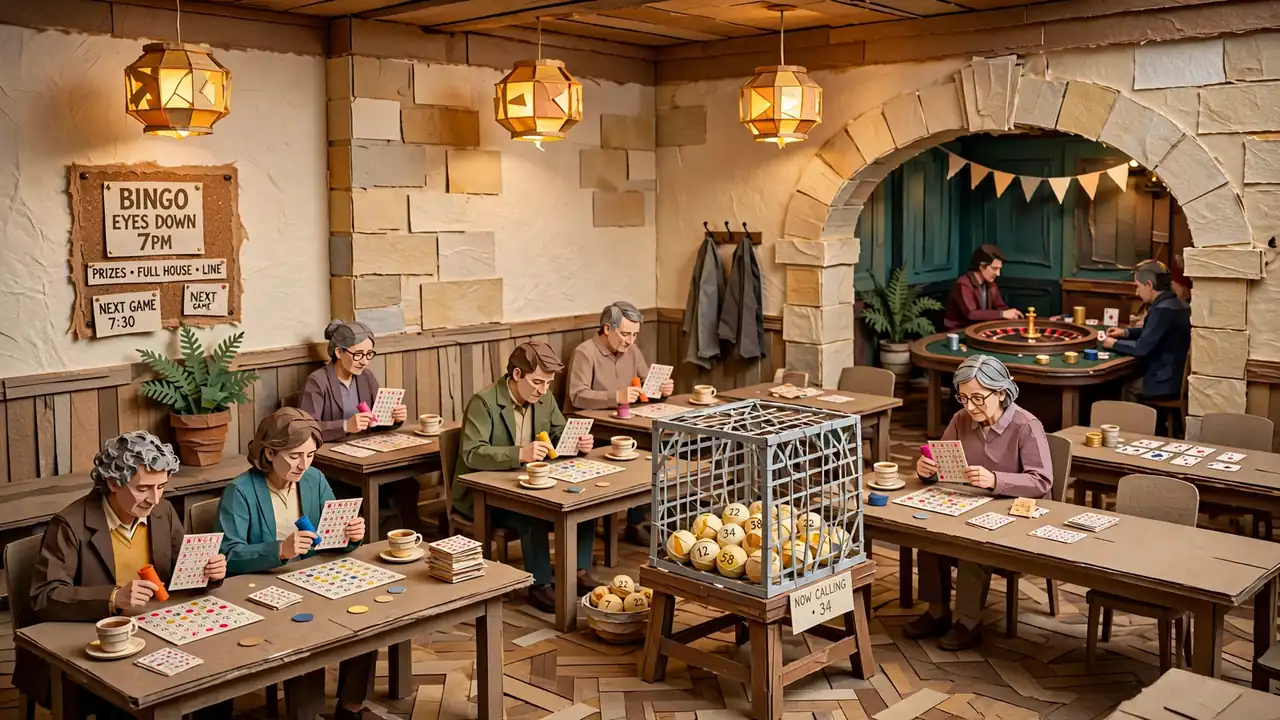
Bingo brings players together for a shared draw, while slots run as separate games, even when both appear under one casino account.
Bingo Rooms Alongside the Casino Floor
An online gambling site can contain several rooms without making them the same room. Bingo may sit beside casino games in the navigation, share an account and use the same cashier, yet retain a social structure of its own. The distinction matters because a bingo room is not merely a casino lobby with different graphics. It is a gathering arranged around a common draw, where players enter the same event and wait for the same numbers.
That arrangement is the old communal idea of bingo translated into software. Players buy tickets, numbers are called, and a prize is determined when one participant completes the required pattern before the others. The screen may be quiet compared with a physical hall, but the principle remains collective. The room exists because several people are present for the same round, not because each person is privately operating a separate machine.
A casino section works differently. Its games are generally selected one by one, with the individual game providing the event. A roulette table, a blackjack table or a slot title can be opened without joining a shared bingo room. The surrounding website may place these products under one roof, but the experience is not interchangeable. One is built around a common timetable and a pool of participants; the other is organised around separate games and individual sessions.
Online European Roulette in the UK: Single-Zero Guide
One account, different rooms
This is why terms such as online casino and bingo can describe a site accurately without describing a single hybrid game. A British gambling website may offer bingo rooms, casino tables and online bingo and slot games through one account. The account is the administrative centre: registration, identity checks, payments, limits and account history belong to the operator rather than to a particular game.
The rooms still have their own logic. A player entering bingo joins a schedule of draws and sees the tickets connected with that room. Someone opening a casino title enters a different kind of play, even if both activities appear as adjacent tiles on the same homepage. The shared setting is practical; the games remain culturally and mechanically separate.
That separation also helps explain the language of “bingo casino” or “bingo casino online”. Such phrases often point to a site combining the two products, not to a new category in which bingo and casino rules have dissolved into one another. A bingo casino can be a single regulated operator with a bingo lobby on one side and casino games on the other. The sign above the door is shared. The furniture is not.
For British players, the legal frame belongs to the operator serving the market. Remote gambling operators selling into Great Britain must hold a UK Gambling Commission licence, and every legal online casino serving UK players must have a current operating licence. A licence is not a decorative seal beside the footer. It places the site within requirements covering fairness, anti-money laundering and responsible gambling. The UKGC licence number should be visible in the footer and checked against the UK Gambling Commission public register before money is deposited.
Online American Roulette in the UK: How It Works
The room as a social timetable
Bingo’s communal character becomes most visible in the rhythm of the day. A specialist review of bingo rooms identifies peak traffic between 7pm and 11pm, with operators scheduling their largest prize pools during those hours. That observation describes a changing commercial pattern rather than a permanent law of bingo. The evening concentration makes sociological sense: the room becomes busier when work and domestic routines loosen their grip, and the promise of a fuller gathering becomes part of the attraction.
The prize pool is therefore only one part of the room’s appeal. A busy bingo lobby gives the game a sense of occasion that a solitary casino title does not need to manufacture. Players are not simply waiting for a random result; they are occupying the same digital event. Chat features, room names and scheduled sessions can reinforce that feeling, although the underlying win still depends on the ticket and the pattern completed.
The communal design does not remove the need for restraint. Licensed operators must provide account-level limit controls and prompt new customers to set a financial limit before the first deposit. They must also offer responsible gambling tools, including self-exclusion. Every player must be 18 or older, and age verification has to take place before funds can be deposited. The bingo room may look informal, even homely. Its obligations are not.
A bingo room is a gathering arranged around a common draw where players enter the same event and wait for the same numbers, unlike a casino section where games are generally selected one by one.
Where the casino floor begins
The casino side may include games that appear beside bingo because they appeal to a similar audience or because the operator wants one destination for several forms of gambling. That proximity should not blur the differences in pace, participation or rules. Bingo is a room with a shared draw. Casino games are separate products, each with its own presentation and mathematical design.
Side games attached to a bingo environment can also carry a lower return-to-player percentage than the bingo room itself. The friendly architecture of the site does not make every product equally generous, and a cheerful banner cannot turn unlike games into one financial proposition. A room may be sociable; its neighbouring game may still be something else entirely.
There is a quiet lesson in the combined site. Digital gambling has gathered old distinctions under one roof, but it has not erased them. Bingo remains a public event conducted through private screens, while the casino remains a collection of individual games. The corridor is shared. The rooms are not.
From Bingo Tickets to Slot Reels
Bingo and slots may share a website, but they do not share a tempo. Bingo is built around a room: tickets gather players around the same sequence of numbers, and the meaning of a win depends on what others are doing in that round. A slot is more solitary. Its reels turn, stop and begin again without waiting for a room to fill or a caller to announce the next number.
That difference matters more than the cheerful category labels suggest. A page described as offering bingo slots online may contain genuine bingo rooms, conventional slot games, or both. The word “bingo” can point to the setting, the theme or a promotional link between products. It is not, by itself, a description of the game’s mathematics.
Online Casino Without ID UK: Checks and Licensing
Two games, two rhythms
In a bingo room, the ticket is the starting point. Numbers are drawn in a shared round, and the winning condition follows the room’s format. The action moves collectively, even when tickets are bought separately. A player may watch several cards develop at once, while the room’s chat and announcements give the round a small social theatre.
A slot does not need that theatre. The reels are a self-contained sequence, and each spin has its own result. There is no shared card to complete and no room-wide pattern to follow. The visual language may borrow balls, numbers, cages or familiar bingo phrases, yet the underlying experience remains a slot game.
This is why online bingo slots games deserve a little grammatical suspicion. A title can sound like a hybrid while functioning entirely as a reel game. The attractive surface is often the least informative part.
The pace is also regulated differently. Online slot autoplay is banned in Britain, and online slot spins must last at least 2.5 seconds. Those rules belong to slot play, even when a machine is decorated with bingo imagery or displayed inside a bingo-branded lobby. The theme does not dissolve the category.
When a ticket unlocks a spin
Some rooms add a link between the two products: a free slot spin is offered for each bingo ticket purchased. This arrangement has been described by a specialist review, so it should be treated as a feature that may appear in a particular offer or room, not as a permanent property of bingo play.
The appeal is easy to understand. A ticket gives access to the communal round, while the associated spin provides a separate piece of instant reel play. One purchase therefore seems to open two doors: one into the room and one into the machine. The doors still lead to different games.
The link between tickets and spins
Some rooms offer a free slot spin for each bingo ticket purchased. This arrangement provides access to a communal round via the ticket and a separate piece of instant reel play via the spin. However, the bingo round and the slot result remain separate processes with their own rules.
The ticket does not become a slot stake, and the spin does not become a bingo ticket. The bingo round continues according to its own rules; the reel result is handled as a slot result. Even when the two are displayed side by side, their outcomes should be read separately.
This distinction also helps explain why a combined lobby can feel busier than either product alone. The bingo room has a rhythm of anticipation, interruption and completion. The slot offers a repeated cycle of selection and result. Linking them creates a sequence of small transitions rather than a new game with a single shared logic.
The lure of the hybrid label
“Bingo casino slots” is a useful description only if it is understood as a product label. It may refer to slots carrying bingo themes, slots found on a site that also hosts bingo, or a feature connecting tickets with spins. These possibilities have different practical meanings.
A bingo-themed slot may use numbered balls as symbols and present wins as if they belonged to a familiar hall. Yet its play remains reel-based. A slot found beside a bingo room may have no thematic connection at all; the site simply places both games under one account. A ticket-linked spin creates a promotional bridge, but not a new set of rules.
The British market makes such distinctions especially important because the regulatory frame follows the game, not the mood of the page. A UKGC-licensed operator must apply the relevant controls to remote gambling, while slot-specific requirements remain relevant to slot play. A friendly bingo interface cannot turn a slot into a harmless extension of the room.
Nor does a shared balance erase the difference. Money held in one account may be available across several products, but the player is still moving between separate activities. The social expectation of bingo and the solitary repetition of slots are not interchangeable simply because a menu places them next to each other.
Online Casino Tournaments in the UK: Rules and Prizes
Reading the game behind the decoration
A sensible description of online bingo and slots should therefore identify what actually happens after the button is pressed. If numbers are drawn for a shared round and the win depends on a card or pattern, the product belongs to bingo. If reels produce the result through a self-contained spin, it belongs to slots. If a ticket purchase grants an additional spin, that is a connection between products rather than a fusion of them.
The distinction sounds technical because gambling interfaces prefer atmosphere. Rooms are dressed as parties; slots borrow the language of celebration; promotional panels make separate actions look like one continuous journey. Underneath, the old divide remains: bingo waits with others, while the reel keeps its own counsel.
A shared site can offer both experiences without making them the same. That is the whole trick.
Playing for Cash: Stakes, Prizes and Limits
Real-money bingo is built from small decisions that are easy to overlook. A ticket has a price, a room has its own prize structure, and a busy screen can make another purchase feel less like spending than participation. The sums may be modest, but the mechanism is cumulative: each additional ticket changes the amount committed to a game.
Online ticket prices run from 1p to 5p in low-stakes rooms, while premium games can charge £1 or more for a ticket. Another published comparison illustrates how sharply the prize scale can change: a 1p game might carry a £10 full-house prize, whereas a £1 game could advertise a jackpot in the hundreds or thousands. That is an example drawn from a specialist review, not a fixed rule of the market. Prize structures belong to individual rooms and can change.
90-ball bingo
Tickets are arranged as three rows by nine columns. Rounds may recognise a completed line, two lines, or a full house.
80-ball bingo
Tickets use an eight-by-four grid. Common winning patterns include four corners, a letter shape, or a completed card.
75-ball bingo
Tickets use a five-by-five card. Target patterns can include a cross, an X, a diamond, a T-shape, or a picture-frame outline.
The useful figure is therefore not the headline jackpot alone. It is the relationship between ticket cost, the number of tickets bought, and the pattern required for a win. A low-priced ticket may permit repeated participation without making any single purchase feel significant. A premium room reverses that emphasis: fewer tickets may represent a more substantial commitment, even before a prize is considered. The mathematics is plain; the atmosphere is not always so plain.
Deposits are the boundary
A bingo balance is funded before tickets are purchased, which makes the deposit limit the most practical point of control. UK operators must ask new customers to set a financial limit before the first deposit and must make account-level controls available. Most operators allow limits for a day, a week, or a month. Those periods serve different purposes: a daily limit interrupts an evening’s drift, while a weekly or monthly limit gives spending a wider frame.
A limit should be treated as a boundary rather than a target. Increasing it because a room is busy, a jackpot is visible, or earlier tickets have lost their value defeats the purpose of setting it. The interface may make purchasing instantaneous; the limit is the deliberately slower decision.
Identity and age checks form another part of real-money play. UK-licensed operators verify identity, commonly requesting photo identification and proof of address, and age must be checked before money can be deposited. The legal minimum is 18+, not a matter of interpretation or mood. The British system makes the account a documented relationship, rather than an anonymous pile of tickets.
The British safeguards
Online bingo is legal in the United Kingdom when offered by an operator holding the relevant UK Gambling Commission licence. Remote operators selling into Great Britain need that authorisation even if their business is based elsewhere. The licence framework covers fairness, anti-money-laundering controls and responsible gambling measures.
Online Casino Games for Real Cash in the UK
The UKGC licence number should be visible in the site’s footer and checked against the Commission’s public register before any deposit is made. This is less glamorous than a jackpot banner, which is precisely why it matters. A licensed operator must also provide self-exclusion and an internal complaints route, with access to an approved Alternative Dispute Resolution service.
Payment choices carry a hard boundary of their own. Credit card gambling is banned in Great Britain, including arrangements that route credit-card funds through a money service business or a wallet that permits such funds to be used for gambling. Debit cards and permitted alternatives remain the relevant category for funding an account.
For recreational players, online bingo winnings are not taxable in the United Kingdom. That does not turn every balance into spendable cash: the money still belongs to a particular game, operator and account, and the terms of that arrangement govern withdrawals. Limits, identity checks and licensing are therefore not decorative warnings around real-money bingo. They are the structure holding it in place.
What a Bingo-and-Slots Site Can Actually Offer
A bingo-and-slots site is best understood as a small gambling ecosystem rather than a single game with two labels. Its value lies in the relationship between its rooms, casino lobby, payment system and account controls. A site may offer 90 ball bingo beside a broad slot catalogue, or keep the bingo selection modest while giving the casino side most of the visual space. The sensible assessment is therefore not a hurried hunt for a universal “best” site, but an examination of what the operator actually puts under one roof.
Site verification checklist
- Is the UKGC licence number visible and verifiable?
- Are bingo and slots clearly represented?
- Are providers, game rules, and terms identifiable?
- Are responsible-gambling controls accessible?
- Are payment methods consistent with the credit-card ban?
- Does the mobile version retain essential information?
Start with the licence, not the lobby
For British players, the first practical distinction is legal. An operator selling remote gambling to Great Britain must hold the relevant UKGC licence. That licence is not decorative wording in a footer: it places the business inside requirements covering fairness, anti-money laundering and responsible gambling.
A site may describe itself as new, modern or mobile-first. None of those descriptions substitutes for a UKGC licence number. The number should be displayed prominently, and it should be checked against the UK Gambling Commission’s public register before any deposit is made. This is an unglamorous first filter, but gambling has never suffered from too much attention to paperwork.
The licence also helps distinguish a genuine British-facing service from an offshore operation that merely accepts British visitors. The latter may remain technically reachable, but it does not belong to the UKGC system. For a site combining bingo and slots, that difference matters across the whole account, not just in the bingo room.
Compare the range, not the marketing adjectives
The product catalogue says more than labels such as “best”, “new” or “exclusive”. A useful comparison asks whether the site has several bingo rooms, whether the casino section is substantial enough to be more than an afterthought, and whether both areas can be managed from the same account without confusing rules.
Monopoly Live Casino UK: How the Game Works
Room variety may include different ticket values, prize structures or ball formats. The slots section may contain games from several providers, but a long list alone proves little. A crowded lobby can be a warehouse rather than a carefully assembled service. Navigation, game information and the visibility of terms are part of the offer too.
A newer bingo site appearing in 2026 may have a fresh interface and a small initial catalogue. That is not automatically a weakness; established operators can also bury a limited bingo selection beneath a large casino menu. The useful question is whether the advertised combination is real and clearly presented.
Examine the account as a whole
Bingo and slots often share registration, verification, payments and account controls. That arrangement can be convenient, but it also means that the site’s standards should be judged across both products. The licence information should be easy to locate, the responsible-gambling material should not be hidden behind several menus, and the terms should explain which promotions or features apply to which game.
Payment restriction
Credit card gambling is banned in Great Britain. Legitimate UK-facing sites must rely on debit cards or other permitted methods for funding an account.
Payment methods deserve particular scrutiny. Credit card gambling has been banned in Great Britain since April 2020. A legitimate UK-facing site cannot treat a credit card as an ordinary route into gambling; payment must rely on a debit card or another permitted method. Any ambiguity here is more revealing than a polished homepage.
The same whole-account approach helps when considering mobile access. A site may work on a phone while offering only a reduced bingo lobby, awkward account controls or an incomplete slot catalogue. “Mobile” should mean more than a page that technically opens on a smaller screen. It should preserve access to the relevant games and the information that governs them.
A practical comparison
A restrained checklist is more useful than an unsupported league table:
- Is the UKGC licence number visible and verifiable?
- Are bingo and slots both clearly represented, rather than one being used as decoration?
- Are providers, game rules and terms identifiable before play?
- Are responsible-gambling controls and complaints information accessible?
- Are payment methods consistent with the Great Britain credit-card ban?
- Does the mobile version retain the essential account and game information?
This approach leaves room for different preferences without turning a commercial catalogue into a supposed ranking. One site may suit someone interested in a fuller bingo community; another may put its strength in casino variety. The important distinction is between what a site offers and what its advertising claims. Catalogue first, adjectives later.
Recommended online casinos
- BeOnBetBonus: 100% up to €500 + 100 FS · Payout speed: 1-3 business days
- NightWinBonus: £900 + 400 free spins · Payout speed: 1-3 business days
- ZombillionBonus: Welcome Pack 250% up to £4000 + 200 FS · Payout speed: 1-3 business days
- BritsinoBonus: Welcome Package – Get your £2,200 + 2,000 FS · Payout speed: 1-3 business days
- DieselwinBonus: Welcome Pack 250% up to £4000 + 200 FS · Payout speed: 1-3 business days
- Revery PlayBonus: 100% up to€1,000+ 100 FS · Payout speed: 1-3 business days
- x3betBonus: Welcome Pack 100% Up to £1.000 + 200 Free Spins · Payout speed: 1-3 business days
Free Play, With the Small Print Attached
Free play at a bingo-and-casino site can look wonderfully weightless. A ticket arrives without a price attached; a slot game opens in practice mode; the screen offers entertainment with none of the solemnity of a bank statement. Yet free does not mean unrestricted. Promotional play has its own geography, its own clock and, most importantly, its own definition of what counts as a win.
A free ticket belongs somewhere
A complimentary bingo ticket is rarely a universal pass. It may be accepted only in a named room or with a particular ball type. A ticket intended for one room may therefore be useless in another, even when both appear in the same bingo lobby. The restriction is easy to miss when the offer is presented as a bright button rather than as a set of terms.
Expiry adds another quiet condition. A specialist review states that some free tickets can lapse after 24 hours. Other promotional terms may set a different period, so the expiry shown in the account or offer rules matters more than the cheerful language surrounding the reward. A ticket that remains visible but has passed its deadline is decoration, not credit.
This is the slightly bureaucratic character of online free play: the gift has an address and a closing time.
Live Casino Lightning Roulette in the UK: How It Works
Free slot play is not cash
Free online bingo slot games may mean a practice version of a slot, where the player explores the reels without staking money, or a promotional spin attached to an offer. Those are not identical arrangements. Practice play does not create withdrawable funds merely because the reels produce a winning display. A promotional spin, meanwhile, can carry conditions governing both eligibility and the treatment of any resulting balance.
The same distinction applies to free online bingo slot machines: the bingo branding may sit beside the slot interface, but the reward remains a promotion rather than ordinary cash. The wording around the offer should establish whether the play is for demonstration, whether winnings are credited, and which games can be used afterwards.
When a free ticket wins
Free tickets cannot be withdrawn as tickets. If one produces a prize, the resulting amount is credited as cash, but that cash may not be immediately available for withdrawal. The operator can attach a wagering requirement to the winnings, and the requirement may mirror the one applied to a deposit bonus.
A specialist review reports wagering requirements for free-ticket winnings ranging from 20x to 65x. That is a description of promotional terms, not a permanent rule of the market; each offer sets its own calculation. The crucial question is what amount the requirement applies to and which bingo play qualifies towards it. A win can therefore appear in the balance while remaining subject to further play before withdrawal.
Free play is not false advertising merely because it has conditions. It is advertising with a smaller typeface.
Free play conditions
Free tickets and spins often come with specific limitations. A complimentary ticket may only be valid in a named room or for a specific ball type, and some may expire after 24 hours. Additionally, winnings from free play may be subject to wagering requirements, sometimes ranging from 20x to 65x.
The Shape of Online Bingo in Britain
Online bingo in Britain retains an old social shape beneath its digital surface. A player selects a ticket for a room, waits for the draw, and watches numbers appear against the printed pattern. The winning condition is not simply the arrival of a lucky number: it is the completion of the required arrangement before another player completes it. The technology has altered the room, not the underlying bargain.
In a 90-ball game, the ticket is arranged as three rows by nine columns. The round may recognise a completed line, then two lines, and finally a full house. That sequence gives the game its familiar sense of rising tension: an incomplete ticket can remain relevant after another player has already marked an earlier stage.
Other formats redraw the furniture. An 80-ball ticket is laid out as an eight-by-four grid, with rooms using patterns such as four corners, a letter shape or a completed card. Another description of 80-ball play uses a four-by-four grid and faster rounds than the 90-ball format. The label therefore needs attention to the particular room’s rules rather than assumptions borrowed from another version.
The 75-ball format uses a five-by-five card. Its target may be a cross, an X, a diamond, a T-shaped letter or a picture-frame outline. Here, the visual design of the card matters as much as the numbers themselves; the draw supplies the marks, but the room decides which arrangement counts.
That structure explains why online bingo still feels recognisably communal even when played alone at home. Tickets enter the same draw, and the result depends on what competing players complete first. A chat panel may decorate the room, but it is the shared race across the cards that gives the format its character.
Mines Casino Game UK: How the Grid and Randomness Work
In the United Kingdom, online bingo is legal, but it sits inside a heavily regulated gambling market. Remote operators serving British customers must hold the relevant UK Gambling Commission licence. A current UKGC licence number is part of the basic legal identity of a site, not ornamental footer text. Age and identity checks belong to that same framework, with play restricted to people aged 18 and over.
The room remains simple. Buy a ticket, follow the drawn numbers, complete the pattern. Then the old suspense does its quiet work.
When a Bingo Slot Is Still a Slot
A bingo-branded slot can look as though it belongs to the bingo room: familiar colours, numbered balls, cheerful calls, perhaps a title borrowed from a well-known pattern. Its appearance is decorative, however. The underlying game remains a slot.
That distinction matters. In a bingo round, players buy tickets, numbers are drawn, and a win depends on completing the required pattern before other players. A slot does not wait for a room to fill, compare one ticket with another, or announce a shared result. Each spin is an individual game cycle generated by the machine’s rules. The bingo vocabulary is costume, not ancestry.
Two different rhythms
Bingo has the tempo of a public event. Numbers arrive in sequence, and the room gives that sequence meaning. A slot is more private and repetitive: one spin ends, another can begin, and the player’s attention is pulled towards the next result. Even where a bingo theme supplies symbols or bonus features, it does not turn the reels into a bingo draw.
The difference is easy to miss because gambling design likes familiar stories. A slot may display cards, fruit, treasure or bingo balls; the image changes while the classification does not. A bingo-themed machine is therefore best understood as a casino game with a bingo motif, rather than as a faster version of a bingo round.
Slot regulations in Britain
Online slot play is subject to specific rules: autoplay is banned, each spin must last at least 2.5 seconds, and maximum stakes are capped based on age (£5 for those 25+ and £2 for those 18-24).
Safeguards follow the game
British rules attach particular controls to online slots. Autoplay is banned, so the machine cannot continue spinning without a fresh player action. Each online slot spin must last at least 2.5 seconds. The stake per game cycle is capped at £5 for customers aged 25 and over, and at £2 for those aged 18 to 24. The £5 limit for all adults took effect on 9 April 2025.
These restrictions apply because the game is a slot, not because its title contains the word “bingo”. The same point holds for responsible-gambling controls: licensed operators must provide account tools, including self-exclusion, and must verify age before accepting deposits. A colourful grid cannot negotiate with regulation. The reels still have to wait.
Slots at a Bingo Site: A Separate Game, Separate Rules
A site built around bingo may also provide a slot lobby. The arrangement is less surprising than it first appears: both products belong to the same licensed gambling account, while remaining different games with different operating rules. Bingo supplies rooms, tickets and a shared draw; slots offer individual spins generated by the game itself. A familiar address does not turn one into the other.
The distinction matters when browsing a bingo-branded website. A slot tab is not merely another bingo room with brighter artwork. It is a separate product area, and its rules follow the British treatment of online slots. The operator must hold a current UK Gambling Commission licence, display its UKGC licence number in the footer and verify the player’s identity and age before deposits are allowed. The licence is not decorative typography.
Plinko Casino UK: How the Game and Rules Work
Age controls sit at the entrance to both forms of gambling, but slot play has additional restrictions. The maximum stake per game cycle is £5 for customers aged 25 and over, while customers aged 18 to 24 face a £2 maximum. The £5 limit for all adults came into force on 9 April 2025. These limits apply because the game is an online slot, not because the site happens to have a bingo logo above the menu.
British rules also prohibit online slot autoplay. Each spin must last at least 2.5 seconds, keeping the game from becoming a blur of automatic decisions. That is a marked contrast with the social appearance of a bingo room, where tickets and drawn numbers create the sense of a common event. On a slot page, the pace belongs to the individual spin, and the law deliberately puts a little friction into it.
Payment rules travel with the gambling activity. Credit card gambling is banned in the UK, including credit-card funding routed through a money service business. A wallet cannot be used where its funds come from a credit card for gambling. Debit cards and permitted alternatives belong to the practical side of access; the bingo site’s branding changes none of this.
A bingo operator can therefore offer slots, but the slot section should be treated as a separate regulated product. Its licence details, age checks, stake limits, spin speed and payment restrictions remain in force, even when the same account also opens a bingo room. Same website, different rulebook.
Bingo and Slots on a Smaller Screen
Mobile gambling has made the combined bingo-and-slots site less like a destination and more like a pocket-sized room. A phone can display the ticket, the called numbers and the chat panel together, while a separate touch of the screen opens a slot. The arrangement is compact, but the games do not become the same game merely because they share a handset.
Mobile gambling
Mobile interfaces must preserve the legibility of bingo grids and the essential regulatory information while providing deliberate navigation between different game types.
The clearest difference appears in the grids. In 90-ball bingo, the ticket is arranged as a 9×3 card, with prizes attached to completing one line, two lines or the full house. A small screen therefore needs to preserve the ticket’s rows without making the numbers too cramped to distinguish. The 80-ball version uses an 8×4 grid and coloured patterns, which may involve four corners, a letter shape or the full card. Its visual logic is more like a pattern being assembled than a row being completed.
The 75-ball format places its numbers in a 5×5 grid. A winning pattern can be a cross, X, diamond, letter T or picture frame. That variety matters on mobile: the board must remain legible while the pattern develops, rather than reducing the game to a blur of tiny squares. Touch controls are useful only when they clarify the board; decoration has little to contribute.
Slots ask for a different kind of attention. Their reels, controls and pay information must fit beneath the bingo display or appear on a separate screen. British online slot play also has its own boundaries: autoplay is banned, and each spin must last at least 2.5 seconds. A phone does not soften those rules. It merely places the regulated game beside the hurried habits of mobile life.
A sensible mobile layout keeps the bingo ticket visible, makes the current game unmistakable and avoids hiding essential information behind decorative menus. It should also make movement between bingo and slots deliberate rather than accidental. The smaller screen is not a smaller set of rules.
No-Deposit Offers: Tickets, Spins and Deadlines
A no-deposit promotion sounds wonderfully weightless: tickets or spins appear before money does. The weight has merely moved into the terms. Such offers may be attached to registration, identity checks, a first visit, or a particular promotional code. “No deposit” describes the entry point, not necessarily the route to withdrawable cash.
Best Keno Online Casinos in the UK: How to Compare
A new-player package described in a specialist review consisted of a £10 cash bonus and 30 free bingo tickets. That is an example of a promotional structure, not a permanent feature of the market. Other offers may separate the two elements: free tickets for a bingo room, spins for a slot, or a cash bonus that becomes available only after a qualifying deposit. The word “free” does a great deal of advertising work.
Read the wagering requirement first
The important distinction is between a ticket or spin and the money produced by it. Free tickets cannot be withdrawn directly. If they generate winnings, those winnings are credited as cash and may carry a wagering requirement before withdrawal. The same condition can attach to a deposit bonus.
A specialist review reported deposit-based bingo offers with wagering requirements from 20x to 65x, with some applying the calculation only to bonus funds. A £40 bonus subject to a 4x requirement would therefore call for £160 in eligible bingo ticket spending before withdrawal. The arithmetic is plain; the eligibility rules are where promotions become less plain.
Slot play may also be excluded, restricted, or assigned a different contribution under the bonus terms. A promotion combining bingo tickets and spins should therefore be read as several linked offers, not as one generous pot. The headline may unite them. The conditions may not.
The clock begins at acceptance
Time limits matter even when the offer costs nothing to claim. A specialist review identified a 30-day wagering window as typical for bonuses, with the countdown beginning when the bonus is credited. An unused ticket or spin can therefore disappear while the account remains open and the promotion remains visible.
The wording to inspect includes expiry, eligible games, minimum qualifying activity, maximum winnings, and whether a bonus must be claimed manually. A ticket restricted to a named room is not interchangeable with a ticket for every bingo room; a spin tied to one slot is not a general casino balance.
Finally, the legal setting is not optional decoration. A British operator offering such a promotion must hold a UKGC licence, display its UKGC licence number in the footer, verify age before accepting deposits, and provide the relevant responsible-gambling controls. Any promotional excitement still sits beneath those rules. Small print, large consequences.
Can I play bingo without buying a ticket?
No, online bingo is played by buying tickets for a draw. Some rooms offer free tickets as promotions, but winnings from them may be subject to wagering requirements.
Is it better to buy many cheap tickets or fewer expensive ones?
Neither option is inherently better: ticket prices and prizes vary, and buying more tickets does not guarantee a win. Most rooms limit how many tickets you can buy per game.
What is a wagering requirement?
It is the amount of eligible play required before bonus funds or winnings from free tickets can be withdrawn. For example, a £40 bingo bonus with a 4x requirement calls for £160 in eligible ticket spending.
What are responsible gambling tools and self-exclusion options?
They include account controls such as deposit limits and self-exclusion. Licensed operators must provide these tools, and new customers must be prompted to set a financial limit before their first deposit.
How do 90-ball and 75-ball bingo differ?
90-ball bingo uses a 9×3 ticket, with prizes for one line, two lines and a full house. 75-ball bingo uses a 5×5 grid, and players win by completing patterns such as a cross, X, diamond, letter T or picture frame.