
Casinos That Accept E-Wallets in the UK
 Available in GB
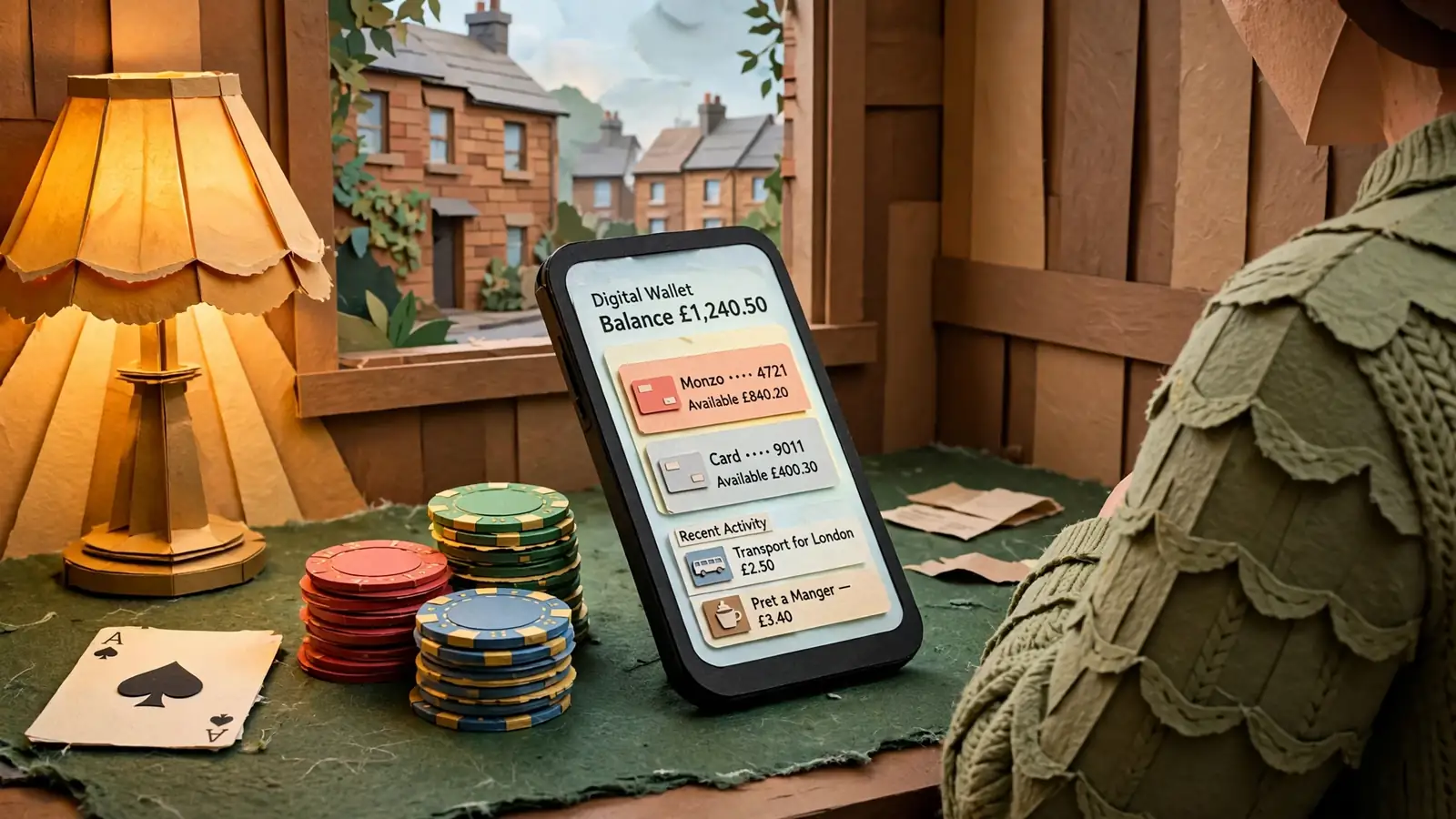
A wallet listed in a casino cashier may not work for every transaction; payment conditions can affect deposits, withdrawals, fees and verification.
Which E-Wallets Work at UK Casinos—and What “Accepted” Means
E-wallets are not one uniform payment family. A wallet appearing in a casino cashier may be available for deposits, withdrawals, both, or neither once the account’s particular conditions are applied. That small distinction matters more than the logo. “Accepted” is often treated as a complete answer when it is really only the beginning of one.
Skrill remains one of the most common deposit methods found at UK-friendly casino sites in 2026, according to a specialist review. Its name therefore appears frequently among online casinos with e-wallets in the UK. Neteller occupies a similar but less universal position: it is available at some sites, rather than being a payment route that can be assumed across the market. PayPal is also present in parts of the sector, valued for the speed and convenience associated with the service. Jeton has a narrower footprint; a specialist review records it at a handful of UK online casinos in 2026.
That spread is not a contradiction. The British casino market contains remote gambling licensees with different cashier arrangements, software integrations and payment policies. A wallet can be familiar to the public yet absent from a particular operator’s payment page. Another can appear during registration but be restricted after the account’s country, currency or verification status has been considered. Payment brands travel widely; their availability does not.
The cashier decides what “accepted” means
The reliable meaning of acceptance is found in the live cashier attached to the account. General payment pages, promotional banners and older comparison material can describe a wider selection than the one currently offered. The cashier shows the methods available for that account at that moment, which is why a list of casino brands would offer less certainty than it might suggest.
The first distinction is between a deposit method and a withdrawal method. A wallet may be displayed as a way to fund an account without being available for receiving a payout. That is not an unusual linguistic trick so much as a difference between two separate payment functions. Deposit acceptance answers one question: can money be sent into the gambling account through this wallet? Withdrawal support answers another: can an approved balance be returned to that same wallet?
Casino Payments in the UK: Methods Compared
The second distinction is between a method being displayed and a transaction being permitted. Account ownership, identity checks and the operator’s closed-loop rules can affect what happens after a deposit. A wallet icon is therefore not a promise that every direction of payment will remain open. The practical description is narrower: the cashier indicates what the remote gambling licensee currently supports, while the account’s payment conditions determine how that support operates.
The four names do not describe one identical choice
Skrill is the most consistently encountered name among the four, particularly on deposit pages. Its presence is still not proof that every casino using the word “e-wallet” supports it for withdrawals. It is also worth separating payment availability from promotional eligibility. According to a specialist review, Skrill and Neteller are often excluded from promotions. The wallet may function perfectly as a funding route while the related deposit does not qualify for a bonus.
Casinos That Accept POLi in the UK: What to Check
Neteller follows a similar pattern of partial availability. It can be offered by some sites and omitted by others, with promotional terms potentially treating it differently from cards or other payment routes. A cashier can therefore show Neteller as available while the bonus terms exclude deposits made through it. Payment and marketing departments, it seems, do not always share a desk.
PayPalis popular for speed and convenience, but a specialist review notes that it may be excluded from bonus eligibility. The important word is “may”: this is a condition to check at the operator level, not a universal rule to attach to every PayPal transaction. Its appearance in a cashier confirms a payment option, not automatic access to promotional treatment.
Jeton is the more limited name in this group. A specialist review places it at a handful of UK online casinos in 2026, so it belongs in the discussion of casino sites accepting e-wallets without being presented as a market-wide standard. Its narrower availability makes the live cashier particularly important.
Skrill
One of the most common deposit methods found at UK-friendly casino sites in 2026.
Neteller
Available at some sites, though it is not a payment route that can be assumed across the market.
PayPal
Valued for the speed and convenience associated with the service.
Jeton
Has a narrower footprint and is recorded at a handful of UK online casinos.
A wallet logo is not a recommendation
Searches for the best or top casinos that accept e-wallets can encourage a tidy ranking, but wallet compatibility is not a stable league table. The useful question is whether the chosen site supports the relevant wallet for the required transaction direction and states the conditions clearly. Skrill, Neteller, PayPal and Jeton each occupy different parts of the market, and none should be treated as interchangeable merely because all are called e-wallets.
The sensible reading of “accepted” is therefore precise: the method is visible in the account cashier, its deposit or withdrawal function is identified, and its promotional treatment is stated separately. Anything broader turns a payment label into a promise.
Recommended online casinos
- BeOnBetBonus: 100% up to €500 + 100 FS · Payout speed: 1-3 business days
- NightWinBonus: £900 + 400 free spins · Payout speed: 1-3 business days
- ZombillionBonus: Welcome Pack 250% up to £4000 + 200 FS · Payout speed: 1-3 business days
- BritsinoBonus: Welcome Package – Get your £2,200 + 2,000 FS · Payout speed: 1-3 business days
- DieselwinBonus: Welcome Pack 250% up to £4000 + 200 FS · Payout speed: 1-3 business days
- Revery PlayBonus: 100% up to€1,000+ 100 FS · Payout speed: 1-3 business days
- x3betBonus: Welcome Pack 100% Up to £1.000 + 200 Free Spins · Payout speed: 1-3 business days
Choosing a Payment Route Without Mistaking Speed for Convenience
An e-wallet is only one route through a UK-facing casino cashier. The alternatives commonly shown alongside it are debit cards, bank transfers and open-banking services; some payment screens also display Apple Pay and cryptocurrency options. A review can describe this landscape, but it cannot turn a general menu into a promise that every account will see the same choices.
That distinction matters because payment compatibility is local and changeable. A casino may advertise Visa and Mastercard while a particular card product, account currency or transaction direction is not available. The payment page is therefore more authoritative than a broad label such as “e-wallet casino sites UK”. The cashier reveals what is enabled for that account at that moment, whether the method is intended for deposits, withdrawals or both, and which conditions accompany it.
E-wallets: a separate payment environment
Wallets appeal because the casino is connected to an existing payment account rather than to the card details entered directly into the cashier. Skrill, Neteller, PayPal and Jeton occupy different positions across the UK-facing market, so “e-wallet accepted” is not a complete description. The named wallet still has to appear in the relevant cashier, and its available transaction functions have to be checked there.
Casinos That Accept Giropay in the UK: Payment Facts
The same principle applies to a search for the best e-wallet online casino in the UK. There is no useful answer based on the wallet name alone. A suitable route depends on whether the casino supports that wallet for the required transaction, whether the account is held in a compatible currency and whether the operator’s payment conditions fit the intended use. A polished badge on a landing page is a poor substitute for a live cashier.
E-wallets can also be treated differently from other methods in promotional terms. PayPal, Skrill and Neteller may be excluded from bonus eligibility, making the payment route part of the offer’s small print rather than a decorative convenience feature. The quickest-looking button can carry the least attractive promotional treatment. A familiar modern problem.
Debit cards: familiar, but not interchangeable
Debit cards remain a common route at UK casinos, with Visa and Mastercard frequently listed. Their familiarity can conceal the need for a current check. Card acceptance on a general payment page does not establish that every Visa or Mastercard product qualifies, nor that the same card route will be available under every account setup.
A card may be attractive where an existing bank relationship makes the process simple. It may be less convenient where a withdrawal cannot follow the same route or where the cashier offers a different payout method. That is why compatibility should be considered before the deposit rather than after it. The relevant question is not merely whether a card can put money into the account, but how the operator handles the complete payment path.
Credit Card Ban
UK-licensed casinos cannot accept credit-card payments for gambling.
The debit-card label also needs a clear boundary. UK-licensed casinos cannot accept credit-card payments for gambling, and a wallet route does not make an otherwise prohibited source acceptable. Payment methods are not morally neutral pipes through which any funding source may pass; the underlying funding arrangement still matters.
Bank transfer and open banking
Bank transfers and open banking belong to a different family from wallets. They connect the gambling account to a bank account or banking service, rather than asking an external wallet to stand between the two. A specialist review reports that these methods can combine instant deposits with fast withdrawals at many sites, but the wording is necessarily site-dependent. The cashier remains the proper place to establish whether that description applies to a particular operator.
Open banking may reduce the number of manual details required in a transaction, while a conventional bank transfer can suit an account holder who prefers a direct bank-to-bank route. Neither label guarantees identical processing. The service shown may depend on the casino, the bank, the account currency and the transaction direction. “Bank transfer” is a category, not a timetable.
This is also where speed can mislead. An instant deposit describes the arrival of funds at the casino, not the entire relationship between funding and payout. Approval, verification and the receiving bank’s handling can affect what happens later. Those are separate stages, and the cashier’s wording should be read as a description of the selected transaction, not as a promise about every subsequent one.
What the cashier can—and cannot—settle
A practical comparison can be made by checking the cashier against a small set of questions:
- Is the method currently displayed for the account?
- Is it offered for a deposit, a withdrawal or both?
- Is the stated account currency supported?
- Are there restrictions attached to the payment route?
- Does the operator describe any promotional exclusion for that method?
- Does the method require a particular account or bank relationship?
This is more reliable than building a static e-wallet casino list from brand badges. A list can identify payment names mentioned across reviewed websites, including Visa, Mastercard, bank transfer, e-wallets and cryptocurrencies, but it cannot confirm live availability for every player. Even Apple Pay, which some UKGC-licensed casinos accept for deposits, is not a universal feature of every cashier.
The sensible comparison is therefore between routes, not casino brands. E-wallets may suit an account already established with a payment provider; debit cards may be familiar; bank transfer and open banking may fit a direct banking arrangement. The “best” route is the one that is actually enabled, compatible with the intended transaction and clear about its conditions. Speed is one detail. Availability is the gatekeeper.
From Deposit to Withdrawal: Why the Same Wallet Matters
An e-wallet can make the first movement of money look almost uneventful. The account is funded, the balance appears, and the casino account is ready for play. That apparent simplicity often creates a false expectation about the return journey. A deposit and a withdrawal are related transactions, but they are not the same operation viewed from opposite ends.
Closed-loop principle
Money placed into an account through a wallet is not automatically free to leave through any alternative route; casinos may require the same wallet for payouts.
The first stage is the cashier. An available wallet is selected, the amount is entered, and the transaction is authorised through the wallet account. Where the payment route supports immediate deposits, the casino balance may update without a prolonged wait. A specialist review describes some e-wallet deposits as instant, but that observation should not be mistaken for a promise about every operator or every account. Payment availability remains specific to the cashier and the account.
The real test comes when funds are withdrawn. UK anti-money-laundering controls commonly require a casino to send money back through the original payment source. This is the practical meaning of the closed-loop principle: money placed into an account through a wallet is not automatically free to leave through any alternative route. The casino may ask for the same wallet to be selected for the payout, even when another method appears more convenient.
That arrangement serves more than administrative neatness. Returning funds to the source helps a remote gambling licensee connect the deposit, the account holder and the eventual withdrawal. It also limits the use of a gambling account as a simple passage between unrelated payment accounts. Finance has always disliked unexplained journeys; gambling compliance merely gives that dislike a formal vocabulary.
The first withdrawal is a separate checkpoint
A first payout can receive closer attention than a routine transaction. The casino may need to complete KYC, confirm identity information and establish that the payment route belongs to the customer. A specialist review notes that initial withdrawals can take longer while these checks are completed. The relevant distinction is not that an e-wallet has stopped working, but that the casino has not yet approved the release of funds.
Casinos That Accept iDEAL in the UK: Payment Guide
This is why a fast deposit does not establish a fast withdrawal. The deposit is an authorisation to move money into the casino balance. The payout is a request for the casino to release money after its own controls have been applied. Internal approval therefore forms part of the withdrawal time, alongside the state of the account verification process.
A fully verified account removes one possible source of delay, although it does not turn every withdrawal into an automatic transfer. The casino still has to review the request and confirm that the chosen route is permitted. A wallet showing in the deposit menu is consequently not, by that fact alone, a guarantee that it will receive the payout.
Why changing methods can complicate the route
The cleanest transaction path is generally one named wallet used consistently for both stages. That does not mean every withdrawal must be sent in precisely the same form as the deposit, since the available options depend on the operator’s payment rules. It means that switching to an unrelated account can create questions about ownership and the destination of the money.
An alternative payout source may require additional verification before the casino accepts it. The issue is especially visible when the withdrawal request names a payment account that was not involved in funding the gambling account. Instead of treating the change as a harmless preference, the casino may need evidence connecting that destination to the account holder or may direct the funds back through the original route.
Do
- Confirm the wallet at the cashier
- Fund the account through the chosen route
- Complete any requested KYC
- Request the payout through the permitted source
Don’t
- Switch to an unrelated account for withdrawals
- Expect automatic access to all promotions
- Assume all e-wallets are interchangeable
For this reason, the sensible sequence is unglamorous: confirm the wallet at the cashier, fund the account through that route, complete any requested KYC, and request the payout through the permitted source. The wallet may handle the movement quickly, but the casino’s approval remains part of the journey.
What the timing actually measures
A deposit that appears immediately measures the speed of authorisation and balance updating. It says little about the time required to approve and deliver a withdrawal. A card deposit can be instant while the corresponding payout takes several business days, according to a specialist review; the same separation applies when the payment route is an e-wallet.
Withdrawal timing therefore reflects at least two stages: the casino’s internal decision and the payment provider’s delivery. Verification can extend the first stage, while the wallet handles the second only after approval has been granted. The label “instant” belongs to a particular transaction stage, not to the entire life of the money.
The wallet is a useful link between deposit and withdrawal, but it is not the sole clock. That is the less glamorous truth—and the important one.
Fees, Currency and the Cost Hidden in the Exchange Rate
The price of an e-wallet payment is rarely confined to the figure displayed beside the cashier button. A casino may apply a transaction charge; the payment provider may add its own fee; an issuer or bank may treat the movement of money differently from an ordinary domestic payment. Network costs can enter the calculation too. Each charge belongs to a different institution, which is why a payment can look inexpensive at one stage and less so by the time it reaches the account.
Casinos That Accept Revolut in the UK: How to Check
A specialist review of e-wallet payment casinos identifies the same broad group of possible costs: the casino, the wallet provider, the bank or card issuer, the currency conversion and the network carrying the transaction. That is a useful map, but not a price list. The terms attached to the particular account and payment route remain decisive.
The fee that is easiest to see
A flat charge is the most legible part of the transaction. It appears as a separate line, can be compared with another displayed charge and gives the reassuring impression that the arithmetic is finished. It is not.
A provider can build part of its cost into the exchange rate rather than showing it as a separate deduction. The difference between the rate used for the transaction and a reference market rate is commonly described as a conversion spread. A specialist review notes that this spread can cost more than the visible flat fee. The quiet cost, in other words, may be the larger one.
This matters when an account, wallet or casino balance is held in different currencies. A payment route that appears to carry no separate charge can still produce a less favourable result when the amount is converted. The meaningful comparison is not the label attached to the fee, but the amount leaving one account and the amount arriving in the other.
GBP is a currency choice, not a guarantee
Currency is established at account level and can affect the route through which money is converted. A British payment made into an account held in another currency may pass through a conversion even where the underlying wallet is familiar.
Currency Conversion
Attention A payment route that appears to carry no separate charge can still produce a less favourable result when the amount is converted via the exchange rate spread.
That distinction is easily lost in the language of “free deposits”. Free may describe the casino’s own charge while saying nothing about the wallet provider, bank, issuer or exchange rate. It may also describe one direction of payment but not the return route. The word is therefore a narrow statement about one cost, not a verdict on the whole transaction.
Compare the route, not the reputation
There is no universal lowest-fee payment method. The result depends on the actual amount, the casino’s charge, the provider’s terms, any bank or issuer fee, the exchange-rate spread and possible network cost. An e-wallet can be economical for one currency path and less attractive for another; a route with a visible charge can still cost less overall if its conversion rate is more favourable.
The sensible comparison is a small piece of accounting:
- identify the amount leaving the wallet or bank account;
- check the amount credited to the casino balance;
- note the currency used on both sides;
- look for a separate casino or provider charge;
- check whether conversion occurs and which rate is applied;
- repeat the calculation for the withdrawal route where relevant.
This avoids treating a payment method as permanently cheap or expensive. Payment costs belong to transactions, not reputations.
The same scrutiny applies to e-wallet deposit casinos and other UK-facing sites that present several payment icons in a row. An icon establishes that a route may exist; it does not settle the fee, currency or exchange-rate question. The cashier’s wording and the account’s currency determine the practical cost. A neat button can conceal untidy arithmetic.
A Deposit Limit Is Part of the Payment Decision
A payment method does not decide only how money enters a gambling account. It also sits inside a framework of limits: the amount permitted for an individual transaction, the total allowed during a day or month, and the financial boundary set by the account holder. A wallet can therefore appear compatible while being a poor fit for the intended deposit pattern.
For customers opening a new account, the first financial decision comes before the first deposit. UK Gambling Commission rules require remote gambling licensees to prompt new customers to set a financial limit before any money is deposited. The control must remain accessible at account level, rather than disappearing into the registration process like an unwanted footnote.
Casinos That Accept USDC in the UK: What to Check
This limit is separate from the payment method’s technical ceiling. It reflects the amount the customer has chosen to make available for gambling, while the cashier may impose its own transaction rules. The smaller boundary governs what can actually be deposited. That distinction matters because a wallet’s available balance does not turn the casino account into an open tap.
The first deposit has two boundaries
The first boundary is the account-level financial limit. It is a deliberate control over planned spending and should be considered before selecting a wallet or another route. A lower limit can make a payment method with a modest transaction allowance entirely adequate; a higher intended deposit may require attention to the cashier’s stated limits and the account’s status.
The second boundary is the minimum deposit. A specialist gambling-payment review places the usual starting point at £10–£20, with the exact floor depending on the selected payment method. That is not a universal rule for every cashier. One wallet may be available only above a particular threshold, while another route may set a different minimum. The figure displayed beside the chosen method is the relevant one.
Financial Limits
- Set a financial limit before the first deposit
- Check the minimum deposit threshold for your wallet
- Verify the maximum transaction limits at the cashier
- Ensure the method fits your intended spending pattern
This is why a search for the best e-wallet casino sites in the UK cannot sensibly be reduced to a wallet logo. The useful question is whether the method’s minimum and maximum fit the account’s financial controls. A payment option that requires more than the intended first deposit is not practical, however familiar its name may be.
Limits can change with the account
Maximum deposits are not fixed market-wide. A specialist gambling-payment review notes that they may vary by transaction, by day or by month, according to both the payment method and the account’s status. Verification progress, account history and the operator’s own risk controls can therefore affect the amount the cashier will accept.
The displayed limit should be treated as a live account detail, not as a permanent promise attached to the wallet brand. It may also be different from the amount permitted through another route at the same casino. The cashier is where the current boundary becomes visible.
There is a small but important civic idea behind these controls: payment convenience is not allowed to outrun financial awareness. The first deposit is not merely a technical test. It is the point at which a spending limit, a method-specific floor and an account-level ceiling meet. Better arithmetic than glamour.
Wallet Payments and the UK’s Credit-Card Boundary
The British payment boundary is straightforward in principle: credit-card payments for gambling are not permitted at UK-licensed casinos. The regulator introduced the ban on 14 April 2020, and it has not been relaxed. The rule applies to the gambling transaction, not merely to the plastic card displayed at the checkout.
Ukash Casinos in the UK: Payment Status and Alternatives
That distinction matters for e-wallet casinos serving UK players. An e-wallet is not automatically an acceptable detour around the restriction. Where the wallet permits funds supplied by a credit card to be used for gambling, the wallet payment falls within the same boundary. Routing the money through an intermediary does not change what the money is being used for. A financial corridor is still a corridor, however ornate its entrance.
The practical result is that a wallet balance cannot be treated as interchangeable with every other balance. A wallet funded from a permitted source is one thing; a wallet supplied by credit-card money for a gambling deposit is another. Remote gambling licensees must not accept wallet payments where the wallet allows credit-card funds to be used for gambling.
This also explains why the payment method shown in a cashier is not the whole story. A wallet’s brand may be available, while the funding route behind it remains unsuitable. The relevant question is therefore not simply whether an e-wallet appears among the icons, but whether the proposed funding chain complies with the credit-card restriction.
Debit cards sit on the permitted side of this particular boundary, although the cashier still determines which card products and routes are available at a given site. Some UKGC-licensed casinos also accept Apple Pay for deposits, but a digital wallet or mobile payment service does not erase the need to consider the source of the funds. The label changes; the rule does not.
KYC
Know Your Customer; the process where a casino completes identity checks and confirms information to establish that the payment route belongs to the customer.
For e-wallet casinos for UK players, compatibility therefore has a legal as well as a technical meaning. The account may accept an e-wallet login, yet the underlying funding arrangement must not turn credit-card gambling into an indirect transaction. This is why responsible payment information distinguishes the wallet itself from the money entering it. A familiar logo is not a permission slip.
When a Payment Needs More Than a Login
A casino account is not merely a username attached to a balance. Behind it sits a question of ownership: whose account is this, and whose money is moving through it? When the personal details on the gambling account match those held by the payment provider, a basic part of that question is easier to answer. That can reduce avoidable friction when an e-wallet is used at a UK casino.
The same principle applies to the payment route. An e-wallet account in the customer’s name creates a clearer link between the casino account and the source of funds. A route belonging to somebody else can make an otherwise ordinary transaction look less ordinary, particularly when the account holder, billing details or payment credentials do not align.
The cleanest arrangement is often one named account used consistently for both funding and receiving funds. This is not a promise that every transaction will pass without questions; KYC and other checks can still apply. It does mean that the basic ownership story is coherent rather than assembled from several unrelated names.
Why an alternative payout source attracts attention
Closed-loop rules and anti-fraud controls commonly favour returning money to the payment source used for the deposit. That link helps remote gambling licensees trace the movement of funds and confirm that a payout is going to the person entitled to receive it. It is an administrative safeguard, not a judgement on the quality of a particular e-wallet.
Casinos That Accept E-Checks in the UK: Payment Guide
If the requested payout cannot return through the original route, an alternative source may be considered instead. The change can require further verification because the casino must establish why the route has changed and whether the new destination also belongs to the account holder. Additional documents or account checks may therefore appear before the transaction is completed.
This is why a payment method should be considered as part of the account’s identity, not as a detachable button in the cashier. A familiar wallet name may be available for deposits, yet its practical use still depends on ownership details and the casino’s controls around withdrawals. The account holder’s name, the wallet registration and the requested destination should tell the same story.
Payment compatibility is only half the arrangement. Ownership is the other half.
Payz, Not EcoPayz: A Name That Still Appears in Searches
EcoPayz is not a separate wallet from Payz. The service changed its name to Payz in 2022, leaving the older term in account histories, payment guides and conversations about e-wallet casinos in the UK. That is why both names continue to appear side by side, although they do not describe two different payment routes.
The distinction matters at the cashier. A page that mentions EcoPayz may be using an older description, while a current payment menu may display Payz instead. Treating the names as separate options can create a false impression that two wallets are available, or that an additional account is required. It is one service with a changed identity.
Payz Branding
EcoPayz changed its name to Payz in 2022, so both terms may appear in older guides and current payment menus.
The rebrand also explains why older instructions can look slightly out of step with current terminology. Payment language ages quickly: a familiar label survives long after the company has altered its public name. In this case, the historical wording is still recognisable, but Payz is the current name.
For anyone comparing a three-e-wallet casino UK payment selection, the practical task is therefore not to count EcoPayz and Payz separately. The relevant question is whether the cashier currently shows Payz and what transaction functions are attached to it. A name in an old review cannot establish what is available in a live account.
The clean reading is simple: EcoPayz refers to the former branding; Payz is the name that followed. One wallet, two labels.
Can E-Wallets Be Used for Both Deposits and Withdrawals?
An e-wallet shown in a casino cashier is not automatically a two-way payment method. Some routes fund the gambling account but cannot receive a payout. Paysafecard, for instance, is deposit-only: it can put money into an account, but it is not a destination for winnings.
That distinction matters because the word “accepted” is too small for the job. A wallet may appear under deposits while being absent from the withdrawal menu. Another may support both directions, but only under conditions set by the remote gambling licensee, the wallet provider, or the account’s payment history. The cashier is therefore the practical test of whether the chosen route works for both parts of the transaction.
For UK casinos, the cleaner arrangement is generally one named wallet used consistently for funding and repayment. UK anti-money laundering controls commonly require a payout to go back to the payment source from which the funds arrived. This is the closed-loop principle: money enters through an identifiable route and winnings return through that route, rather than wandering towards an unrelated account.
Casinos That Accept Tether in the UK: Payment Guide
An alternative withdrawal source is not necessarily impossible, but it can create another layer of scrutiny. The casino may ask for evidence connecting the replacement wallet to the account holder, or request additional KYC before releasing funds. That is not a peculiar punishment attached to e-wallets; it is an anti-fraud and AML safeguard.
So, can e-wallets be used for online casinos in the UK? Yes, where the particular wallet is enabled for deposits and withdrawals at that casino, and where its ownership matches the gambling account. A deposit button proves only the first half of the journey. The withdrawal menu tells the rest.
Withdrawal Speed Depends on More Than the Wallet
A familiar wallet name does not turn a casino withdrawal into an instant event. The money still passes through the operator’s own review, and that stage can matter more than the payment service selected. A withdrawal may wait for internal approval, particularly where the account has not yet completed verification. The wallet is then only the final door in a longer corridor.
A specialist review identifies PayPal, open banking services and debit cards connected to rapid payout systems among the quicker routes available at some UK-facing casinos. That is a comparison of possible delivery paths, not a promise attached to every cashier. Availability and processing practice remain specific to the remote gambling licensee.
Bank transfers have their own small calendar, which is rarely as dramatic as the word “pending” makes it seem. A request submitted after the bank’s cut-off time may move into the next processing window. Weekends can add further waiting, while currency conversion introduces another stage between the casino and the receiving account. A transfer in a different currency is therefore not merely a transfer with a different symbol attached to it.
The sensible measure of speed is the whole journey: casino approval, completed KYC, the payment provider’s handling and, for bank transfers, the banking timetable. A wallet can be well suited to online casino payments in the UK and still be slower on one withdrawal than another route elsewhere. “Instant” belongs to deposits more comfortably than payouts.
Timing has a bureaucracy of its own.
Why can a fast payout casino still delay my withdrawal?
Because fast payment methods do not bypass the casino’s internal approval process. First withdrawals may take longer while verification is completed, and withdrawals can also be affected if the account is not fully verified.
Which payment methods are accepted in Great Britain?
UK casinos commonly accept Visa and Mastercard debit cards, bank transfers, open banking and some e-wallets, including Skrill, Neteller and PayPal at selected sites. Some casinos also offer Apple Pay, Paysafecard or cryptocurrency; check the account cashier for the methods available to you.
Are Visa and Mastercard deposits definitely debit cards?
No. UK casinos commonly accept Visa and Mastercard debit cards, but the card product and its eligibility should be checked in the cashier.
Can I deposit in GBP?
Yes, GBP is supported at the supplied sites. Check that your account is set to GBP before depositing to avoid currency conversion.
What is the current minimum deposit?
The minimum deposit usually starts at £10–£20, depending on the payment method.
Which method has the lowest fees?
There is no universally cheapest method: costs can include casino and provider fees, bank or issuer charges, currency-conversion spreads and network fees. Compare the total cost for your chosen amount, since a conversion spread can exceed a flat fee.